Best Way to Buy Silver for Investment in India: Coins, Bars, or Digital?


Introduction: Coins, Bars, or Digital – what’s the smartest way to buy silver in India (2026)?
Silver is having a moment. Beyond jewellery, it powers solar panels, EVs, and electronics – making it both an industrial workhorse and a diversification tool. For young Indians looking for the best way to buy silver for investment, 2026 is about convenience, liquidity, and costs – without compromising purity.
“In 2024, silver industrial demand reached a record 680.5 million ounces (Moz), driven by the green economy and electronics.” – Source
What you’ll learn in this comparison
-
A clear, head-to-head breakdown of buying silver as an investment via Coins, Bars, Digital Silver, and Silver ETFs/FoFs.
-
Who should pick what: gifting, liquidity, SIP-style investing, low total costs, or bulk buying.
-
How regulation, storage, purity, and taxes differ – so you can act with confidence, not guesswork.
At-a-glance verdict by goal
-
Gifting: Coins (beautiful, ready to gift).
-
Maximum liquidity: Silver ETFs (T+0 trading during market hours) or quality Digital Silver (T+0 buy/sell within the platform).
-
SIP-style investing: Silver ETFs/FoFs.
-
Lowest all-in costs: Silver ETFs (expense ratio beats making charges/premiums).
-
Bulk buying: Bars (lower premium per gram vs coins/jewellery).
Where OroPocket fits
-
Start small, build big: Micro-invest from ₹1 via UPI and grow habits with daily streaks and spin-to-win.
-
Earn while you buy: Get free Bitcoin (Satoshis) on every silver purchase – two assets, one action.
-
Vault-backed and simple: 24/7 access, insured storage, and frictionless selling – ideal for first-time investors and consistency-driven savers.
Regulation, in one line
-
SEBI-regulated: Silver ETFs/FoFs.
-
Not uniformly regulated: Platform-based Digital Silver. Always check the platform’s bullion partner, custody, insurance, and audit practices before investing.
Comparison at a glance: Coins vs Bars vs Digital Silver vs Silver ETFs
|
Category |
Purity |
Minimum investment |
Liquidity (T+0/T+2) |
Total costs (premium/making/expense ratio/platform fee) |
Storage |
Taxation |
Delivery/gifting |
Best-for use cases |
|---|---|---|---|---|---|---|---|---|
|
Coins |
Typically 999/999.9 from reputable mints |
~₹500–₹3,000+ (denomination-dependent) |
T+0 if selling to local dealer; price spread applies |
Premium over spot; minting/assay; 3% GST on silver |
Self-storage or bank locker |
STCG as per slab; LTCG ~12.5% (holding period typically >24 months) |
Excellent for gifting and occasions |
Gifting, small physical keepsakes |
|
Bars |
Typically 999/999.9 |
~₹5,000–₹50,000+ (lower premium per gram at higher weights) |
T+0 with bullion dealers; negotiate spread |
Lower premium vs coins; 3% GST |
Self-storage/locker |
STCG as per slab; LTCG ~12.5% (>24 months) |
Can be delivered/gifted but less ceremonial |
Bulk buying, lower premium stacking |
|
Digital Silver |
Generally 999 backed by partner vaults |
Often ₹1–₹100 minimum |
T+0 buy/sell within platform; transfer timelines vary |
Provider spread; platform/storage fees (GST may apply to fees) |
Vault-backed by the provider; insured |
STCG as per slab; LTCG ~12.5% (>24 months) |
Digital gifting, physical delivery often offered |
Beginner-friendly, habit-building, quick access |
|
Silver ETFs |
Backed by 99.9% purity as per SEBI norms |
1 unit (usually a few hundred ₹); FoFs allow SIPs from low amounts |
T+0 trading (market hours); settlement T+1/T+2 |
Expense ratio; brokerage; typically no GST |
No storage burden on investor |
STCG as per slab; LTCG ~12.5% (>12 months for ETFs; FoFs may differ) |
No physical delivery; demat transfers only |
Low-cost exposure, SIPs, high transparency |
For visual learners: How Silver ETFs work (2-minute explainer)
How silver behaves in India (and why that should guide how you buy)
Silver wears two hats in India – precious and industrial. That dual role matters. EVs, solar, and electronics are long-term demand engines, while tradition and gifting keep investment demand steady. Result: silver can run faster than gold in upcycles, but it also swings harder. How you buy should match that behavior.
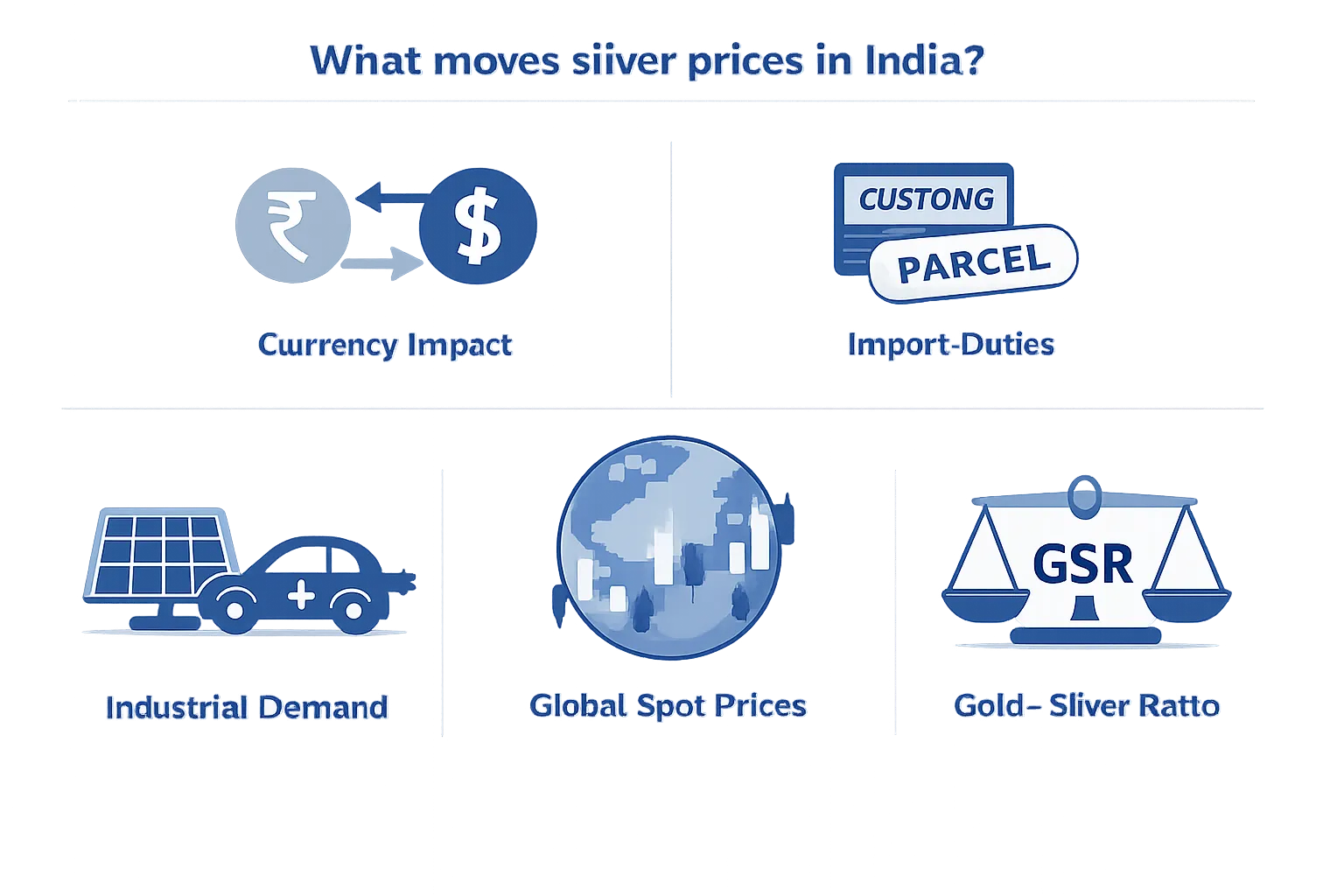
What truly moves silver in India
-
Currency and duties: A weaker INR and changes in import duties can push local prices higher even if global spot is flat.
-
Global spot and macro: Fed policy, risk sentiment, and commodity cycles ripple into MCX silver.
-
Income and seasonality: Festive-season buying and rural income (monsoon) trends influence retail demand.
-
Gold–silver ratio (GSR): When the GSR is elevated and starts compressing, silver often leads.
Volatility vs gold: right-size your allocation
-
Silver is typically more volatile than gold. For most investors, keeping silver at ~5–15% of the portfolio balances upside and risk.
-
If you’re new, start smaller and scale with discipline instead of trying to time every dip.
Timing vs discipline: SIPs and streaks beat FOMO
-
Rather than guessing the “best time to invest in silver,” automate buys through SIPs (in ETFs/FoFs) or streak-based micro-accumulation in digital silver.
-
Small, frequent purchases help average costs and reduce the stress of volatility.
Format implications
-
Traders: Prefer Silver ETFs for intraday price discovery, tight spreads, and quick exits.
-
Long-term accumulators: Digital Silver works well for micro-tickets, UPI convenience, and habit-building.
-
Gifters: Coins shine for presentation and occasion-worthiness.
-
Bulk buyers: Bars usually have lower premium per gram than coins.
“At the 2011 precious metals peak, the gold–silver ratio compressed to roughly 31:1 as silver outperformed gold.” – Source
“SEBI’s Silver ETF framework requires investment in 99.9% purity LBMA Good Delivery silver bars (standard bars under the Master Circular).” – Source
Option 1 – Physical Silver Coins: tactile, giftable, but mind the premiums
What you’re buying
-
BIS-hallmarked, 999/999.9 purity silver coins from reputed mints.
-
Comes in sealed, tamper-evident packaging with assay or purity certificate.
Typical premiums (and why they matter)
-
Coins carry higher premiums than bars because of minting, design, packaging, and distribution costs.
-
Jewellery adds making charges (and sometimes wastage), which don’t recover at resale – dragging long-term returns.
Liquidity and resale realities
-
Expect a buy–sell spread. Local dealers may deduct for testing, scratches, or packaging damage.
-
Reputed mints with clear buyback terms can reduce friction. Keep invoices and packaging intact to avoid ‘wastage’ deductions.
Best use cases
-
Gifting at weddings, festivals, and milestones.
-
Small keepsakes and ritual use where presentation matters.
Buyer’s checklist
-
Hallmark and purity: Look for BIS hallmark and 999/999.9 fineness.
-
Invoice and authenticity: Always take a bill; verify serial numbers if provided.
-
Mint/brand: Prefer reputed, LBMA-recognized refiners/mints.
-
Packaging: Tamper-proof blister; avoid opening before resale.
-
Buyback policy: Understand the conditions, deduction %, and ID requirements.
Storage choices
-
Home safe: Accessible, but insure against theft/fire and control humidity.
-
Bank locker: Annual fee applies; factor this into total cost of ownership.
Option 2 – Physical Silver Bars: lower premiums for serious accumulators
Why bars
-
Lower premium per gram than coins because you’re paying for metal, not presentation.
-
Ideal for bulk buying in standard weights like 100g, 250g, and 1kg where spreads are tighter.
-
Simple to stack and track if you’re building a long-term “core” position.
What to check before you buy
-
Purity and assay: Look for 999/999.9 fineness with an assay card and clear marking of weight, purity, and mint/refiner.
-
Serial numbers: Prefer uniquely serialized bars for stronger provenance and easier resale verification.
-
Brand reputation: Choose well-known, widely accepted refiners/mints. Consistency and recognition matter at resale.
-
Packaging: Tamper-evident sealing reduces disputes and deductions during buyback.
Liquidity: how to sell smart
-
Where to sell: Established bullion dealers, reputed jewellers, or refinery buyback desks. Call ahead to confirm rates and documents needed.
-
Spread expectations: Bars usually trade with a tighter buy–sell spread than coins, but spreads can widen on volatile days.
-
Timing: Avoid off-peak or illiquid hours. Carry invoice, keep packaging intact, and be prepared for purity testing (XRF) to minimize deductions.
Storage and insurance: count the real costs
-
Home storage: Use a high-grade safe, humidity control, and add a home insurance rider that covers bullion (check limits and exclusions).
-
Bank locker: Annual locker fees add to your total cost of ownership; also consider travel and access constraints.
-
Documentation: Keep invoices, assay cards, and bar serial records together – this preserves value at resale.
Who it suits
-
Long-term holders who prioritize low premiums and can manage secure storage.
-
Investors accumulating in larger tickets (100g–1kg) for multi-year holding periods.
-
Those comfortable with physical logistics (storage, transport, insurance) in exchange for tighter spreads.
Option 3 – Digital Silver (platforms): convenience + micro-investing + delivery on demand
How it works
-
Buy fractional, vault-backed 999 silver in seconds with UPI.
-
Track holdings 24/7, sell instantly within the platform, or convert to coins/bars and request doorstep delivery.
-
Ideal for micro-investing and goal-based accumulation without managing physical storage.
Regulation reality
-
Digital Silver from platforms isn’t uniformly SEBI-regulated. Evaluate:
-
Custody partner (e.g., Brink’s/Sequel), vault location, and insurance coverage.
-
Independent audits and whether metal is fully allocated to your name.
-
T&Cs for redemption, delivery timelines, and dispute resolution.
-
Fees to watch
-
Buy–sell spread on each transaction.
-
Platform fee; storage charges after any free-storage period.
-
Delivery/minting charges when you convert to coins/bars and ship to your address.
Why beginners love it
-
Start from ₹1–₹100, build a daily/weekly habit, set goals, and gift fractional silver.
-
No demat, no paperwork, no locker. Pure UPI-native investing.
OroPocket advantage
-
₹1 entry. Instant UPI. Vault-backed silver.
-
Bitcoin rewards on every buy (Satoshis), daily streak bonuses, spin-to-win, and referral rewards – turning saving into a repeatable habit while stacking a real asset.
Alternatives exist – what to check
-
Who is the custodian and insurer? Are holdings 100% allocated and audited?
-
Maker/refiner brand, delivery options, and purity certificates.
-
All-in charges: spreads, platform fee, annual storage beyond the free period, and redemption/minting costs.
When to prefer Digital Silver over ETFs
-
You don’t have a demat account and want fractional investing or gifting.
-
You plan to take delivery later as coins for occasions.
-
You value 24/7 buy/sell flexibility beyond market hours.
Option 4 – Silver ETFs and FoFs (SEBI-regulated): clean, transparent exposure
What they are
-
Silver ETFs hold 99.9% purity bullion under SEBI’s framework and trade on NSE/BSE like stocks.
-
Silver FoFs invest in underlying Silver ETFs, allowing SIPs without a demat account.
Costs
-
Expense ratio and brokerage (for ETFs); FoFs add an extra layer of expenses.
-
Returns can deviate slightly from spot due to tracking error.
-
No making charges or personal storage costs.
Liquidity
-
Buy/sell during market hours. Use limit orders to control execution price and spreads.
-
Prefer higher-volume ETFs for tighter bid–ask spreads.
Taxes
-
Taxed similar to debt funds under current rules: STCG as per slab; LTCG at around 12.5% beyond specified holding periods (surcharge/cess extra).
-
No GST on units; no locker costs.
Who it suits
-
Market-linked investors who want transparency and exchange liquidity.
-
SIP users and retirement accounts seeking disciplined, set-and-forget exposure.
-
Those who want silver price exposure without handling physical metal.
ETF vs FoF: quick take
-
ETF: Needs demat + trading account; potentially lower total cost; intraday liquidity.
-
FoF: No demat needed; easy SIPs via mutual fund platforms; slightly higher expenses due to the FoF wrapper.
Costs, taxes, and hidden charges: what actually hits your returns
Buying silver as an investment isn’t just about the spot price. Premiums, GST, platform spreads, storage, brokerage, and capital gains all affect your net outcomes. Here’s a clear snapshot – so you can choose the best way to buy silver for investment without nasty surprises.
Pricing/fees/tax matrix (typical ranges; educational only)
|
Route |
Upfront pricing components |
Ongoing costs |
Transaction costs |
Tax treatment (current law) |
Practical notes |
|---|---|---|---|---|---|
|
Physical Coins |
5–15% premium over spot; 3% GST on metal value; jewellery coins can add making charges (5% GST on making) |
Locker/insurance if stored in bank/home safe |
Buy–sell spread at dealers; possible purity testing deduction if packaging opened/damaged |
STCG as per slab; LTCG ~12.5% beyond 24 months (surcharge/cess extra); keep invoice |
Presentation value for gifting; higher premium vs bars; maintain tamper-proof packaging to reduce resale deductions |
|
Physical Bars |
~2–7% premium over spot; 3% GST on metal |
Locker/home insurance; humidity control |
Typically tighter spread than coins; testing charges may apply |
STCG as per slab; LTCG ~12.5% beyond 24 months |
Better for bulk (100g/250g/1kg); prefer serialized bars with assay cards for smoother resale |
|
Digital Silver (Platforms) |
Platform buy–sell spread ~0.5–2.5%; no GST on metal to investor directly; GST may apply to platform/storage/delivery fees |
Storage fee after free period (often 0–1%/yr equivalent); platform fee if applicable |
Delivery/minting/redemption charges if converting to coins/bars; instant platform sell usually T+0 |
STCG as per slab; LTCG ~12.5% beyond 24 months; download statements for records |
24/7 UPI-native; micro-investing; check custodian (e.g., Brink’s/Sequel), audits, and full allocation |
|
Silver ETF (Demat) |
No premium/making; no GST on buy; tracks domestic silver price |
Expense ratio ~0.3–1.0% p.a.; tracking error |
Brokerage both sides (~0.03–0.5% per trade); DP charge on sell |
STCG as per slab; LTCG ~12.5% beyond 12 months (surcharge/cess extra) |
Intraday liquidity on NSE/BSE; use limit orders for tighter execution |
|
Silver FoF (Mutual Fund) |
No demat needed; SIP-friendly; no GST on buy |
Expense ratio of FoF + underlying ETF (layered) |
Exit loads (if any) as per scheme; no brokerage/DP |
STCG as per slab; LTCG ~12.5% beyond 24 months |
Easiest SIP route; slightly higher total expense due to FoF wrapper |
Example walkthroughs (illustrative, not advice)
-
₹5,000 coin (gift-focused): If the coin premium is 10% and GST is 3% on metal value, your effective entry cost can be roughly 10–13% above spot. On resale, a dealer spread plus any testing/packaging issues can further reduce net proceeds.
-
₹50,000 bar (accumulation): With a 4% premium and 3% GST, effective entry uplift is ~7%. Add pro-rated locker/insurance if applicable to estimate your true holding cost over time.
-
₹2,00,000 Silver ETF (clean exposure): No GST; expense ratio say 0.7% p.a., brokerage 0.1% round-trip, DP charge on sell. Over a year, total friction might be ~0.9–1.2% depending on your broker and ETF. FoF route trades demat convenience for slightly higher ongoing expenses.
Keep every invoice/contract note, bar serial record, and platform statement. For taxes, your holding period and paperwork are what determine whether you pay slab-rate STCG or 12.5% LTCG (plus surcharge/cess) under current rules.
Safety, purity, and counterparty risk: stay smart, stay insured
Purity standards you can trust
-
Physical silver: Look for BIS hallmarking and 999/999.9 fineness on coins/bars. Prefer tamper-evident packaging and an assay/quality certificate.
-
Vault silver/ETFs: Expect 99.9% purity in line with Good Delivery standards (LBMA). For ETFs, purity and storage standards are part of the SEBI framework and disclosed in scheme documents.
Counterparty checks for Digital Silver (platforms)
-
Who holds the metal: Confirm the vaulting partner (e.g., Brink’s or Sequel), vault location, and whether holdings are fully allocated to you.
-
Insurance cover: Ask what risks are covered (theft, fire, transit) and who the insurer is. Ensure the policy explicitly covers customer metal.
-
Trustee and audits: Prefer platforms that use an independent trustee/escrow setup and publish regular third-party audit certificates of metal holdings.
-
Redemption terms: Read T&Cs on delivery timelines, minting/conversion fees, minimum delivery lots, and dispute resolution.
-
Solvency safeguards: Look for segregated client assets, independent custodians, and transparent financials. Avoid platforms that co-mingle customer metal or funds with operating capital.
ETF custody chain: how it protects you
-
SEBI-approved custodians: Silver is held with regulated custodians; fund houses must adhere to strict investment and custody rules.
-
Independent audits and disclosures: ETF portfolios are audited and NAVs disclosed daily; annual reports detail custody, valuation, and risk management.
-
No platform solvency dependency: Your units are with the mutual fund/ETF trust, not a private platform balance sheet.
Scam filters: red flags to avoid
-
“Too-good-to-be-true” discounts far below spot or vague pricing that excludes fees until checkout.
-
No clarity on vault, custodian, or insurance; evasive answers to “who holds my metal?”.
-
Missing invoices, serial numbers, or purity certificates; reluctance to provide audit reports.
-
Pressure tactics (limited-time flash deals with steep hidden delivery or storage charges).
Documentation to keep – your proof of ownership
-
Invoices and payment receipts (physical, digital, ETF/FoF contract notes).
-
Delivery notes and courier proof for home deliveries.
-
Bar/coin serial numbers, assay/quality cards, and tamper-proof packaging intact.
-
Platform statements and annual holding certificates; ETF/FoF account statements and CAS (Consolidated Account Statement).
Staying safe is simple: verify purity, verify custody, and verify paperwork. If anything’s opaque, walk away.
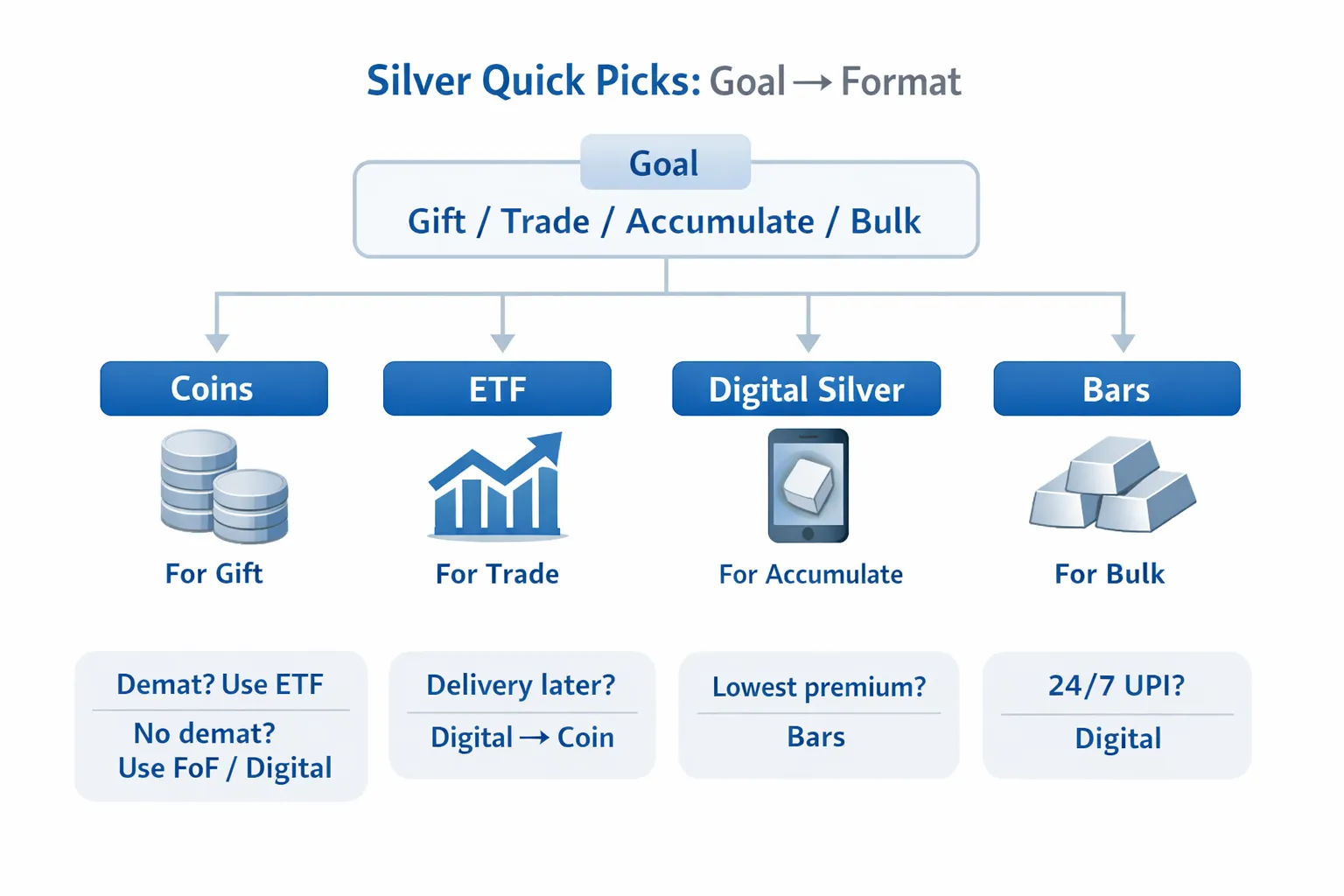
What’s best for your goal and budget? (Quick picks)
Under ₹500
-
Digital Silver via UPI. Build the habit first; convert to a coin later if you want something tangible.
₹500–₹5,000
-
Digital Silver or a Silver FoF SIP. Automate monthly buys; easy to gift digitally.
₹5,000–₹50,000
-
If you have demat: Silver ETF for clean, low-cost exposure.
-
No demat or want delivery later: Digital Silver, then redeem as a coin/bar when needed.
₹50,000+
-
Bars for the lowest premiums if you’ve sorted secure storage.
-
Or choose an ETF for market-hour liquidity and no storage hassles.
Gifting/tradition
-
Coins from a reputed mint for presentation value.
-
Or gift Digital Silver instantly, then convert to a coin close to the occasion.
Traders vs accumulators
-
Traders → Silver ETF (tight spreads, market-hour execution).
-
Accumulators → Digital Silver (micro-investing, UPI-native, 24/7).
-
Collectors → Coins (design, presentation).
-
Long-term bulk → Bars (lower premium per gram).
Pairing with gold
-
Consider a 70:30 or 60:40 gold:silver split for stability and upside.
-
Rebalance annually to capture gains and keep risk in check.
Start in 5 minutes (UPI, SIPs, or delivery) + Final verdict
Digital (beginner-friendly)
-
Download OroPocket on your phone
-
Complete quick KYC
-
Add money via UPI
-
Buy silver from ₹1 instantly
-
Earn Bitcoin rewards (Satoshis) on every purchase
-
Turn on daily streaks, spin-to-win, and referrals to boost your rewards – and build a consistent investing habit
ETF (demat users)
-
Shortlist a Silver ETF with good AUM and volumes
-
Place a limit order on NSE/BSE via your broker
-
Prefer SIPs? Use a Silver FoF in your mutual fund app to automate monthly buys (no demat needed)
Physical
-
Choose a reputed mint/dealer
-
Verify BIS hallmarking/999 purity, serial/assay card, and clear buyback terms
-
Store safely (home safe/locker). Keep invoices and packaging intact for smoother resale
Final verdict
-
Want the simplest start, micro-tickets, and rewards? Choose Digital Silver on OroPocket. You get ₹1 entry, UPI-native purchases, Bitcoin cashback, and gamified streaks – perfect for building discipline without overthinking timing.
-
Want regulated, low-maintenance exposure (and have demat)? Choose a Silver ETF or a FoF for SIP convenience.
-
Want tangibility for gifting or the lowest premiums on bulk? Pick Coins for gifting; Bars for bulk – provided you have secure storage and keep documents/assay cards.
CTA Ready to stack silver the modern way? Download the OroPocket app and start with ₹1 today – https://oropocket.com/app
Appendix: What to check before you buy (mini checklists)
Coins/Bars checklist
-
Purity and hallmarking: BIS hallmark + 999/999.9 fineness; assay/quality card included.
-
Brand/mint: Reputed, widely recognized refiners; consistent buyback acceptance in your city.
-
Serial numbers: Prefer uniquely serialized bars/coins; match serial on assay card and invoice.
-
Invoice: Full bill with GST breakup, purity, weight, brand, and buyer details.
-
Buyback terms: Written policy on deductions, packaging condition, ID needed, and payment timelines.
-
Packaging: Tamper-evident blister intact; avoid opening before resale.
-
Spread quote: Ask for live buy/sell spread to estimate exit price.
-
Weights: Standard denominations (e.g., 10g/20g coins; 100g/250g/1kg bars) aid resale.
-
Storage plan: Home safe vs bank locker; insurance rider; humidity control for long-term storage.
-
Verification: Ask seller about XRF testing access during resale to minimize “wastage” deductions.
Digital Silver checklist
-
Custodian and vault: Who holds the metal (e.g., Brink’s/Sequel), vault location, and whether holdings are fully allocated to you.
-
Insurance: Scope (theft, fire, transit), insurer name, and whether customer metal is explicitly covered.
-
Trustee/escrow and audits: Independent trustee setup; frequency of third‑party audits; access to audit certificates.
-
Purity and maker: 999 purity, Good-Delivery standard bars, mint/refiner details.
-
Pricing method: How buy/sell prices are derived (e.g., link to global benchmarks + FX) and refresh frequency.
-
Fees: Buy–sell spread, platform fee, storage after any free period, delivery/minting/redemption charges, inactivity fees (if any).
-
Delivery policy: Minimum redemption lots, making options (coins/bars), timelines, shipping/insurance terms.
-
Limits/KYC: Per-transaction and cumulative limits, PAN/KYC thresholds, PMLA compliance.
-
Solvency safeguards: Segregation of client assets, no co-mingling with company funds, disaster recovery, and grievance redressal.
-
Records: Downloadable transaction history, monthly statements, year-end tax summary.
ETF/FoF checklist
-
Structure: ETF holds physical silver; FoF invests in Silver ETF (no demat needed for FoF).
-
Expense ratio (TER): Compare across funds; note that FoFs layer FoF TER + ETF TER.
-
Tracking quality: Historical tracking error/track‑diff versus domestic silver price; methodology (LBMA-linked).
-
Liquidity: ETF AUM, average daily turnover, typical bid–ask spreads; creation/redemption mechanism.
-
Orders and costs: Use limit orders; check brokerage, DP charges (ETFs), and any exit load (FoFs).
-
SIP availability: FoFs typically allow SIPs; confirm minimum amount and dates.
-
Disclosures and custody: SEBI-compliant custodians, daily NAV disclosures, audited reports.
-
Taxes: Holding-period rules for STCG/LTCG under current law; confirm any indexation updates if rules change.
-
Operations: Cut-off times (FoFs), dividend vs growth options, corporate action handling.
Records you must keep for taxes and resale
-
Physical: Tax invoice, payment receipt, photos of intact packaging, serial/assay card copies, storage/locker and insurance documents.
-
Digital platforms: Download monthly statements, trade confirmations, delivery notes, and annual holding certificates.
-
ETFs/FoFs: Broker contract notes, CAS (Consolidated Account Statement), AMC statements, and cost-of-acquisition records.
-
Tax working: Maintain a simple ledger with date, quantity, price, fees, and realized gains for accurate filing.