
Gold Price History: Major Peaks, Dips & What It Means for Investors in 2026


Gold Price History: Major Peaks, Dips & What It Means for Investors in 2026
Gold price history isn’t a straight line up. It’s a cycle of fear, inflation, interest rates, and global power shifts – and those cycles matter more in 2026 than ever.
If you’re an Indian retail investor (student, salaried, freelancer, small business owner), your real problem isn’t “Is gold going up?”
It’s this:
-
You don’t want to buy at the top.
-
You don’t want your savings to quietly lose value to inflation.
-
You want something simple, mobile-first, UPI-friendly – not another complex trading account.
-
And you’d love rewards while building wealth.
This guide gives you a scannable timeline of gold’s biggest peaks and dips, the real drivers behind each move, and the practical lessons for 2026 – especially how to invest smarter using SIP-style accumulation (instead of guessing tops and bottoms).
The 5 forces that move gold (and explain every major peak/dip)
If you understand these five, gold price history stops looking “random” and starts looking predictable in patterns:
-
Inflation shocks (prices rising faster than wages)
-
Interest-rate cycles (higher real rates = pressure on gold)
-
USD strength/weakness (gold often moves opposite to the dollar)
-
Geopolitical risk (war, trade fights, sanctions → safe-haven demand)
-
Central-bank demand (reserve diversification into gold)
“As of mid-2025, gold constituted approximately 20% of global foreign exchange reserves… Central banks collectively held around 36,344 tonnes of gold.” – Source
2026 takeaway: gold is being driven not just by retail investors – but by large, price-insensitive buyers (central banks). That changes the floor.
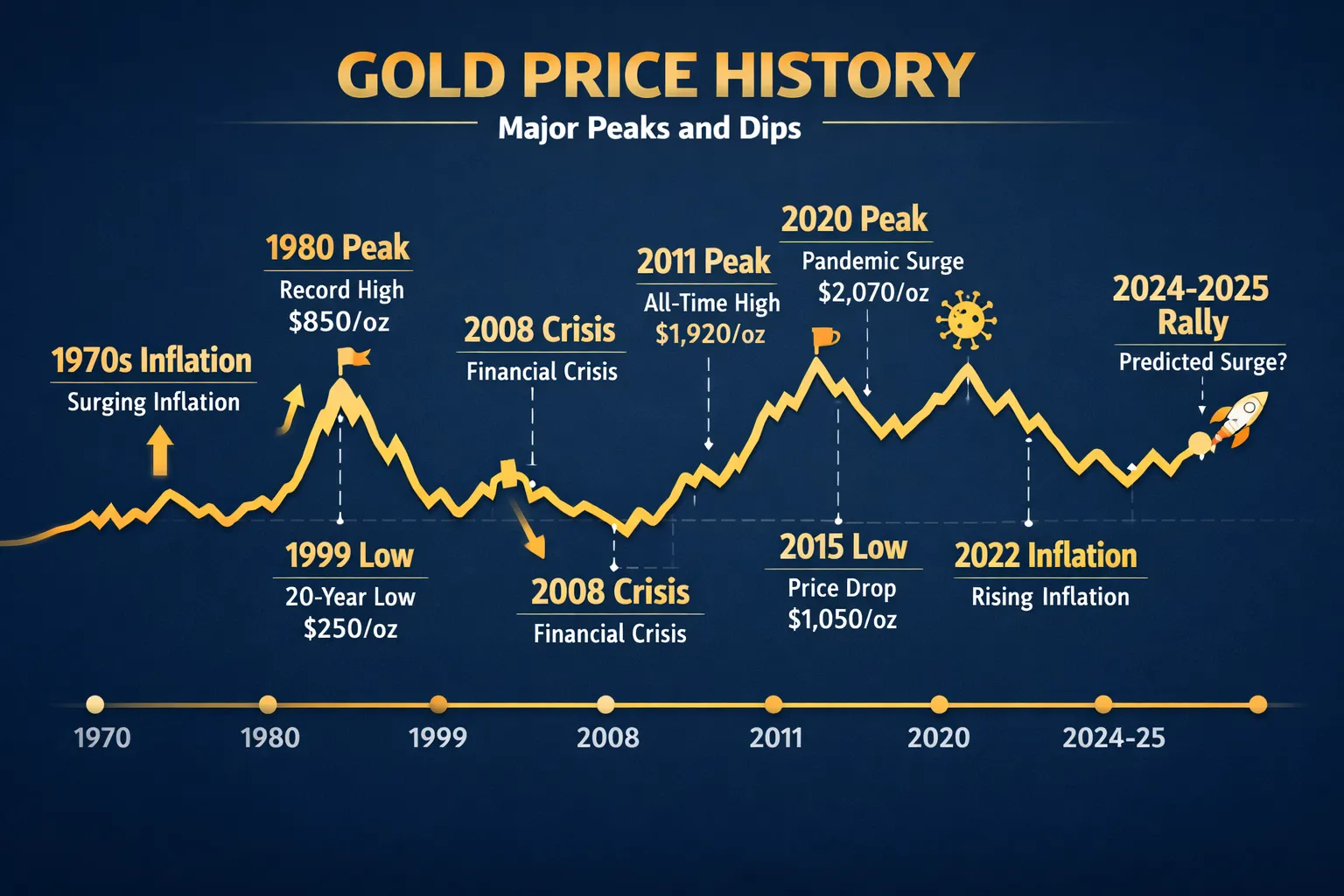
Gold price history timeline: major peaks & dips (and what caused them)
You’ll see this pattern repeat:
Inflation + uncertainty → gold rallies
High real rates + confidence → gold cools off
1) 1970s: the “inflation decade” (gold wakes up)
What happened: Oil shocks + high inflation + currency instability pushed investors into hard assets.
Key lesson: gold is a confidence meter. When people stop trusting paper promises, gold gets repriced.
2) 1980: the legendary peak (then a brutal reality check)
Gold hit a historic peak in 1980 – then corrected hard after aggressive rate hikes restored confidence in cash and bonds.
Key lesson: gold can fall fast when real rates rise (interest rates minus inflation).
3) 1999–2001: multi-decade low (gold is “dead”… until it isn’t)
This was peak faith in equities, globalization, and central bank policy. Gold demand was weak.
Key lesson: the best long-term gold entries usually feel boring or unpopular.
4) 2008–2011: crisis era peak (GFC + money printing)
The global financial crisis shifted the world from “growth optimism” to “system risk.” Gold surged into 2011.
Key lesson: gold thrives when the market fears the financial plumbing is broken.
5) 2013–2015: the drawdown (taper tantrum, USD strength)
Gold corrected for years as the dollar strengthened and policy normalized.
Key lesson: gold isn’t a “get rich quick” asset – it’s a regime hedge.
6) 2020: COVID shock (gold hits new highs)
Gold rallied as rates collapsed and stimulus exploded.
Key lesson: when yields drop, gold becomes more attractive because it doesn’t need to “beat” bond interest.
7) 2022–2023: inflation returns + central banks step in
Inflation surged globally – and central banks accelerated gold buying. This added a structural pillar under prices.
Key lesson: gold demand can be policy-driven, not just investor-driven.
8) 2024–2025: the rebasing higher (trade tensions + reserve diversification)
In late 2025, J.P. Morgan Global Research described gold’s move as a rebasing higher and forecasted prices pushing toward ~$5,000/oz by late 2026 (not linear, but bullish drivers intact).
Key lesson: gold isn’t only reacting to inflation now – it’s also reacting to de-dollarization and geopolitical fragmentation.
Content gap competitors miss: “Nominal vs real returns” (what you actually feel)
Most blogs show gold’s price chart and stop. Smart investors ask:
Nominal return: “Price went up”
Real return: “Did my purchasing power improve after inflation + costs?”
That’s why a “flat” gold year can still be a win if inflation is eating cash – and why a “high return” year might feel less impressive after costs and rupee depreciation.
If you want a simple breakdown of what actually drives daily rates, spreads, and pricing mechanics, read digital gold price explained: live rates, spreads, and how pricing works.
India lens: why gold price history feels different in INR
Indian investors don’t buy “global gold.” You buy:
Gold price in USD + USD/INR movement + import costs + local demand premiums.
Here’s what adds an India-specific twist:
1) USD/INR can amplify moves
Even if gold is flat in USD, INR weakness can make gold rise in India.
2) Import duties and taxes matter
Import-related costs can widen the gap between global spot and domestic rates.
3) Festival & wedding demand creates seasonal pressure
Indian physical demand often spikes around:
-
Akshaya Tritiya
-
Dhanteras / Diwali
-
Wedding seasons
2026 investor move: don’t try to “outsmart” seasonality. Use it to plan staggered buying.
What gold price history teaches you about investing in 2026 (practical rules)
Rule 1: Stop trying to time the top/bottom
Most retail investors lose money on gold by doing one thing: buying big after headlines.
Instead, use accumulation:
-
small buys
-
repeated over time
-
with periodic rebalancing
That’s how pros handle volatile assets.
A deep guide to this approach: when is the best time to buy gold: indicators, seasonality, and mistakes to avoid.
Rule 2: Expect volatility – even in a bull market
Gold rallies are rarely linear. Corrections of 5–15% can happen even inside strong uptrends. That’s not a “crash.” That’s gold being gold.
Rule 3: Use gold as a system for habits, not a one-time bet
Gold works best when it becomes automatic – like saving. Which is why micro-investing + SIP-style buying wins long term.
The OroPocket way: invest in digital gold like it’s 2026 (because it is)

Most platforms help you buy gold. OroPocket helps you build wealth behavior.
Why OroPocket is built for real Indian investors
-
Start from ₹1: no “minimum” excuses.
-
Instant UPI payments: buy in under 30 seconds.
-
100% secure & compliant: RBI-compliant, insured vault storage, authorized bullion partners.
-
Gamified investing: daily streaks, spin-to-win, tiered rewards – so investing feels easy, not painful.
-
Referral rewards: both sides earn 100 Satoshi + a free spin (habit + viral growth).
The unfair advantage: Free Bitcoin on every gold/silver purchase
You don’t just buy gold – you earn Satoshi cashback too.

This is the Gold + Bitcoin combination:
-
Gold = stability (5,000-year track record)
-
Bitcoin rewards = growth potential, without you needing to “trade crypto”
Stop watching. Start growing.
2026 checklist: indicators to watch (so you’re early, not late)
Use this as your monthly dashboard:
|
Indicator |
Why it matters for gold |
What to watch in 2026 |
|---|---|---|
|
Real interest rates |
Higher real rates pressure gold |
Inflation cooling faster than rates = risk |
|
USD strength (DXY) |
Strong dollar often caps gold |
Risk-on rallies in USD can create dips |
|
Central bank buying |
Structural demand floor |
Continued reserve diversification |
|
Geopolitical escalation |
Safe-haven flows |
Middle East, trade restrictions, sanctions |
|
INR weakness |
Boosts domestic gold prices |
Import-cost + currency effect |
|
Local demand seasonality |
Short-term premiums |
Festivals, weddings, retail buying waves |
Final verdict: what gold price history means for you in 2026
Gold price history proves one thing: gold rewards patience, not prediction.
In 2026, you don’t need to be a macro expert. You need:
-
a simple way to buy small amounts regularly,
-
a secure platform,
-
and a system that keeps you consistent even when the market is noisy.
That’s exactly what OroPocket is built for. Start with ₹1, pay with UPI, and earn free Bitcoin on every purchase.
Your future self won’t thank you for timing the perfect dip.
They’ll thank you for starting – and staying consistent.


Join the Conversation
Be the first to share your thoughts.