What will gold be worth in 5 years in India?

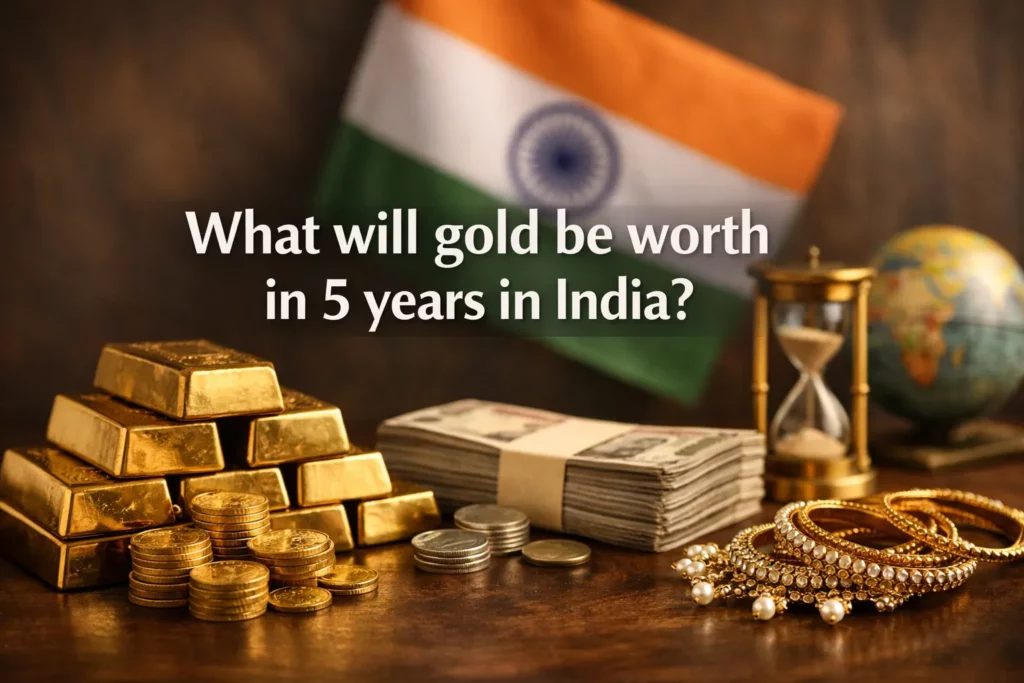
What will gold be worth in 5 years in India? (A realistic 5-year outlook for 24K, 22K & smart investors)
If you’re asking this question, you’re not alone. In India, gold isn’t just jewellery – it’s a plan: for weddings, emergencies, and long-term wealth.
But here’s the real pain point for most retail investors (students, salaried professionals, small business owners):
-
Prices keep moving.
-
Entry feels expensive.
-
Physical gold has making charges + storage stress.
-
And “timing the market” usually means… doing nothing.
This guide gives you a practical 5-year gold value outlook, what can realistically move the price up/down, and how you can start building your gold position from ₹1 – without overthinking it.

The 5-year gold price prediction in India (2026–2030): a range, not a “single number”
No one can guarantee an exact gold price in 2031. What we can do is build a range based on the big drivers: inflation, INR–USD, central bank buying, geopolitics, and Indian demand.
Below is a reasonable 24K gold outlook in India per 10 grams if gold remains in a long-term uptrend (with normal corrections in between):
|
Year |
Expected 24K Gold Range (₹/10g) |
What it implies |
|---|---|---|
|
2026 |
1,28,000 – 1,38,000 |
Market consolidates after a big run |
|
2027 |
1,35,000 – 1,47,000 |
Volatility + safe-haven demand supports prices |
|
2028 |
1,43,000 – 1,57,000 |
Inflation + supply constraints keep pressure upward |
|
2029 |
1,52,000 – 1,68,000 |
INR risk + Asia demand lifts local rates |
|
2030 |
1,62,000 – 1,80,000 |
Bullish case if macro risks persist |
What this means in plain English: gold may not “explode” every year, but a gradual rise is still plausible – especially if inflation stays sticky and global uncertainty remains.
If you want a deeper breakdown of what you actually pay (spot price vs local price, GST, premiums), read: spot price vs local gold rate in India.
Quick conversion: What about 22K and 18K?
In India, most buying is 22K jewellery, while investment-grade is typically 24K.
A simple approximation:
-
22K ≈ 91.6% of 24K
-
18K ≈ 75% of 24K
Example: if 24K is ₹1,60,000 per 10g, then:
-
22K ≈ ₹1,46,560 per 10g
-
18K ≈ ₹1,20,000 per 10g
Note: real market quotes vary with local premiums and taxes.
What can move gold up (or pull it down) over the next 5 years?

1) Inflation and real interest rates
When inflation stays high (or rates don’t beat inflation), gold becomes attractive as a store of value.
2) USD–INR (rupee strength/weakness)
India imports most of its gold. If the rupee weakens, gold becomes costlier in INR even if global gold is flat.
3) Central bank buying
Central banks buying gold reduces available supply and boosts long-term confidence.
“In 2024, the RBI added 72.6 tonnes to its gold reserves, taking total holdings to 876 tonnes by year-end.” – World Gold Council
4) Indian wedding & festival demand
India’s cultural demand is real – and it creates recurring seasonal support for prices and premiums.
“Weddings account for approximately 50% of India’s annual gold jewellery demand.” – World Gold Council
5) Corrections are normal (and healthy)
Even in a bull market, gold can drop 5–15% during periods of:
-
strong equities
-
rising interest rates
-
short-term “risk-on” sentiment
If you want to learn how to read trend strength, supports, and reversals, use: gold charts explained (support, resistance, indicators).
The biggest content gap most forecasts miss: your real return depends on how you buy
Competitor forecasts often talk about “gold price in 2030” but gloss over what kills returns for retail investors:
Physical gold “leakage”
-
making charges (jewellery)
-
buy/sell spread at jewellers
-
storage/locker cost
-
purity and resale friction
The smarter approach: build gold like a habit (not a one-time purchase)
Instead of waiting for the “right time,” consistent buying (weekly/monthly micro-buys) reduces timing risk.
So… should you invest now or wait?
If your horizon is 5 years, the more useful question is:
“How do I start without overpaying or overcommitting?”
That’s exactly where digital gold micro-investing wins – especially for first-time investors who want flexibility.
How OroPocket makes 5-year gold investing simpler (and more rewarding)

OroPocket is built for Indians who want to beat inflation without complicated investing.
Here’s the OroPocket edge (why users switch from “watching prices” to building wealth)
-
Start with ₹1: no “minimum amount” anxiety. Start immediately.
-
Instant UPI payments: buy gold in under 30 seconds.
-
Free Bitcoin on every purchase: earn Satoshi cashback when you buy gold/silver – two assets, one action.
-
Gold + Bitcoin combination: gold’s stability + Bitcoin’s growth potential without “trading stress”.
-
Gamified investing: daily streaks, spin-to-win, tiered rewards – habit beats hype.
-
100% secure & compliant: RBI-compliant workflows, insured vault storage, authorized bullion partners.
-
Referral rewards: both referrer and friend earn 100 Satoshi + a free spin.
If you’re comparing formats, this helps: how to invest in gold in India (smart options for 2026).
Conclusion: your 5-year gold plan doesn’t need perfect timing – just a smart system
Gold in India is still positioned as a long-term inflation hedge and crisis asset. Over the next 5 years, a gradually rising range (with normal dips) is more realistic than a straight-line rally.
The winning move for most people isn’t predicting a perfect number – it’s starting small, staying consistent, and avoiding return leaks.
Stop watching. Start growing.
Start your gold journey on OroPocket from ₹1, pay via UPI, and earn free Bitcoin rewards on every buy – so your portfolio grows in two directions at once.