
What is the 7 5 3 1 rule in SIP?


What is the 7-5-3-1 rule in SIP? (And how to actually use it)
Most people start a SIP with the right intention – discipline. Then reality hits:
-
“Why aren’t my returns great after 2–3 years?”
-
“Should I stop the SIP in a market crash?”
-
“Am I even diversified… or just buying 3 ‘different’ funds that behave the same?”
That’s exactly what the 7-5-3-1 rule solves. It’s not a magic formula. It’s a behavioral framework that helps you stay consistent long enough for compounding to do its job.
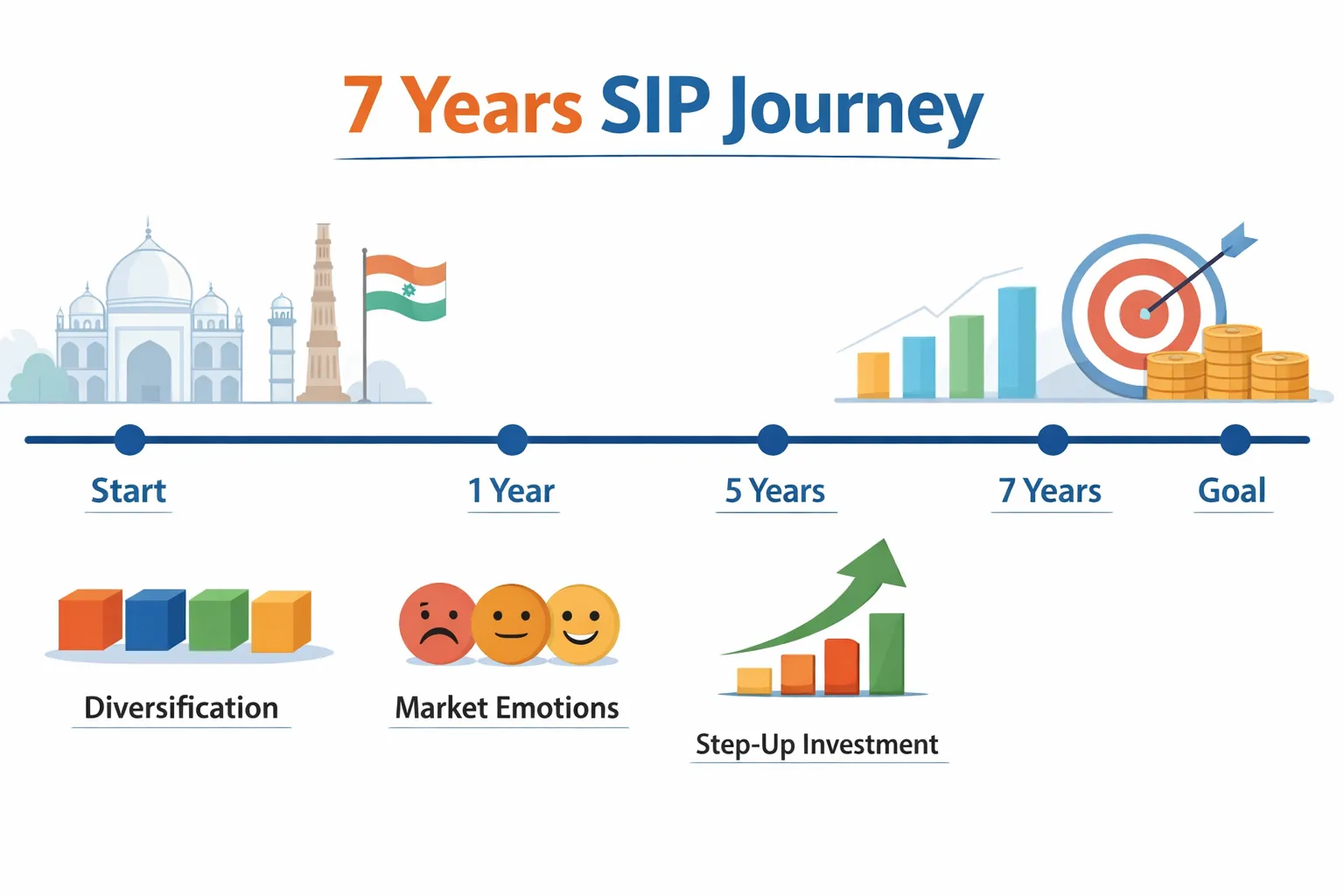
The 7-5-3-1 rule – broken down simply
The rule stands for:
|
Number |
Meaning |
What you do in real life |
|---|---|---|
|
7 |
Stay invested 7+ years |
Commit to a long horizon so volatility smoothens out |
|
5 |
Diversify across 5 buckets |
Don’t bet your future on one style/sector/market |
|
3 |
Prepare for 3 mental phases |
Expect emotional turbulence and don’t quit mid-way |
|
1 |
Step up SIP every 1 year |
Increase SIP annually so your corpus doesn’t stay “small” forever |
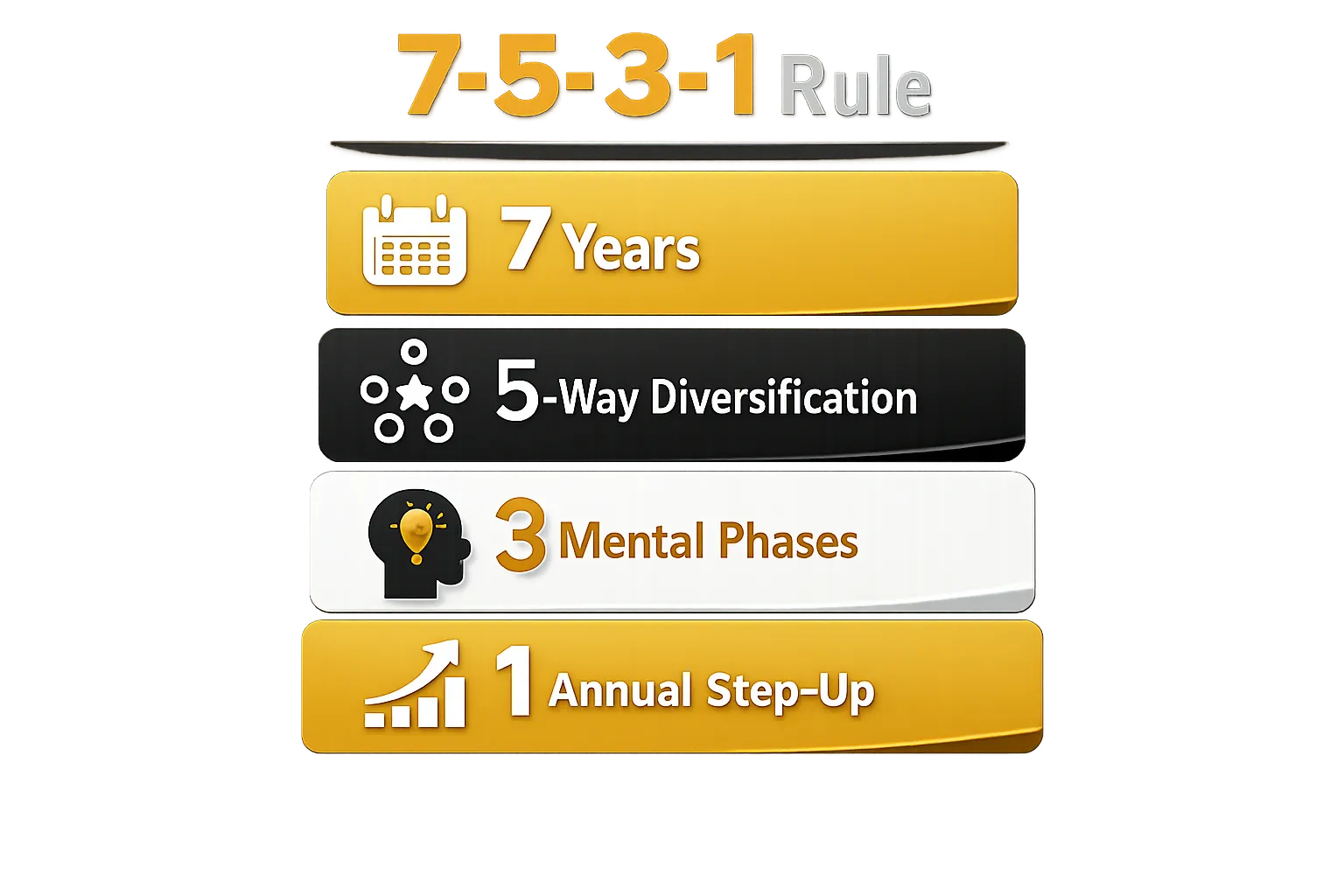
7 = Patience: why 7 years is the “minimum serious” SIP horizon
Equity SIPs are not designed for quick wins. They’re designed for market cycles.
A key reason “7 years” shows up in so many investing frameworks: over long rolling periods, the odds improve dramatically.
“From June 30, 1979, to Jan 31, 2024, the 7-year rolling returns of the BSE Sensex were positive in 94% of the periods analyzed.” – HSBC Asset Management (Investor Education PDF)
How to apply the “7”
-
Don’t judge equity SIP performance in 12–36 months.
-
Use SIPs for goals that are 7+ years away: wealth building, retirement, child education, long-term corpus.
-
If your goal is 1–3 years away, don’t force equity – choose safer instruments.
5 = Diversification: the “5-finger” approach to reduce regret
Many investors think they’re diversified because they hold 4 funds. But if all 4 are large-cap growth-heavy funds, you’re not diversified – you’re duplicated.
The rule suggests diversifying across 5 equity buckets (or closely related categories), such as:
-
Quality / Large-cap stability
-
Value
-
Growth / GARP (growth at reasonable price)
-
Mid & small-cap growth
-
International / global exposure
A smarter “5” portfolio mindset (practical)
Instead of selecting 5 random funds, diversify by behavior:
-
One fund that does well in stability phases
-
One that benefits from recoveries
-
One that captures high-growth segments
-
One that adds global shock-absorber diversification
This is where most competitor content stops – but here’s the real unlock:
Hidden diversification mistake (most SIP investors miss)
Overlap risk. Two different funds can hold the same top 20 stocks.
Fix: check overlap before adding a new fund – or keep it simple with fewer, more distinct funds.
3 = The 3 mental fights (this is where SIPs are won or lost)
Even perfect fund selection can fail if your behavior breaks.
The 7-5-3-1 rule highlights three psychological phases SIP investors often go through:
1) Disappointment (returns feel “too low”)
You expected 20%. Market gives 8–10%. You feel cheated.
What to do: zoom out; compounding needs time. Review your asset allocation, not your mood.
2) Irritation (returns look like FD returns)
When equity returns hover around 0–7%, the mind says: “FD would’ve been easier.”
What to do: remind yourself – equity isn’t paid for being easy. It’s paid for being stayed with.
3) Panic (negative returns)
This is where most SIPs die – people stop at the worst possible time.
What to do: if your goal is 7+ years away, downturns are not “danger” – they’re lower purchase prices.
1 = Step-up your SIP every 1 year (the wealth multiplier)
A fixed SIP is good. A step-up SIP is how you go from “saving” to serious wealth building.
Why the annual step-up matters
-
Your income generally rises
-
Inflation rises
-
Your goals get bigger (house, freedom, early retirement)
-
If SIP doesn’t rise, your future corpus stays capped
A simple rule: step up SIP by 5–10% yearly (or match your annual increment).
Want to understand the compounding engine behind this? Read: how compounding interest works with simple examples.
Where OroPocket fits in (even if your SIP is mutual funds)
The 7-5-3-1 rule is usually taught for equity mutual fund SIPs – but the principles are universal: long horizon, diversification, discipline, step-ups.
Here’s how OroPocket upgrades your “SIP behavior” using gold + rewards + habit-building:
Why young India is adding gold to the SIP mindset
Gold is widely used as:
-
a volatility hedge
-
an emergency buffer
-
a “stay-invested” stabilizer when equity feels scary
And when you do it right (digitally, transparently, without heavy making charges), it becomes practical for salaried and first-time investors.
If you’re exploring gold, start here: how to invest in gold with little money in India (start from ₹1).
OroPocket’s edge (built for consistency)
-
Start from ₹1: no “I’ll do it after salary day” excuses
-
Instant UPI buys: invest in under 30 seconds
-
Gamified investing: streaks + spin-to-win = habits that stick
-
Free Bitcoin on every gold/silver purchase: you build a gold habit and get Satoshi cashback – two assets, one action
-
100% secure & compliant: RBI-compliant flows, insured vaults, authorized bullion partners
-
Referral rewards: both sides earn 100 Satoshi + free spin
And yes – gold has shown powerful long-term protection in recent years:
“As of Feb 4, 2026, 24K gold reached ₹1,56,709 per 10 grams, up from ₹37,018 per 10 grams five years earlier – about a 323% increase.” – IndiaGraphs
To avoid overpaying while buying digital gold, read: digital gold charges explained (spreads, GST, storage, selling fees).
The cleanest way to apply the 7-5-3-1 rule (a quick action plan)
If you’re doing equity mutual fund SIPs
-
Lock a 7-year mindset (goal-based, not market-based)
-
Diversify across 5 distinct buckets (avoid portfolio overlap)
-
Expect the 3 mental phases and pre-decide your behavior
-
Step up once every year (automate it)
If you want to make the habit easier (and more rewarding)
Add a micro, daily/weekly gold habit via OroPocket:
-
₹1 entry point
-
UPI instant investing
-
Rewards + streaks that keep you consistent
-
Free Bitcoin cashback that makes you feel progress immediately
Final verdict: Don’t chase returns. Engineer consistency.
The 7-5-3-1 rule is a reminder that SIP success is less about prediction and more about process:
-
time beats timing,
-
structure beats guesswork,
-
and behavior beats brilliance.
If you’re serious about building wealth in India – stop watching. start growing.
Start your OroPocket gold/silver micro-investing habit from ₹1, earn free Bitcoin on every buy, and build a system your future self will thank you for.