History of Gold Prices: Key Cycles, Major Events & What They Mean Today

History of Gold Prices: Key Cycles, Major Events & What They Mean Today
If you’ve ever looked at gold charts and thought, “Why does it suddenly spike… and then go quiet for years?” – you’re not alone.
Gold isn’t a straight-line investment. It moves in big cycles driven by inflation, interest rates, the US dollar, central-bank buying, and fear (yes, fear is a real market force). And in India, gold’s story adds extra layers: INR swings, import duties, wedding season demand, and local premiums.
This guide breaks down the history of gold prices into the few cycles that actually matter – then turns that history into clear signals you can watch today so you don’t buy just because it’s trending.

Early tip: if you want to track today’s gold moves while learning the long-term cycles, start with OroPocket’s live gold prices today page and compare it with the historical timeline below.
Competitor synthesis (what top-ranking articles get right – and what they miss)
Across top competitor posts (Investopedia + Indian platforms like ClearTax and Groww), the winning patterns are consistent:
What they do well
-
Timeline-based storytelling: 1971 → 1980 → 2008 → 2020 is the core “gold cycle” narrative.
-
Macro drivers explained: inflation, USD strength, interest rates, crisis demand.
-
India-specific tables: long price histories in INR per 10g build trust.
The content gaps we’ll close here
-
Actionable signals: Most explain what happened but don’t give a simple checklist for what to watch now.
-
Real interest rates (the key driver): Mentioned, but rarely clarified in plain English.
-
India premium mechanics: Import duties, INR depreciation, and festival demand often get only a paragraph.
-
Modern execution: Few connect the lesson to how a retail investor should invest today (micro-investing, UPI, habit-building, avoiding peak-chasing).
This article is built to be the “final word” plus the practical playbook.
The shortest explanation of gold price cycles (so you don’t overthink it)
Gold’s long-run rallies typically happen when cash and bonds feel less rewarding or less safe.
Gold tends to rise when:
-
Inflation is high (money loses purchasing power)
-
Real interest rates are low/negative (bank interest minus inflation = weak)
-
USD weakens (global gold price in USD often benefits)
-
Crisis risk rises (war, recession, banking stress)
-
Central banks buy more gold (structural demand)
Gold tends to cool off when:
-
Rates rise faster than inflation (real yields go up)
-
USD strengthens sharply
-
Risk-on markets dominate (equities booming, volatility low)
A visual timeline: the 6 eras that shaped modern gold prices
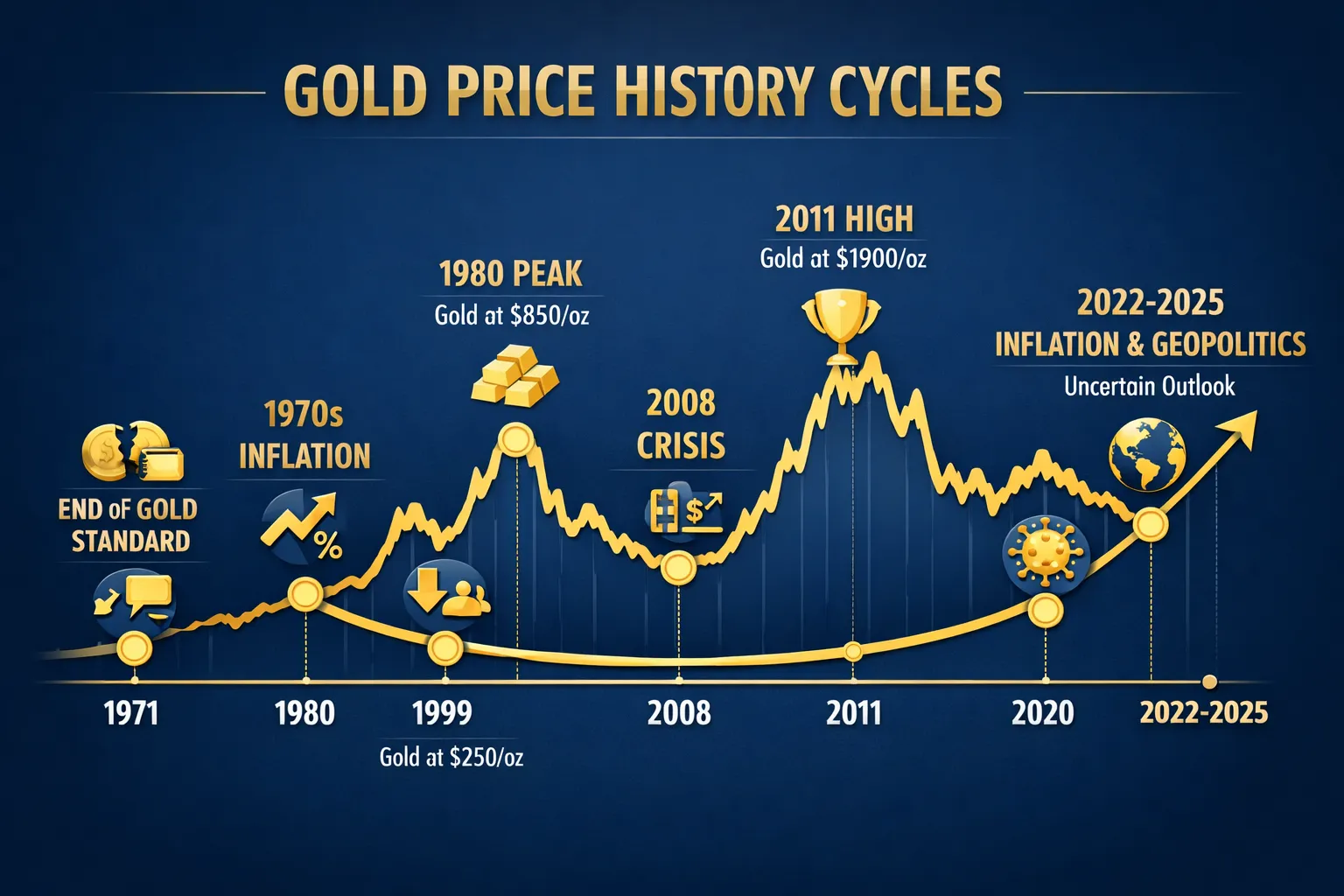
Below is the simplified timeline you should remember.
Era 1: 1971 – End of the gold standard (the “unlocking” of gold)
When the US moved away from direct convertibility of dollars into gold (end of Bretton Woods), gold stopped being “fixed” and became fully market-priced.
What changed
-
Gold became a free-floating asset
-
Investors could price inflation and currency risk into gold more directly
Lesson for today
Gold is not just a commodity. It’s also a monetary asset – a vote on trust in paper currency.
Era 2: 1970s to 1980 – Inflation shock and the first modern gold mania
This is the era everyone quotes: stagflation, oil shocks, high inflation. Gold surged aggressively and peaked around 1980 (nominally), becoming the symbol of “inflation protection.”
Why gold exploded
-
Inflation ran hot
-
Confidence in macro stability fell
-
Investors wanted a store of value
What most investors forget
After mania peaks, gold can go through multi-year digestion phases.
Lesson for today
If gold is rising because everyone is panicking, your best move is usually not lump-sum at the top – it’s systematic buying.
Era 3: 1980s–1999 – The long lull (gold underperforms while economies stabilize)
Gold did not “always go up.” The 80s and 90s saw long stretches where stocks did better and inflation cooled.
What drove the stagnation
-
Falling inflation expectations
-
Stronger financial markets
-
Periods of relatively higher real yields
Lesson for today
Gold is a cycle asset. You buy it for portfolio resilience – not for constant excitement.
Era 4: 2008–2011 – Global Financial Crisis (fear + money printing)
During the Great Financial Crisis, trust in banks and financial systems cracked. Gold benefitted from safe-haven flows and extremely accommodative monetary policy.
Why gold rallied
-
Flight to safety
-
Quantitative easing (money supply expansion)
-
Low/near-zero interest rates
Lesson for today
Gold typically shines when people question the system’s stability.
Era 5: 2020 – Pandemic shock (uncertainty + liquidity wave)
COVID-19 triggered a global demand shock and aggressive policy responses. Gold surged again as uncertainty peaked.
Why gold moved fast
-
High uncertainty (unknown economic damage)
-
Rapid stimulus + rate cuts
-
Supply chain disruptions in some markets
Lesson for today
Gold’s biggest moves often happen when headlines feel uninvestable.
Era 6: 2022–2025 – Inflation returns, rate hikes, and geopolitics (a tug-of-war)
This era confuses investors because gold faced two opposing forces:
-
Upward: inflation, wars/geopolitics, central-bank demand
-
Downward: rising rates and periods of strong USD
Gold’s performance became more “choppy” – not a straight sprint.
Lesson for today
Stop asking: “Will gold go up tomorrow?”
Start asking: “What’s happening to real rates, USD, and risk?”
The #1 driver most people miss: real interest rates (explained simply)
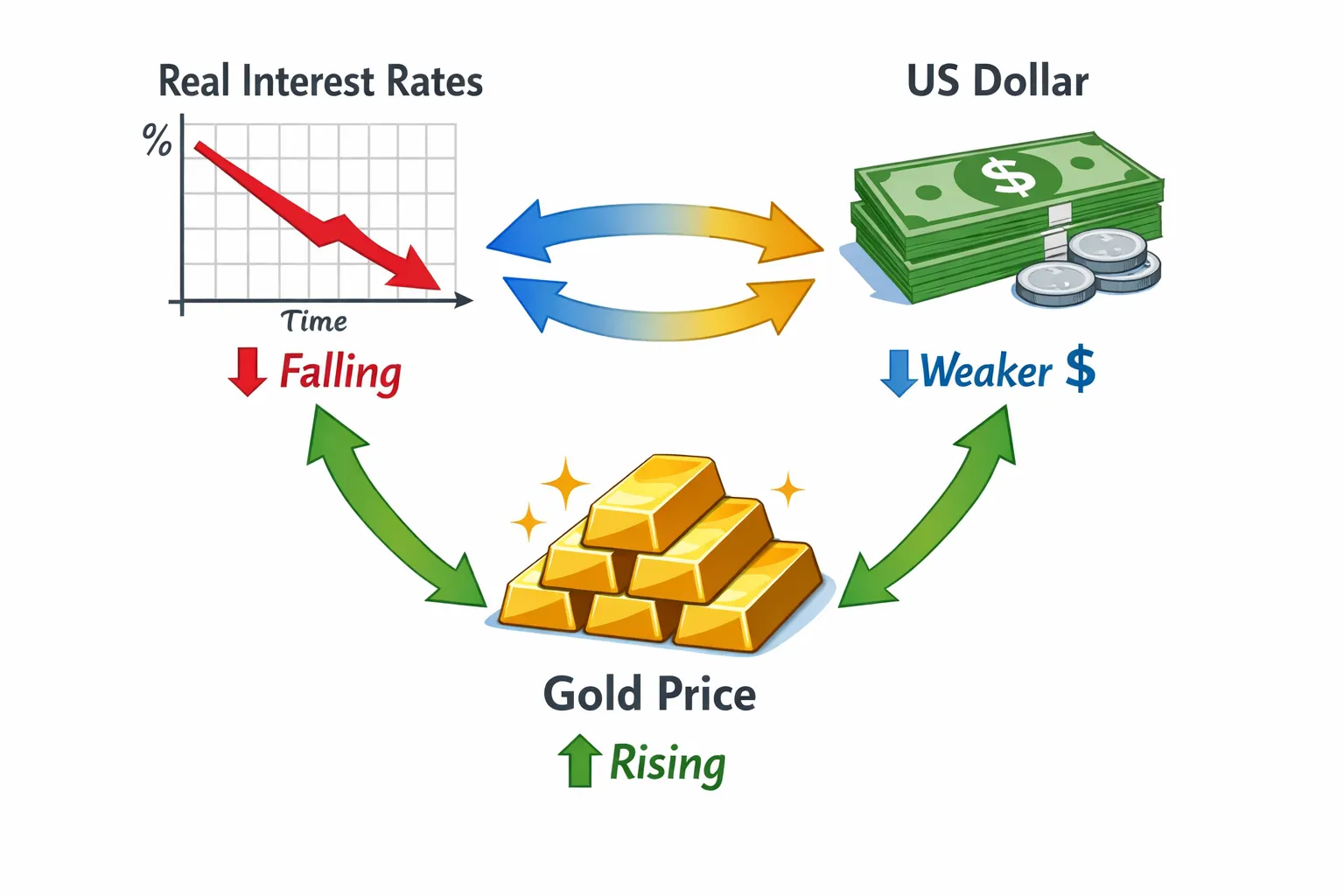
Real interest rate = interest rate – inflation
-
If you get 7% in a fixed deposit but inflation is 6%, your real return is ~1%.
-
If inflation rises faster than your FD return, your real return can become negative.
Why this matters for gold
Gold doesn’t pay interest. So when real returns on “safe” instruments are weak, gold looks more attractive.
The India angle: why gold prices in INR don’t behave like global gold prices
Indian gold prices are shaped by global gold price + USD/INR + taxes + local demand.
Key India-specific drivers (that global articles underweight)
1) USD to INR exchange rate
India imports a lot of its gold. If the rupee weakens, gold becomes more expensive locally – even if global prices are flat.
2) Import duties + GST
Policy changes can push retail prices up/down even when spot gold is stable.
3) Jewellery and festival demand
Weddings, Diwali, Akshaya Tritiya – these create seasonal demand spikes and local premiums.
4) Local premiums/discounts
Retail pricing can diverge from “spot” due to supply constraints, demand bursts, and inventory cycles.
“In 2010, India accounted for 32% of global gold demand, purchasing 933.4 tonnes.” – World Gold Council
That’s why India is not just a “consumer” – it’s a real force in gold pricing psychology.
What history teaches you (translated into a simple investor playbook)
Here are the lessons from every major gold cycle – converted into rules you can actually use.
1) Don’t chase peaks – build a gold habit
Gold tends to punish peak-chasing and reward consistency. The simplest edge is discipline, not prediction.
2) Track the “big 5” signals (instead of headlines)
Use this checklist to set expectations:
|
Signal |
If it’s rising… |
What gold often does |
|---|---|---|
|
Inflation expectations |
Purchasing power fear increases |
Often supportive |
|
Real interest rates |
Opportunity cost of gold changes |
Lower real rates often help |
|
US dollar strength (DXY) |
Gold priced in USD becomes “costlier” globally |
Strong USD can pressure |
|
Geopolitical risk |
Safe-haven demand increases |
Often supportive |
|
Central bank gold buying |
Structural demand rises |
Often supportive |
3) Accept that gold can be boring
Boring is not bad. A hedge is supposed to be quiet until you need it.
“So should I invest in gold now?” A realistic way to decide (no hype)
Instead of guessing tops and bottoms, decide based on:
-
Your time horizon (gold works better as a multi-year asset)
-
Your goal (inflation defense, diversification, crisis buffer)
-
Your behavior (will you panic-sell?)
If you want a practical way to track entry points daily, use a simple reference like a gold price chart and focus on consistency over timing.
How OroPocket upgrades gold investing for 2026 India (micro + rewards + speed)
Traditional gold buying has friction:
-
high ticket sizes
-
making charges
-
purity anxiety
-
storage risk
-
slow bank transfers
OroPocket is built for modern India – UPI-first, app-first, habit-first.
Why OroPocket works especially well in gold cycles
-
₹1 entry point: Start immediately. No “I’ll do it later.”
-
Instant UPI payments: Buy in under 30 seconds.
-
100% secure & compliant: RBI-compliant ecosystem, fully insured vault storage, authorized bullion partners.
-
Gamified investing: streaks, spin-to-win, tiered rewards – build the habit, not just the portfolio.
-
Free Bitcoin on every purchase: You don’t just buy gold – you get Satoshi cashback too.
-
Gold + Bitcoin combination: Gold’s stability + Bitcoin’s growth potential – without you needing to trade crypto.
“When domestic inflation exceeded 6%, gold prices rose by an average of 12.6% annually (historically in the Indian context).” – World Gold Council
Gold is about protection. OroPocket adds momentum via rewards.
The simplest “set it and grow it” gold strategy (built for retail investors)
If you want a clean approach without complexity:
-
Pick a monthly amount you won’t miss (even ₹10/day is fine)
-
Buy systematically (don’t wait for “the perfect dip”)
-
Watch real rates + INR + global risk (not influencer noise)
-
Keep your gold allocation realistic (diversifier, not your whole net worth)
-
Rebalance over time
And yes – seeing your daily progress helps. That’s why tracking the history of gold prices alongside today’s rates is the best way to avoid emotional decisions.
Final verdict: gold rewards patient builders – OroPocket rewards them twice
Gold’s history is clear: the biggest winners aren’t the people who predict the next spike. They’re the people who stay consistent through cycles.
If you want the 21st-century way to do that – start with ₹1, pay instantly via UPI, earn Bitcoin rewards, and turn investing into a habit you’ll actually stick with – OroPocket is built for you.
Stop watching. Start growing. Download OroPocket, start your ₹1 gold journey today, and get rewarded in gold + Satoshi every time you invest.