
Which is better for investment, buying digital gold or physical gold?

Digital Gold vs Physical Gold: Quick Answer (and TL;DR)
In one line
-
Digital gold = easiest way to invest small amounts at live prices with no storage hassles.
-
Physical gold = best when you want to wear, gift, or hold heirloom assets you can touch.
Who should choose what
-
Choose digital gold if you value: convenience (UPI), SIP-style micro-buys, instant liquidity, easy tracking.
-
Choose physical gold if you value: tangible possession (coins/bars/jewellery), gifting, or zero platform dependency.
At-a-glance comparison (we’ll go deeper below)
-
Purity: Digital (24K/999) vs Physical (22K jewellery common; 24K coins/bars available)
-
Minimum investment: Digital (as low as ₹1–₹100) vs Physical (typically ≥ 1g; jewellery has higher ticket size)
-
Costs: Digital (GST 3% + spread + possible storage after free period) vs Physical (GST 3% + making/wastage for jewellery + locker/insurance)
-
Liquidity: Digital (sell instantly in-app) vs Physical (resale at jeweller; spreads vary)
-
Risks: Digital (platform/counterparty risk) vs Physical (theft/storage risk)
-
Regulation: Digital gold is outside direct RBI/SEBI regulation; Physical guided by BIS hallmarking & consumer laws.
Feature-by-feature TL;DR comparison
|
Feature |
Digital Gold |
Physical Gold |
|---|---|---|
|
Purity |
24K (999) backed by vaulted bullion |
22K common for jewellery; 24K coins/bars available |
|
Minimum ticket size |
Start from ₹1–₹100 |
Typically ≥ 1 gram; jewellery has higher outlay |
|
Core costs |
3% GST + platform spread; storage after free period |
3% GST + making/wastage (jewellery) + locker/insurance |
|
Liquidity |
Instant in-app buy/sell at live prices |
Sell to jeweller; spreads, testing, negotiation apply |
|
Storage & safety |
Insured vaults; no home locker needed |
Self-storage/locker; theft and damage risks |
|
Regulation |
Outside direct RBI/SEBI; platform governance |
BIS hallmarking norms + consumer protection |
|
Best use case |
Micro-investing, goal-based saving, quick liquidity |
Wearing, gifting, heirloom/long-term tangible holding |
Where OroPocket fits (30 seconds)
-
Mobile-first digital gold for Indians with ₹1 entry, UPI payments, and free Bitcoin (Satoshi) rewards on every buy – so you stack gold + BTC together.
-
Habit-building features: daily streaks, spin-to-win, referrals, and instant gifting (Send Gold).
“Over the past five years, gold in India delivered ~18% average annual returns – far above typical savings rates.” – Source
What Is Digital Gold (India): How It Works, Fees, and Fine Print
How it works (plain English)
-
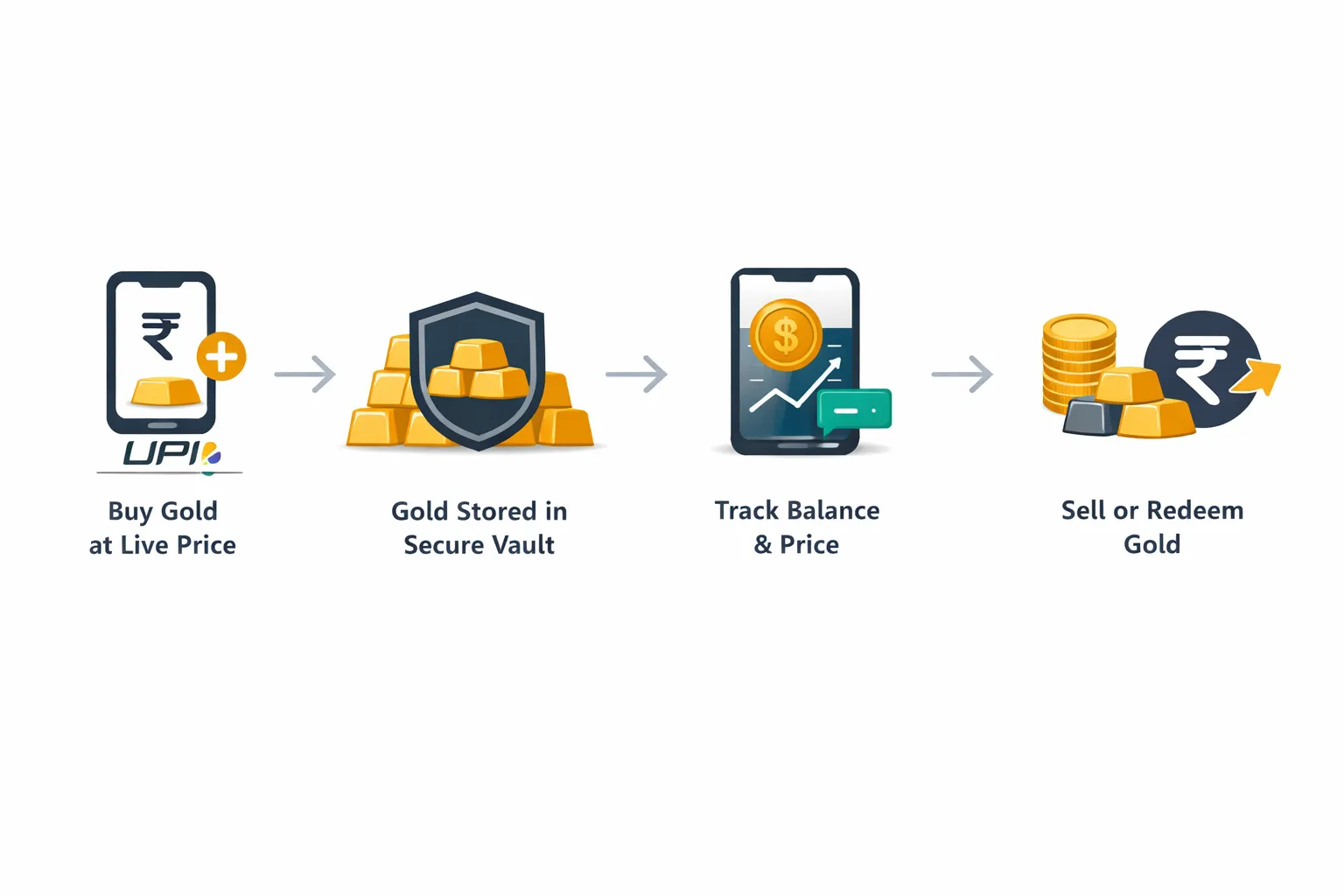
You buy at live price (by ₹ or grams); provider sources 24K/999 gold.
-
Gold is stored in insured vaults with a custodian/trustee; you see digital balance in-app.
-
You can sell back instantly, or redeem as coins/bars (minimums + minting/delivery fees apply).
Key moving parts to check before you buy
-
Purity & partners: Confirm 24K/999 backing and who holds the bullion/vaulter (e.g., MMTC-PAMP, SafeGold, Augmont). Look for independent audits and certifications.
-
Pricing: Understand the buy/sell spread, any platform fee, 3% GST on purchases, and FX charges if funding in non-INR.
-
Storage: Know the free storage window and the annual fee thereafter (commonly ~0.5–1% after 3–5 years).
-
Redemption: Check minimum grams for coin/bar delivery, minting + shipping fees, and delivery timelines/coverage.
-
Limits & KYC: Review minimum/maximum order sizes and PAN/KYC requirements for larger limits.
Risks (and how platforms mitigate them)
-
Counterparty/operational risk: Mitigated via trusteeship structures, segregated client holdings, insurance, and third-party audits.
-
Cyber risk: Protected through 2FA, device binding, and encryption. If your phone is lost, immediately reset credentials and lock account from the web/helpdesk.
India regulation snapshot (simple)
-
Digital gold isn’t directly regulated by RBI/SEBI. If you prefer fully regulated options, consider SGBs (RBI/GoI), Gold ETFs (SEBI), or EGRs (SEBI).
“SEBI has clarified that ‘digital gold’ isn’t under its direct regulation, while SGBs (RBI), Gold ETFs (SEBI) and EGRs (SEBI) are regulated alternatives.” – Source
OroPocket side-note (why readers care)
-
Start with ₹1, pay via UPI, and earn free Satoshis on every purchase – pair a 5,000-year store of value (gold) with Bitcoin upside.
-
Build habits with daily streaks, spin-to-win, referrals, and instant gifting (Send Gold).
The True Cost of Ownership (1–5 Years): Digital vs Physical
What drives total cost
-
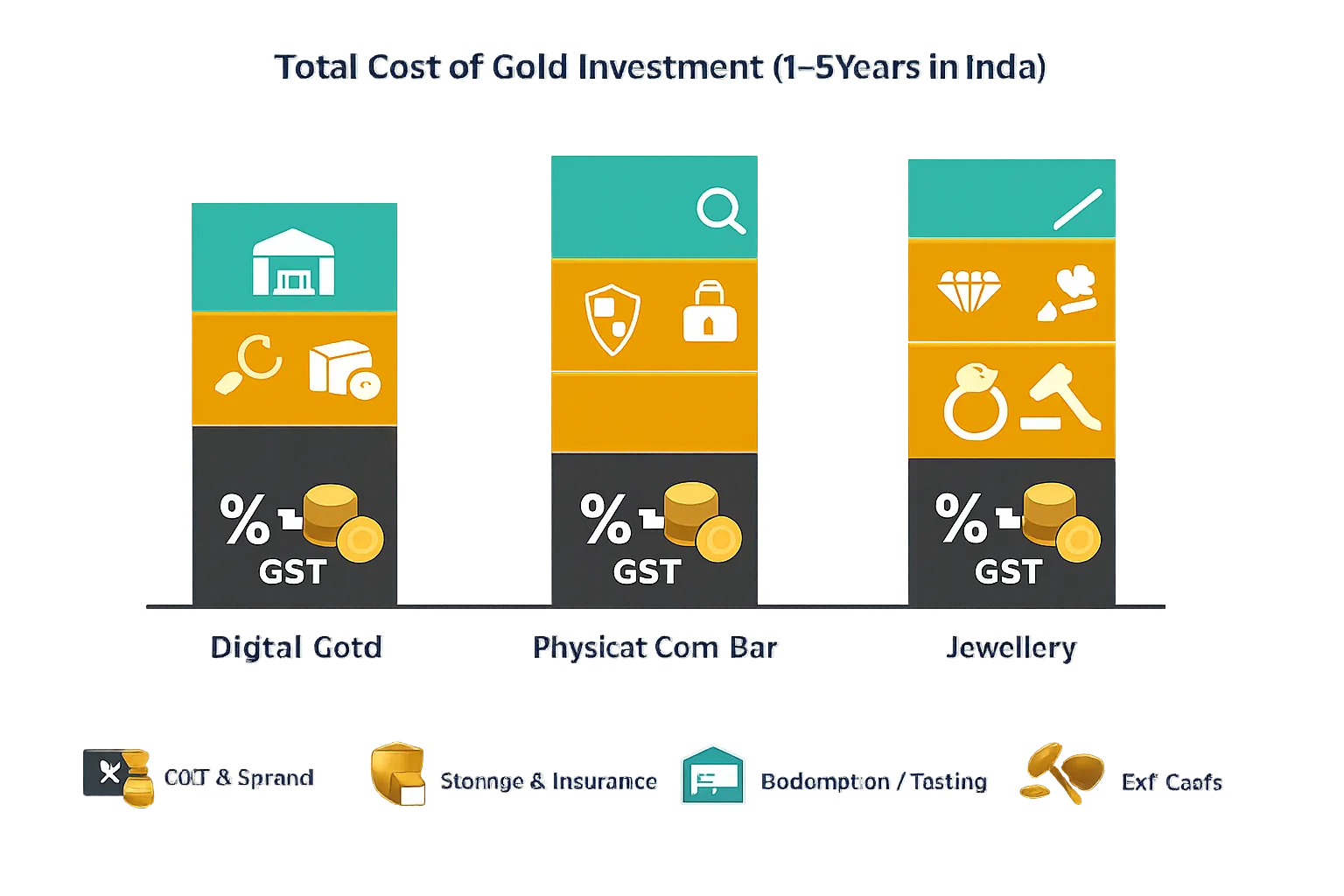
Entry costs: GST (3% both), spreads (digital/platform vs physical/dealer), making charges (jewellery only).
-
Holding costs: Digital storage after free period (often ~0.5–1%/yr); Physical locker/insurance (₹2,000–₹15,000+/yr typical ranges).
-
Exit costs: Sell spread, redemption/minting/shipping (digital), testing/melting deductions (physical), transit.
Scenarios to model (illustrative, not advice)
-
SIP-style micro-buys (₹1,000/week for 1 year) → friction and tracking comparison.
-
Lumpsum buy (₹50,000 coin vs digital) → holding 3 years, then sell.
-
Jewellery purchase (₹2 lakh) → investment vs usage value, resale haircut impact.
Side-by-side cost stack by scenario
|
Cost Layer |
Digital Gold |
Coin/Bar (Physical) |
Jewellery (Physical) |
|---|---|---|---|
|
Entry |
3% GST + platform spread (typically a few %) |
3% GST + dealer spread/premium |
3% GST + making/wastage (often 8–25%+), stones extra |
|
Holding (1–5 yrs) |
Free storage window; then ~0.5–1%/yr |
Locker + insurance (₹2,000–₹15,000+/yr) |
Locker + insurance (₹2,000–₹15,000+/yr) |
|
Exit |
Sell spread; redemption minting + shipping if taking delivery |
Testing/assay + dealer spread on buyback |
Haircut for melting/removal of making/stone value; spreads vary |
|
Notes |
Best for SIP-style micro-buys, easy tracking and liquidity |
Better for pure investment than jewellery; brand/dealer impacts spreads |
Suits wearing/gifting; least efficient for pure investment due to making charges |
Takeaway
-
For pure investment, avoiding jewellery making/wastage often improves outcomes; micro-buys favor digital convenience.
Liquidity, Resale, and Loanability
Liquidity
-
Digital: Sell in-app at live quotes; funds are typically settled quickly (often T+0 to T+2 depending on the platform and payment rails). No travel, no negotiation.
-
Physical: Resale happens at a jeweller/dealer. Expect time for purity testing (assay), document checks, and price negotiation. Spreads vary by city, brand, and market conditions.
Resale spreads to expect
-
Jewellery: The widest haircut because making/wastage and stones are not recovered on resale; melting charges may apply.
-
Coins/Bars: Narrower than jewellery; spreads depend on brand recognition, purity (24K/999 vs 995), and dealer policy.
-
Digital: Platform spread is visible upfront; always compare the buy vs sell quote in-app before placing an order.
Using gold for loans
-
Physical: Widely accepted by banks/NBFCs. Loan-to-Value (LTV) and interest rates vary by lender and regulator guidelines; documentation and in-person valuation are standard.
-
Digital: Acceptance is emerging. Some lenders or fintech partners may support digital gold collateral, typically with instant, online verification. Check eligibility, LTV, and partner list before relying on it.
Redemption to physical (from digital)
-
Minimum redemption weights apply (varies by platform and coin/bar denomination).
-
Expect minting and delivery fees; verify shipping timelines and serviceable locations.
-
Redeem when you specifically need coins/bars for gifting or storage; otherwise, selling digitally often remains the most cost- and time-efficient route.
Safety, Custody, and Regulation (No-Nonsense View)
Digital gold safety
-
Vaulting, insurance, trusteeship/segregation; audit transparency; platform cybersecurity (2FA, device lock, alerts).
-
Platform risk still exists: pick reputable partners; read storage terms and redemption rules.
Physical gold safety
-
BIS hallmarking and invoice for authenticity; secure storage plan (locker vs home safe).
-
Practical theft prevention and documentation (photos, bills, insurance policy details).
Regulation snapshot
-
Digital gold: outside direct RBI/SEBI ambit; governed by contracts/company law; follow NITI Aayog guidance where applicable.
-
Regulated alternatives to consider for investment-only exposure: Gold ETFs, SGBs, EGRs (SEBI/RBI/Exchange regulated).
“SEBI regulates Gold ETFs and has issued a comprehensive risk framework and master circular for Electronic Gold Receipts (EGRs), while BIS hallmarking certifies physical gold purity; app-based ‘digital gold’ remains outside direct RBI/SEBI regulation.” – Source
Taxes and GST: Keep It Simple
Direct taxes (capital gains) for both digital and physical
-
STCG: if sold < 3 years → taxed at your slab rate.
-
LTCG: if sold ≥ 3 years → 20% with indexation (plus cess/surcharge as applicable).
Indirect taxes
-
3% GST on purchase of gold (digital or physical coins/bars/jewellery gold value).
-
Jewellery also attracts GST on making charges; digital redemption to coins/bars may have minting/shipping taxes/charges.
SGB/ETF quick contrast (for reference only)
-
SGBs: interest taxable; capital gains on maturity are exempt (as per prevailing rules); off-market sale rules differ.
-
ETFs: expense ratio applies; gains taxed like mutual funds holding gold (capital gains rules apply on sale).
Decision Framework: Which One Should You Choose? (Final Verdict)
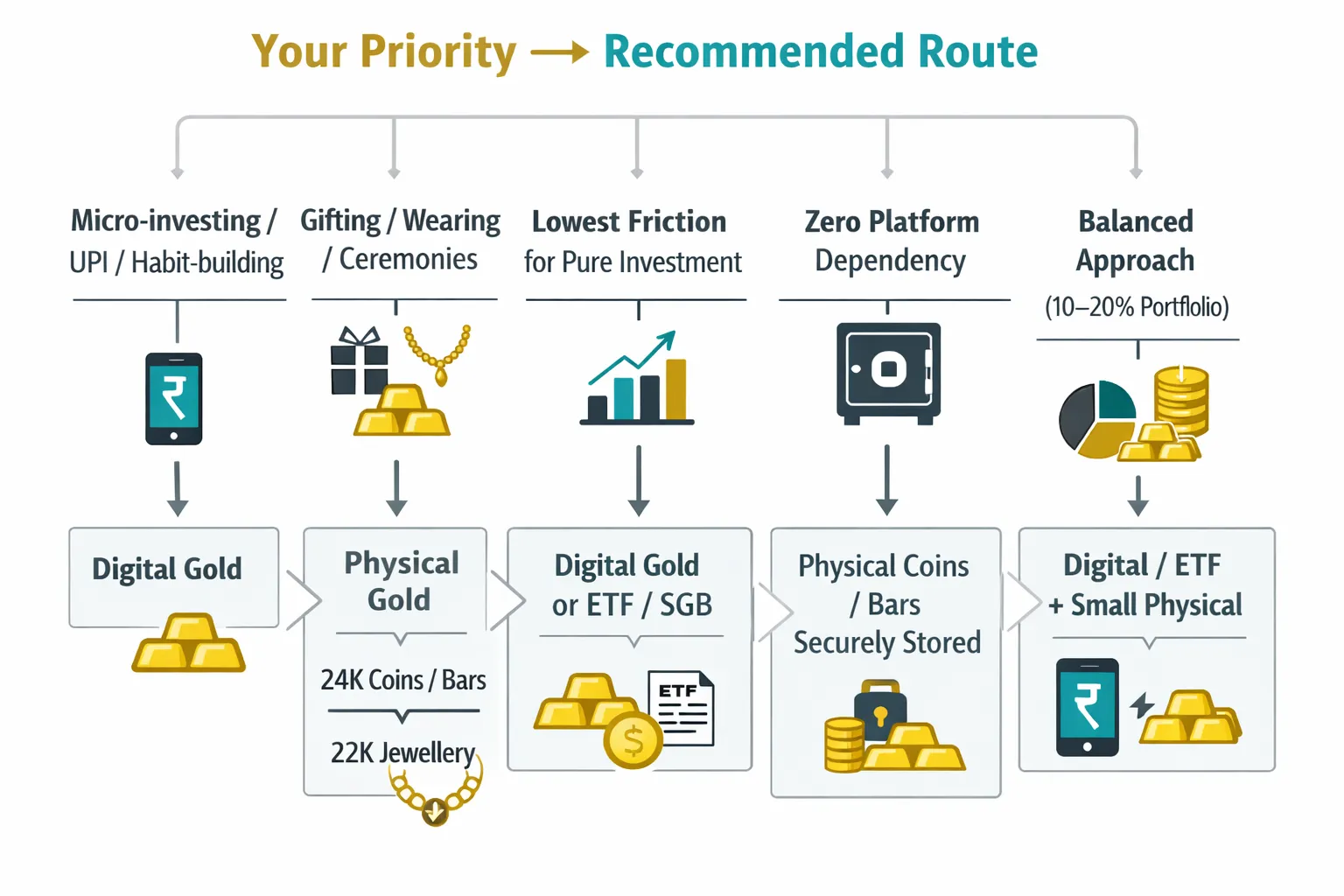
If you prioritise… choose this
-
Micro-investing, UPI-first convenience, habit-building → Digital gold.
-
Gifting, wearing, cultural/ceremonial use → Physical gold (prefer 24K coins/bars for investment; 22K for jewellery usage).
-
Lowest friction for pure investment exposure → Digital gold or regulated ETFs/SGBs (no jewellery making charges).
-
Zero platform dependency → Physical coins/bars stored securely.
Balanced approach
-
Consider a mix: e.g., 10–20% portfolio in gold exposure; split between digital/ETF for investing and a small portion in physical for life events.
Our call (why we lean digital for investing)
-
For investment-only goals, digital gold offers easier accumulation, transparent pricing, and instant liquidity – especially powerful for first-time investors building the habit with small, regular buys.
Where OroPocket Fits + How to Start (in 3 steps)
Why OroPocket for digital gold
-
Start with just ₹1 via UPI – no minimums.
-
Earn free Bitcoin (Satoshi) on every gold/silver purchase (tiered rewards).
-
Gamified investing: daily streaks, spin-to-win, referral rewards (100 Satoshi + free spin for both).
-
24K pure, 100% insured, RBI-compliant partners; instant gifting (Send Gold).
3-step getting-started checklist
-
Download the OroPocket app (iOS/Android) → https://oropocket.com/app
-
Set your plan: SIP small (e.g., ₹100–₹1,000) or buy lumpsum on dips; turn on streaks and alerts.
-
Review fees & rules once; periodically rebalance (consider adding ETFs/SGBs for regulated exposure if that suits your goals).
Final CTA
-
Take control of your money the 21st‑century way – stack gold from ₹1 and earn Bitcoin on every purchase. Download OroPocket now.