
What happened to gold prices during the 2008 crash?

What happened to gold prices during the 2008 crash?
If you’re searching “gold price crash” or tracking the price of gold live, you’re really asking two things:
-
Did gold fall in 2008 like stocks did?
-
Why did gold end up becoming one of the best-performing “fear assets” after the crash?
Here’s the real story: gold dipped early in the crisis – but then surged as panic deepened, central banks printed money, and investors rushed to safety. That pattern is exactly why many Indians still use gold as an inflation hedge and a “sleep-better” asset.
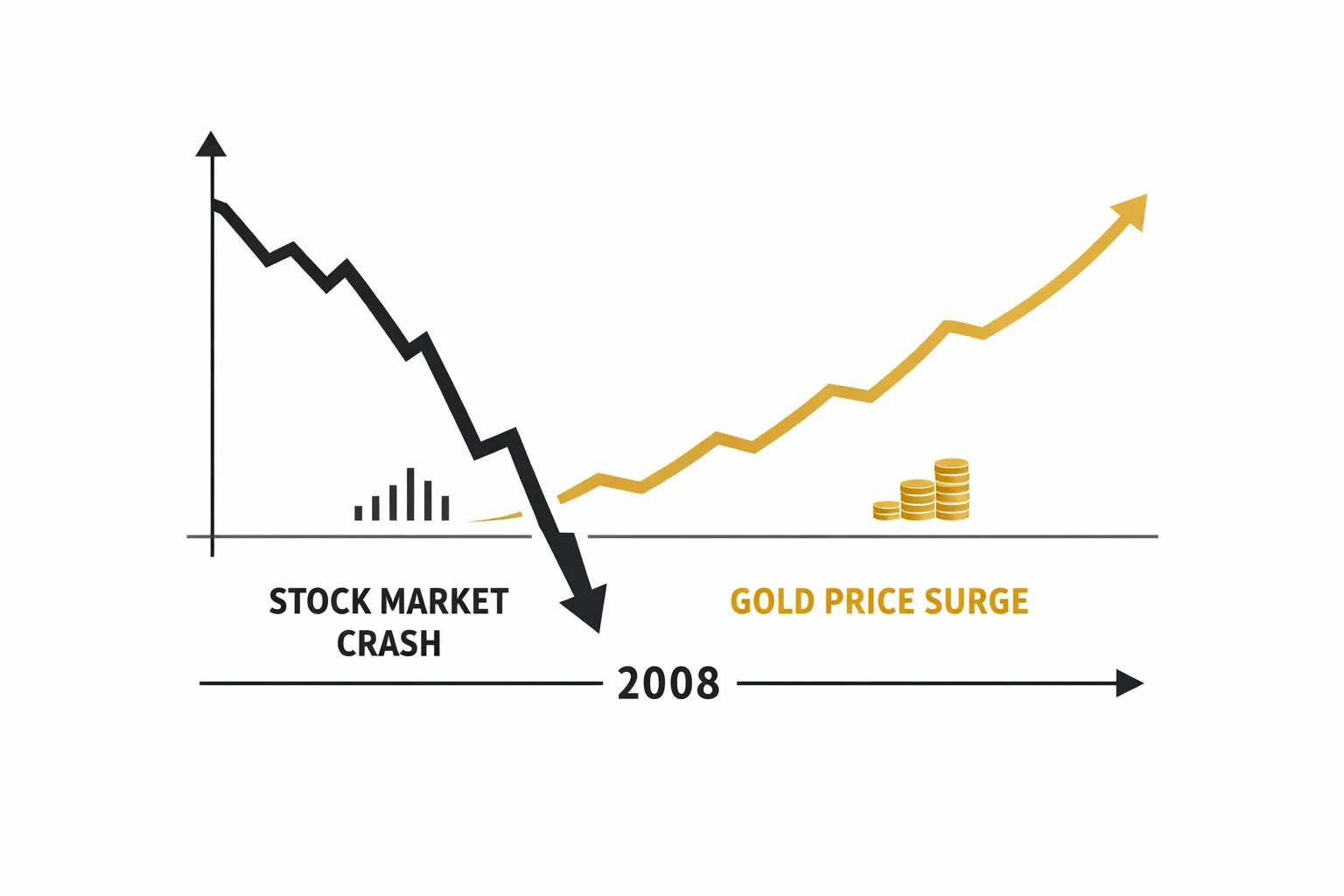
The short timeline: gold in 2008 wasn’t a straight line up
Phase 1 (early 2008): gold was already strong
Even before Lehman collapsed, gold was rising due to uncertainty, commodity momentum, and early recession signals.
Phase 2 (late 2008): gold fell briefly with everything else
When the crisis hit peak panic, investors sold what they could to raise cash. That included gold – because in a liquidity crunch, even “safe” assets get sold.
Phase 3 (2009–2011): gold rallied hard
Once the dust settled, the narrative changed from “sell everything” to “protect purchasing power.” Quantitative easing (money printing), low interest rates, and fear of currency debasement pushed more buyers into gold.
What the data says (not opinions)
BLS producer price data shows gold’s post-crash strength clearly.
“Between 2008 and 2012, the Producer Price Index (PPI) for gold ores increased by 101.1 percent.” – Source
And gold didn’t just rise – it reached a historic peak soon after:
“In late August 2011, gold prices reached an all-time high of $1,917.90 per ounce.” – Source
Translation for retail investors: gold’s real “winning move” wasn’t the crash week – it was the multi-year run that followed when fear + stimulus + low rates dominated.
Why gold rose after the crash: 4 drivers that still matter today
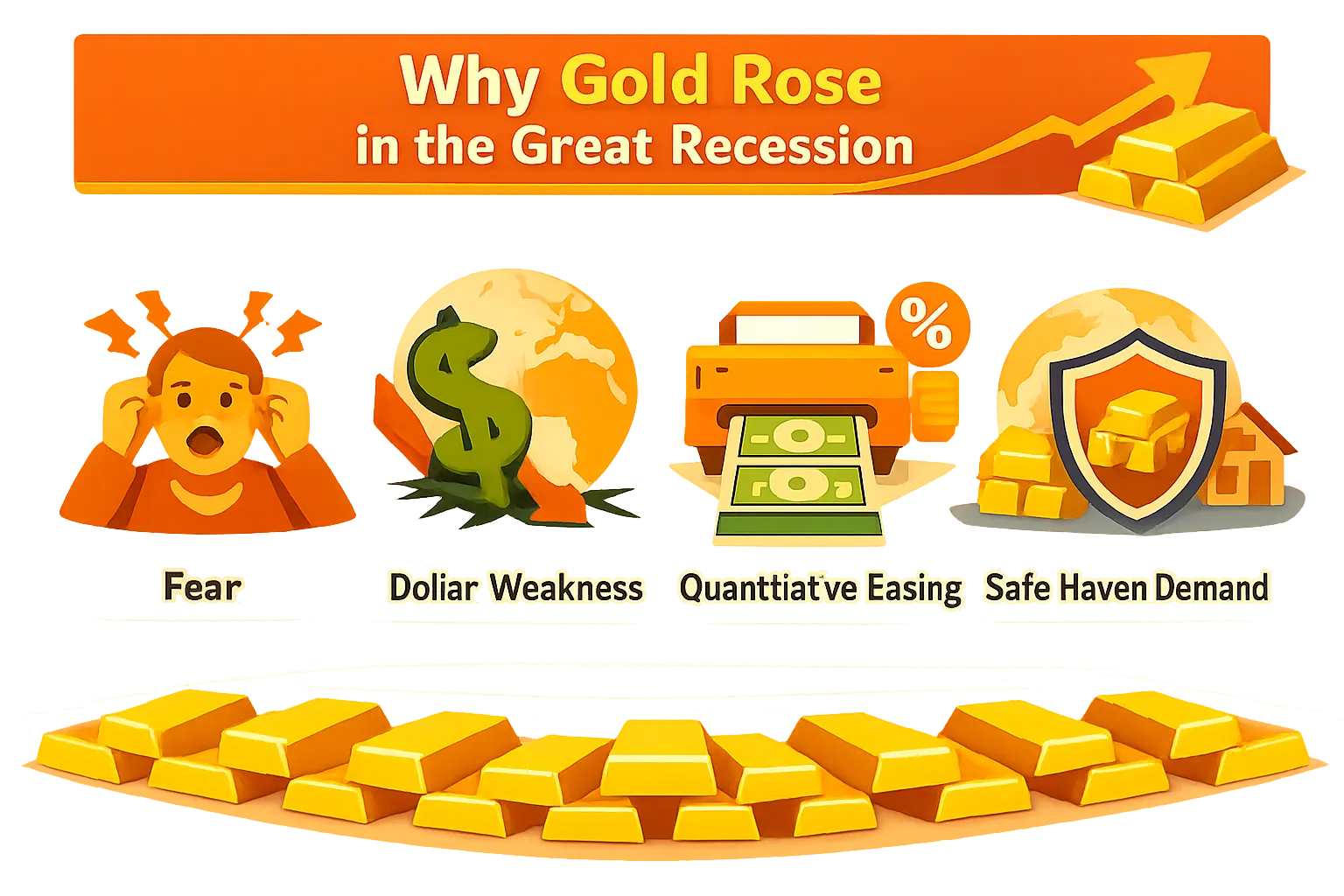
1) “Tail risk” fear (people wanted insurance)
In crises, investors stop chasing returns and start chasing survival. Gold becomes financial insurance because it doesn’t rely on a company’s profits or a borrower repaying a loan.
2) Money printing + low interest rates
When interest rates fall, holding cash and fixed deposits often feels less rewarding. Gold tends to benefit because the “opportunity cost” of holding it reduces.
3) Currency weakness fears
Gold is priced globally, and when people worry about currency value (or inflation), gold demand rises as a hedge.
4) Herd behaviour + momentum
Once gold starts outperforming, more buyers pile in – ETFs, institutions, and retail. That demand creates a self-reinforcing move (until it doesn’t).
Was gold a perfect safe haven in 2008? Not exactly.
Gold helped – but it wasn’t immune.
Important truth most competitors gloss over:
During the worst weeks of 2008, gold’s short-term move was messy because liquidity was king. Gold’s “safe haven” role is strongest when the crisis shifts from “need cash now” to “protect wealth over time.”
That’s why for most people, gold works best as:
-
a portfolio stabiliser
-
a long-term inflation hedge
-
a discipline asset you accumulate steadily (instead of trying to time the bottom)
If you want to track this behaviour in real time, use a reliable live gold prices page and watch how volatility spikes during macro shocks.
What this means for Indian investors tracking “gold price crash” today
Here’s the practical takeaway: gold can dip during panic, then rise strongly after. So the goal isn’t to “buy perfectly” – it’s to build a position consistently.
A simple approach many smart savers use:
-
Invest small amounts on a schedule (daily/weekly/monthly)
-
Track the gold price chart to understand volatility, not to predict it
-
Keep gold as a stabiliser while your growth assets (equity) do the heavy lifting
Why OroPocket is built for this exact moment (micro-investing + rewards)
Most Indians don’t fail at investing because they don’t know gold is valuable. They fail because:
-
they wait for the “perfect price”
-
they think they need a big amount
-
they lose motivation after week 1
OroPocket fixes that with a system designed for habit + rewards:
-
Start from ₹1 (no minimum barrier)
-
Buy in under 30 seconds with UPI
-
100% secure & compliant (insured vault storage, authorized bullion partners)
-
Gamified investing (daily streaks, spin-to-win, tiered rewards)
-
Free Bitcoin (Satoshi) on every gold/silver purchase
You’re not just stacking gold – you’re stacking a second asset too.

Digital gold vs physical gold during a crisis (what actually matters)

|
Factor |
Physical gold |
OroPocket digital gold |
|---|---|---|
|
Minimum buy |
Usually high (coins/jewellery) |
₹1 entry point |
|
Liquidity |
Store visit, negotiation |
In-app buy/sell |
|
Safety |
You manage storage risk |
Insured vault storage |
|
Convenience |
Not instant |
UPI in under 30 seconds |
|
Extra rewards |
None |
Free Bitcoin cashback |
If your aim is capital preservation + liquidity (the real crisis combo), digital wins on speed and practicality.
Final verdict: gold fell briefly in 2008 – then proved why it’s crisis insurance
Gold didn’t magically rise every single day in 2008. It wobbled during the liquidity shock, then outperformed strongly as the world moved into stimulus, uncertainty, and inflation fears.
If you’re still “watching the price of gold live” and waiting, you’re already late – because wealth isn’t built by perfect timing. It’s built by consistent action.
Stop watching. Start growing:
-
Track the price of gold today
-
Start with ₹1
-
Get gold stability plus free Bitcoin rewards
That’s OroPocket.