
How to Invest in Gold Without Buying Gold: Shares, Funds, and Digital Gold


Introduction: Ways to get gold exposure without buying bars
Why consider gold without the hassle of holding it
If you’ve been wondering how to invest in gold without buying gold bars or jewellery, you’re not alone. Gold remains a proven hedge against inflation and a powerful diversifier alongside FDs, stocks, and mutual funds. But physical gold has baggage: making charges, GST, purity doubts, storage hassles, and theft risk.
The good news: you can still ride gold’s price moves without storing a single gram. In this guide, we’ll compare:
-
Shares of gold miners (equity exposure tied to gold)
-
Funds: Gold ETFs and gold mutual funds (SEBI-regulated)
-
Sovereign Gold Bonds (SGBs) by RBI
-
Digital Gold (app-based, vault-backed gold)
“Indian gold ETFs saw net inflows of INR313bn (US$3.6bn) in Jan–Nov 2025 – the highest annual addition on record.” – Source
At a glance: Which route fits whom (1-min skim)
|
Route |
Minimum amount |
Liquidity |
Costs/fees |
Taxation (high-level) |
Risk level |
Ideal for |
How to buy in India |
|---|---|---|---|---|---|---|---|
|
Shares (Gold miners) |
Price of 1 share |
High (market hours; T+ settlement) |
Brokerage, STT, stamp duty |
Equity tax rules (STCG/LTCG as per listed shares) |
High (company + market risk; imperfect gold tracking) |
Active investors seeking higher-beta exposure to gold |
Through a stockbroker/Demat |
|
Funds (Gold ETFs & Gold Mutual Funds) |
ETF: 1 unit (~1g equivalent) • MF SIP: starts ~₹500 |
ETF: Intraday • MF: T+2 |
Expense ratio (ETFs typically lower than FoFs), brokerage for ETFs |
ETFs: LTCG ~12.5% >12 months; FoFs: LTCG ~12.5% >24 months; STCG at slab |
Moderate (tracks domestic gold price; tracking error applies) |
Hands-off investors who want pure gold exposure via Demat/SIP |
ETFs via broker + Demat; MFs via fund/app with SIP |
|
Sovereign Gold Bonds (SGBs) |
1 gram |
8-year tenor; early exit from year 5 on coupon dates; exchange trading has variable liquidity |
No making/storage costs; 2.5% interest p.a. paid semi-annually |
Capital gains at maturity exempt; interest taxed per slab; rules apply on premature sale |
Low–Moderate (sovereign-backed; price risk remains) |
Long-term, tax-efficient investors comfortable with lock-in |
Through banks, designated Post Offices, brokers during tranches; secondary market |
|
Digital Gold (vault-backed apps) |
From ₹1 |
24×7 buy/sell; instant in-app liquidity |
Buy–sell spread; platform/storage fees; delivery charges if you take coins/bars |
Treated like physical gold (e.g., LTCG >24 months; STCG at slab) |
Moderate (gold price + platform/counterparty risk) |
Micro-investors, UPI-first users, gifters, habit builders |
Mobile apps; UPI payments; e.g., OroPocket offers RBI-compliant partners, insured vaults, and Bitcoin rewards |
Note: As a digital gold option, OroPocket lets you start from just ₹1 via UPI, with 24K gold held in insured vaults – and you earn free Bitcoin (Satoshis) on every purchase. Great for micro-investing and building a daily streak.
What you’ll learn in 8 minutes
-
The costs you actually pay across each route (including hidden charges like spreads, expense ratios, and taxes)
-
Liquidity and exit scenarios (T+ settlements, lock-ins, and 24×7 in-app exits)
-
The specific risks of each option and who they suit best
-
Exactly how to start small (₹1–₹500) using UPI or SIPs – so you can invest in gold without buying bars and still stay diversified
Keywords covered: how to invest in gold without buying gold, invest in gold shares, how to invest in gold shares, digital gold investment india
Option 1 – Gold mining shares (direct stocks or miners ETFs)
What they are and how they track gold
When you invest in gold mining shares (individual listed miners) or a miners ETF, you’re buying equity in businesses that explore, mine, and sell gold – not the metal itself. Their share prices are influenced by gold, but also by company fundamentals.
Key drivers include AISC (all-in sustaining costs), production volumes, expansion pipelines, debt levels, hedging policies, and even local FX where mines operate. That’s why miners can outperform gold in bull markets (operating leverage), and underperform when costs or execution slip. Put simply: you’re investing in a business exposed to gold – not a pure spot-price proxy.
Pros
-
Potential for amplified gains in strong gold cycles (operating and financial leverage)
-
Easy to buy/sell via your brokerage; high liquidity for leading global miners and popular miners ETFs
-
Optional SIPs via some brokers into ETFs, if your platform supports international investing
Cons
-
Equity-like volatility; exposure to management, ESG, regulatory, and geopolitical risks
-
Not a pure gold-price tracker due to hedging, cost inflation, and mine-specific issues
-
Currency risk if you buy global miners or foreign-listed ETFs
Costs, liquidity, taxation
-
Costs: Brokerage, exchange/SEBI charges, STT/stamp duty (varies by venue); currency conversion fees for overseas trades
-
Liquidity: Typically high for large-cap miners and major miner ETFs; bid-ask spreads can widen in volatile markets
-
Taxation: Treated under equity/foreign equity rules depending on where you transact (domestic vs. international/IFSC). Consult your broker/tax advisor for current slabs and holding-period rules.
How to start
-
Prefer a diversified miner ETF for simplicity if your broker enables international access – this spreads risk across multiple producers instead of betting on one company.
-
Allocation tip: If your goal is to track gold’s price, keep miners as a satellite position (tactical bet), not your core gold exposure.
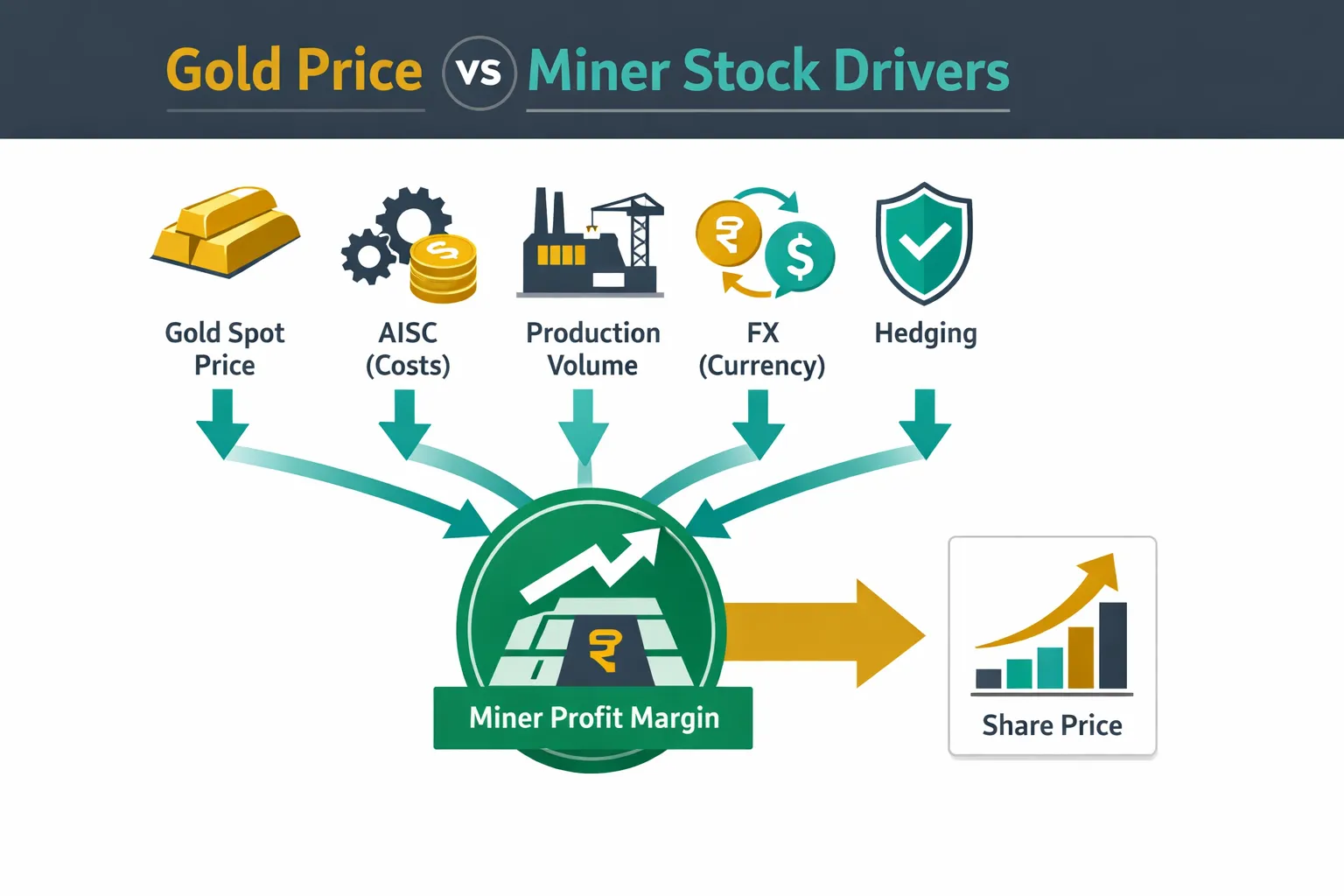
“Gold miner funds and stocks don’t perfectly track spot gold; they’re driven by company fundamentals like AISC, hedging, production, and broader equity market moves.” – Source
Option 2 – Gold ETFs (SEBI‑regulated)
What they are
-
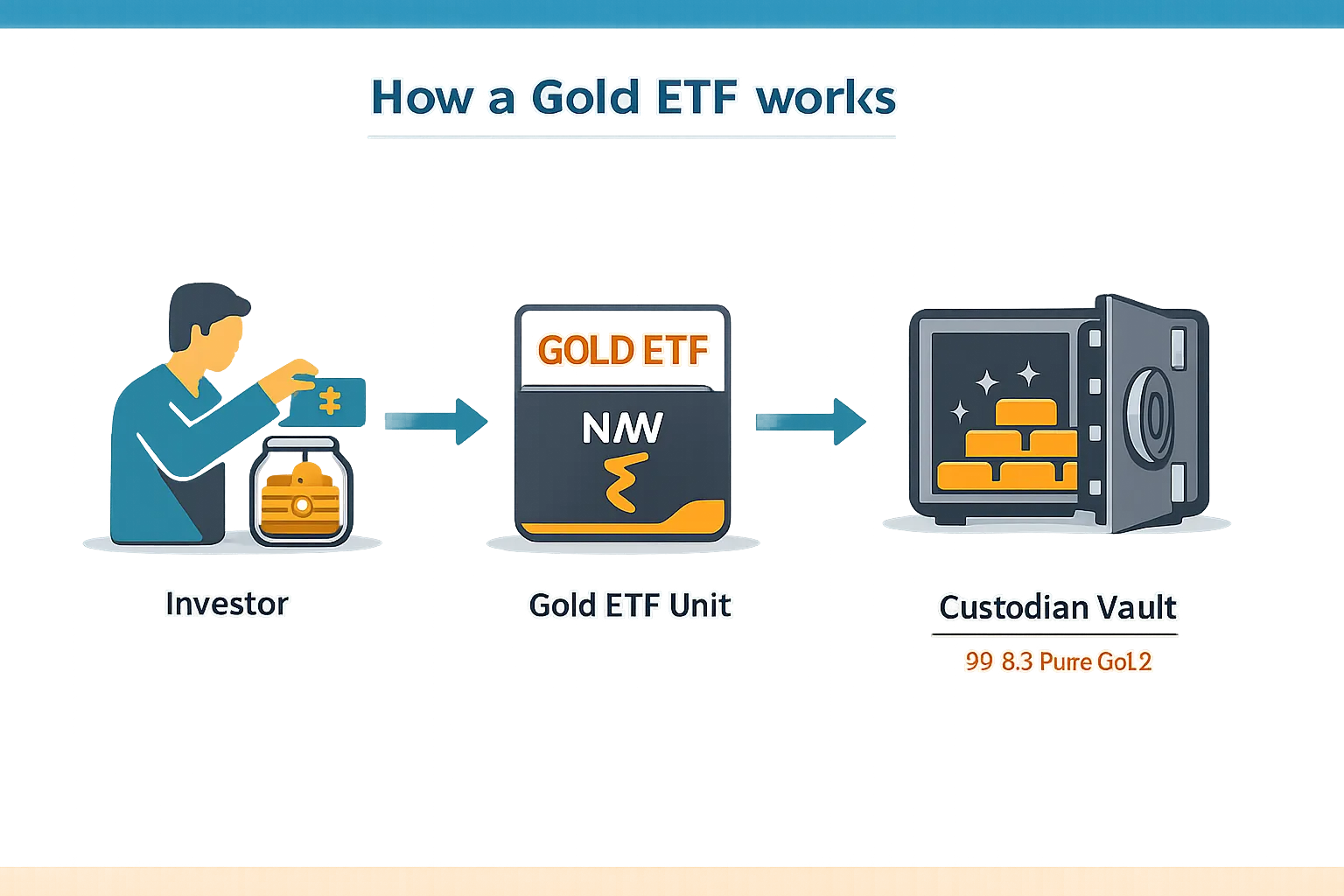
Exchange-traded funds that hold 99.5% purity physical gold in secure, insured vaults.
-
Each unit represents a small quantity of gold, and the NAV closely tracks India’s gold price, minus the fund’s expense ratio.
Pros
-
Transparent pricing, liquid during market hours, and no making charges or purity doubts.
-
Small ticket sizes and compatible with stock SIPs on many Indian brokers.
Cons
-
Requires a Demat and trading account; you’ll pay brokerage plus the ETF’s expense ratio.
-
Units can trade at a small premium/discount to NAV; liquidity is available only during market hours.
Costs, liquidity, taxation
-
Expense ratio varies by fund; brokerage and other exchange charges apply.
-
Taxation: Long-term capital gains typically at 12.5% after 12 months; short-term gains taxed as per slab rates (as per prevailing rules).
How to start
-
Open a Demat account, search for “Gold ETF,” and compare expense ratio, tracking error, and AUM before you buy.
Option 3 – Gold mutual funds (FoFs that buy Gold ETFs)
What they are
-
Fund-of-funds that invest your money into underlying Gold ETFs. You get gold price exposure without needing a Demat or trading account.
Pros
-
Start small with a ₹500 SIP; auto-debit makes it fully hands-off.
-
Ideal for first-time investors who prefer mutual fund flows and features like STP (Systematic Transfer Plan) and SWP (Systematic Withdrawal Plan).
Cons
-
Double layer of fees (FoF expense ratio + underlying ETF’s expense).
-
NAV is calculated once per day – no intraday trading like ETFs.
Costs, liquidity, taxation
-
Costs: FoF expense ratio varies; check for any exit load on short holding periods.
-
Liquidity: Buy/sell at end-of-day NAV; normal mutual fund T+ settlement timelines apply.
-
Taxation: Treated as “specified mutual funds.” As per prevailing rules, LTCG ~12.5% if held >24 months; STCG taxed as per your slab.
How to start
-
Shortlist FoFs with low total cost (FoF + ETF), lower tracking error over time, and sufficient AUM for stability.
-
Complete KYC on your mutual fund/wealth app and set up a monthly SIP (₹500+).
Option 4 – Sovereign Gold Bonds (SGBs)
What they are
-
RBI-issued, Government of India-backed bonds linked to the domestic gold price, denominated in grams of gold.
Pros
-
2.5% annual interest paid semi-annually.
-
No GST or making charges; capital gains at maturity are tax-exempt (as per current rules).
Cons
-
8-year maturity with an early exit window from year 5 on coupon dates or via secondary market (which may be illiquid or at a discount).
-
No instant liquidity like ETFs or digital gold.
Costs, liquidity, taxation
-
Online applications typically get a small issue price discount; interest is taxable as per income slab; capital gains at maturity are exempt (subject to prevailing rules).
How to start
-
Subscribe during RBI tranches through your bank, broker, or designated post office; hold units in Demat or as a certificate of holding.
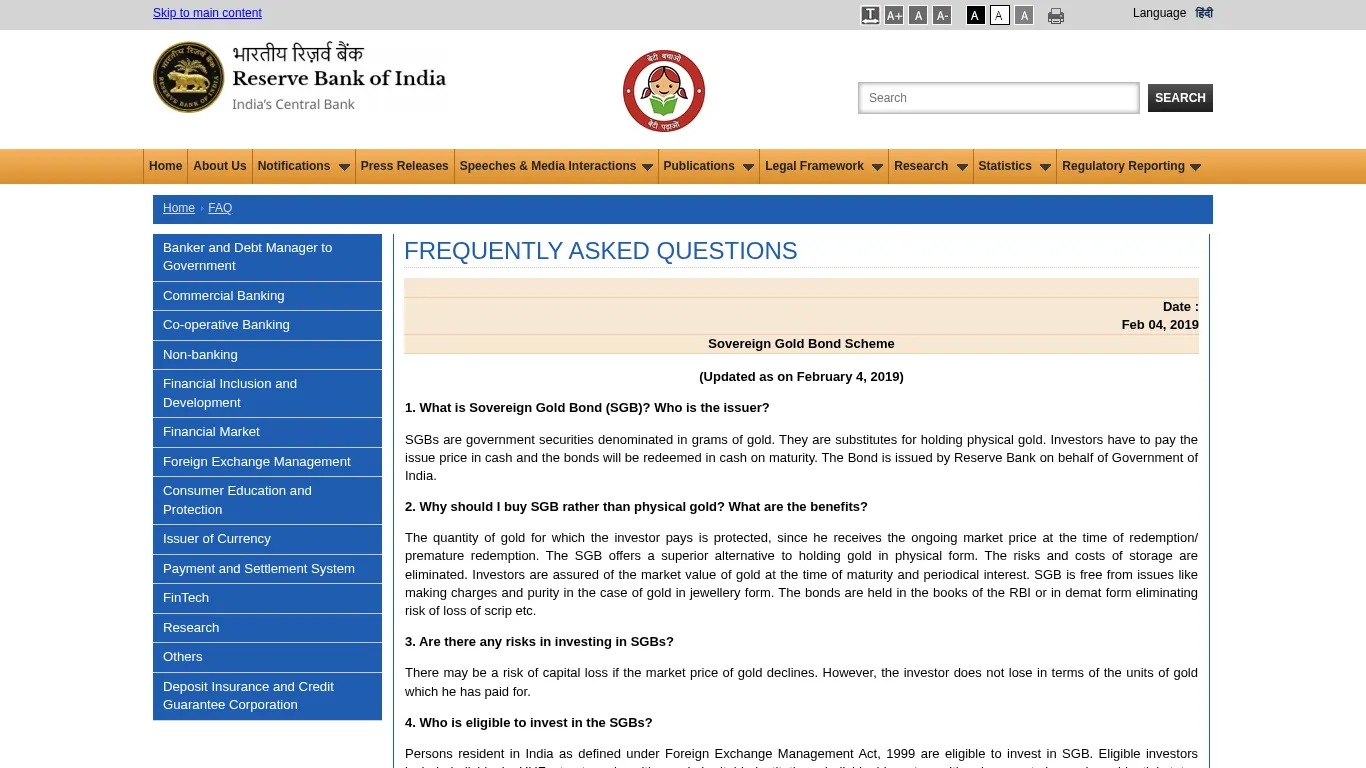
“SGBs carry a fixed interest rate of 2.50% per annum (paid semi-annually). Interest is taxable, but capital gains on redemption at maturity for individuals are exempt.” – Source
Option 5 – Digital gold (vault-backed, app-based)
What it is and how it works
-
Buy fractional 24K gold online while the provider stores equivalent insured bullion with accredited custodians.
-
Get real-time pricing, buy/sell anytime, and optionally request doorstep delivery of coins/bars (delivery and making/handling fees may apply).
Pros
-
Lowest entry barrier – start from ₹1 via UPI; no Demat account and no long KYC delays beyond basic checks.
-
Encourages habit-building via micro-investing and gamified rewards; effortless gifting to friends and family.
Considerations
-
Not a SEBI-regulated security. Choose platforms working with RBI-compliant, audited, insured-vault partners. Read T&Cs for storage fees, buy–sell spreads, and redemption/delivery rules.
Where OroPocket fits (fair, strategic view)
-
For first-time and small-ticket investors who value convenience and rewards: instant UPI buys, daily streaks, referrals, and unique Bitcoin cashback on every purchase.
-
For regular accumulators who want automation, transparent vaulting, and the ability to gift or send gold seamlessly.
How to start
-
Download the OroPocket app, complete KYC, link UPI, and begin with ₹1. Set daily/weekly streaks or SIP-like schedules and enable gifting for family and friends.
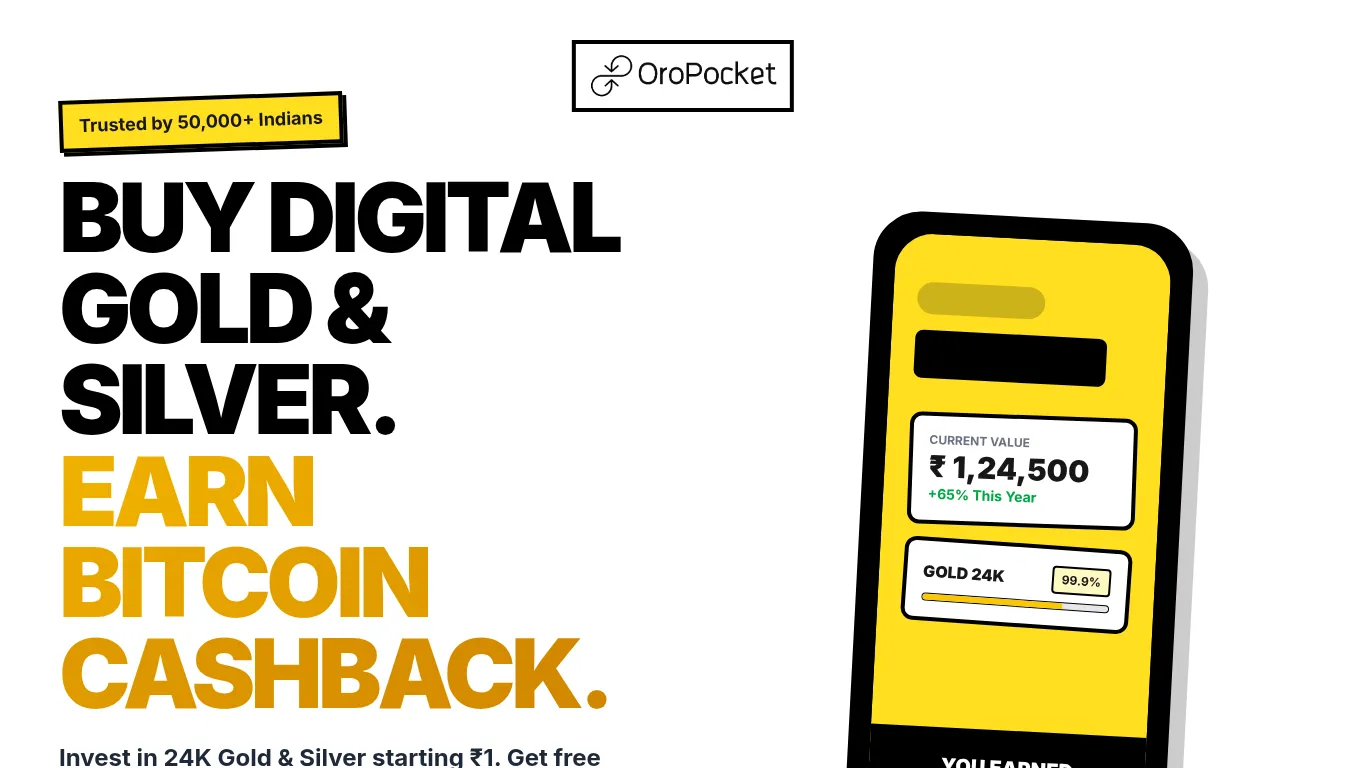
“India’s digital gold transactions nearly tripled in value in 2025, reflecting rapid adoption via online platforms, especially among younger investors.” – Source
“SEBI has cautioned that ‘digital gold’ products offered by unregulated entities are not under its purview; investors should verify custodianship, vaulting, and insurance.” – Source
Costs, liquidity, and taxes – side‑by‑side
What you really pay
-
Visible fees: expense ratios (ETFs/FoFs), brokerage and statutory charges, SGB issue/redemption mechanics, app convenience/storage/delivery fees for digital gold.
-
Hidden drags: bid–ask spreads, tracking error (ETFs/FoFs), premiums/discounts to NAV (ETFs) or to gold value (SGBs on exchange), exit loads (some FoFs).
Liquidity reality check
-
T+ settlement timelines on exchanges; market hours trading for shares/ETFs vs 24×7 in-app for digital gold.
-
SGBs can be sold on exchanges (depth varies) or redeemed early only on coupon dates from year 5.
-
Digital gold physical delivery has manufacturing/logistics timelines if you opt to take coins/bars.
Taxes (current rules overview – not advice)
-
ETFs/FoFs: LTCG typically 12.5% beyond respective holding periods (ETFs >12 months; FoFs >24 months); STCG taxed per slab.
-
SGB: interest taxed as per slab; capital gains at maturity exempt (as per prevailing rules).
-
Digital gold: generally treated similar to physical gold for capital gains; confirm specifics with a tax advisor.
|
Route |
Fees (ongoing/one-time) |
Liquidity speed |
Exit frictions |
Typical taxes |
Operational caveats |
|---|---|---|---|---|---|
|
Shares (Gold miners) |
Brokerage, STT/stamp duty; FX conversion fees if buying overseas; no fund expense |
Intraday trading during market hours; T+ settlement |
Equity‑like volatility; wider spreads in smaller names |
Equity tax rules for listed shares; foreign equity may differ |
Company risk (AISC, hedging, execution), commodity/currency/geopolitics; not a pure gold tracker |
|
Gold ETFs |
Ongoing expense ratio; brokerage, exchange charges; small bid–ask spread |
Intraday during market hours; T+ settlement |
Premium/discount to NAV in thin markets |
LTCG ~12.5% >12 months; STCG per slab (prevailing rules) |
Tracking error vs domestic gold price; requires Demat/trading account |
|
Gold Mutual Funds (FoFs) |
FoF expense + underlying ETF expense; possible exit load |
End‑of‑day NAV; standard MF T+ timelines |
No intraday exit; exit load if redeemed early (scheme‑specific) |
LTCG ~12.5% >24 months; STCG per slab (prevailing rules) |
Double‑layer fees; tracking depends on underlying ETF; no Demat needed |
|
SGBs |
No making/storage; occasional online issue discount; no brokerage at issue |
Exchange trading (depth varies); early redemption only on coupon dates from year 5; 8‑yr maturity |
Lock‑in risk; may trade at discount/premium on exchange |
Interest taxed per slab; capital gains at maturity exempt (as per rules) |
Government‑backed; price risk remains; secondary liquidity can be patchy |
|
Digital Gold (app‑based) |
Buy–sell spread; storage/maintenance per provider; delivery/making fees for coins/bars |
24×7 in‑app buy/sell; bank credit timelines for withdrawals |
Platform downtime/limits; delivery timelines if taking physical |
Generally similar to physical gold; verify with advisor |
Not SEBI‑regulated; counterparty/custodian considerations; verify vault insurance and audits |
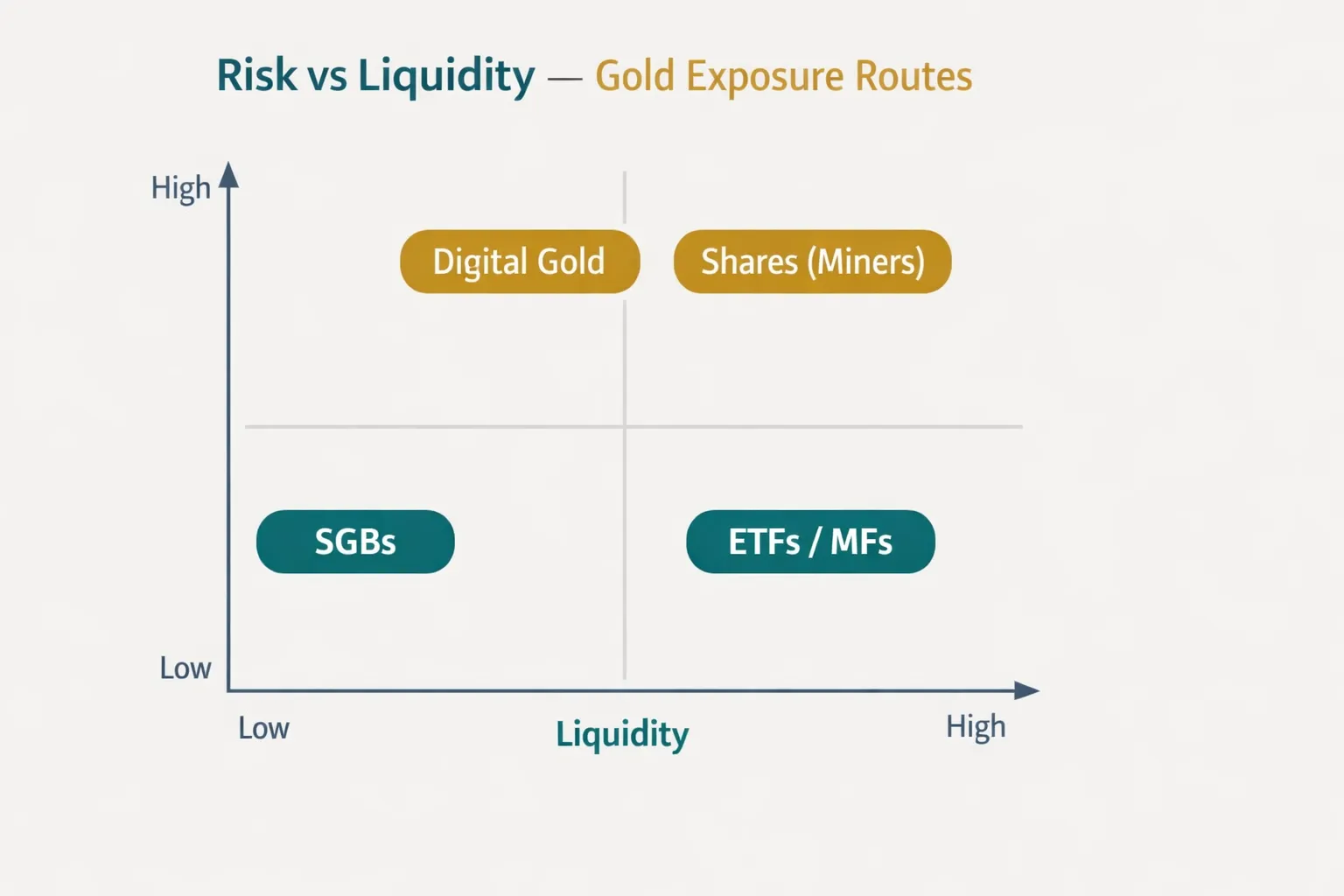
Risks decoded: pick the right route for your goal
Key risks by route
-
Miners: Equity-like swings, management and geopolitical risks; performance can diverge from spot gold.
-
ETFs/FoFs: Tracking error and expense drag; liquidity only during market hours.
-
SGBs: 8-year tenor; early-exit pricing depends on secondary market; interest is taxable.
-
Digital gold: Counterparty/operational risks; understand storage fee policies and delivery rules.
Match route to goal
-
Pure price tracking: ETFs/FoFs or SGBs (for long horizons).
-
Income + gold exposure: SGBs (semi-annual interest).
-
High-risk growth tilt: Miners or miners ETFs.
-
Micro-savings + instant liquidity: Digital gold apps.
Allocation tips
-
Keep total gold exposure within a prudent band that suits your risk tolerance; start small and scale gradually.
-
Rebalance annually to lock gains and maintain your target mix.
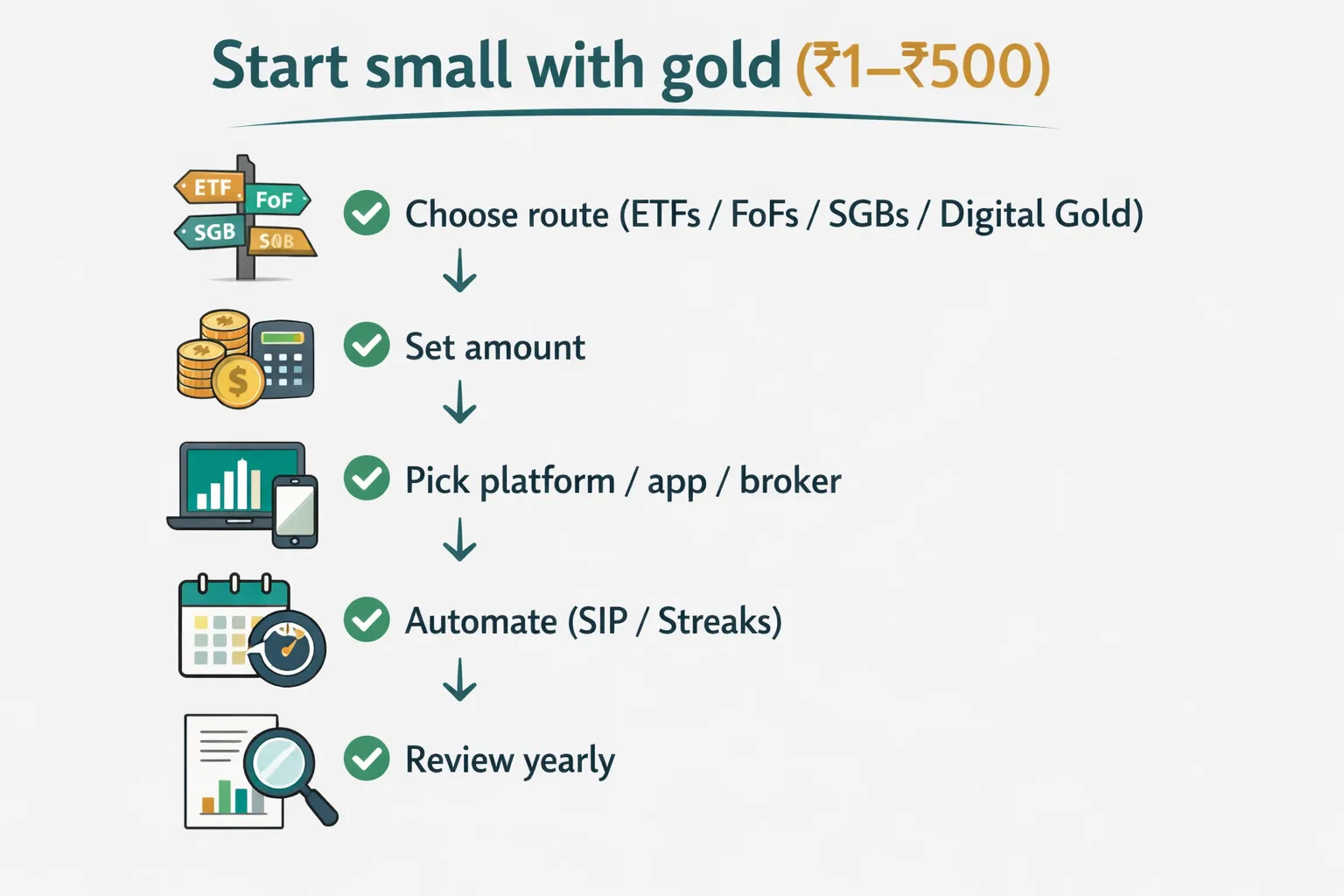
Step-by-step: Start with tiny amounts (₹1–₹500)
If you prefer gold funds (no Demat):
-
Pick a Gold FoF on your MF app and start a ₹500 SIP; set auto-debit via UPI for discipline.
If you have a Demat:
-
Choose a low-cost Gold ETF; set a monthly stock SIP; review tracking error and AUM periodically.
If you want government-backed exposure:
-
Track RBI SGB tranches via your bank/broker; subscribe online to avail the issue price discount.
If you want the simplest on-ramp (₹1 via UPI):
-
Download OroPocket → complete KYC → add UPI → buy gold in 30 seconds.
-
Turn on streaks and SIP-like schedules; gift gold easily; earn Bitcoin cashback on every purchase.
Which one should you choose? (Final verdict)
Quick recommendations by profile
-
First-time investor with ₹1–₹2,000/month: Choose digital gold via OroPocket to build the habit fast with UPI ease, daily streaks, gifting, and Bitcoin rewards on every purchase.
-
Long-term (5–8 yrs) and tax efficiency: Sovereign Gold Bonds (SGBs) for the 2.5% interest and tax-exempt capital gains at maturity (as per current rules).
-
Liquidity + transparency with market access: Gold ETFs for pure price exposure, intraday liquidity, and clear expense ratios.
-
No Demat and SIP comfort: Gold FoFs (fund-of-funds) to start SIPs from ₹500 and use MF features like STP/SWP.
-
High-risk/return tilt: Gold miner ETFs/stocks as a small satellite for amplified upside – and downside.
Sensible next steps
-
Start small, automate contributions (SIPs/streaks), and review total fees yearly.
-
Keep documents handy (CAS, contract notes, SGB certificates); understand exit timelines and liquidity constraints.
-
Diversify routes if needed – combine SGBs (long-term) with ETFs (liquidity) or digital gold (micro-savings).
CTA
-
Download the OroPocket app to start with ₹1 and earn Bitcoin on every purchase: https://oropocket.com/app