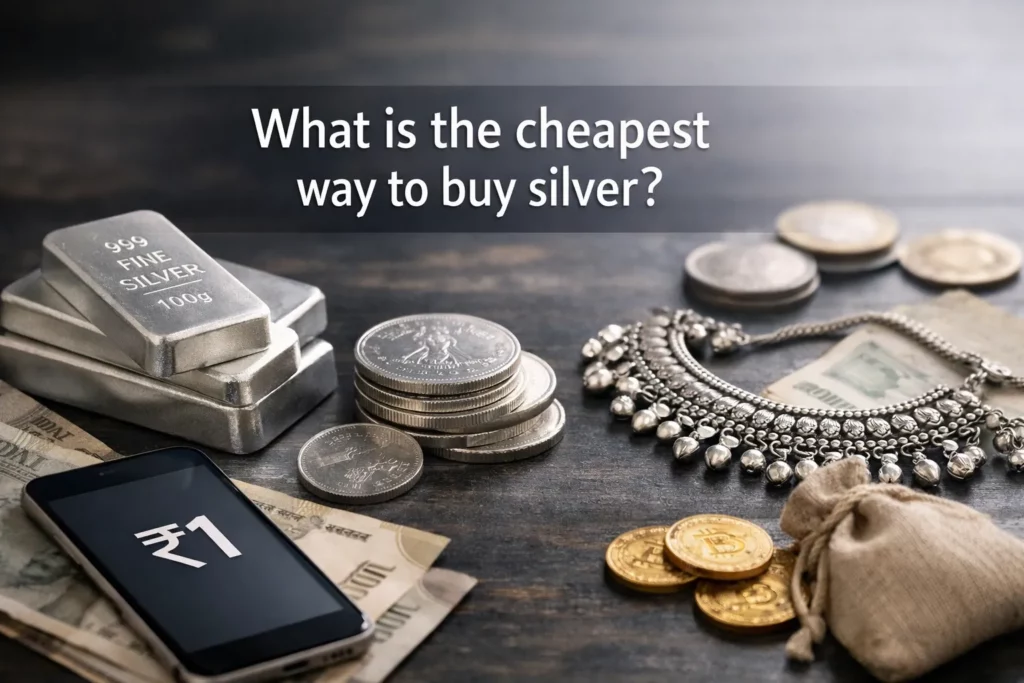
What is the cheapest way to buy silver?

Cheapest Way To Buy Silver In India (2026): Start Here
“Industrial demand for silver reached ~680.5 million ounces in 2024.” – Source
What “cheapest” really means (hint: total cost of ownership, not just price/gram)
“Cheapest” isn’t about today’s lowest sticker price. It’s about what you pay across the full journey – from buy to sell.
All-in cost = Spot price + premium + taxes + platform/broker fees + storage + buy-sell spread − rewards/benefits
-
Premium: The markup over spot (higher on small coins/jewellery, lower on larger bars/ETFs/digital).
-
Taxes: Physical silver attracts 3% GST; jewellery also has making charges (often with 5% GST on making).
-
Fees: Brokerage/DP for ETFs, platform fees for digital, locker cost for physical.
-
Spread: The difference between buy price and sell price – this is your “friction” on exit and it matters more than a one-time discount.
-
Rewards: Cashbacks, loyalty tiers, and bonus benefits reduce your effective net cost. With OroPocket, you earn free Bitcoin (Satoshis) on every silver purchase – bringing down your effective acquisition cost further.
Why liquidity and exit spreads trump “today’s lowest price”: If you can’t sell back quickly at a fair spread, your net returns suffer. Prioritize platforms and products with tight spreads and reliable liquidity.
The quick answer
-
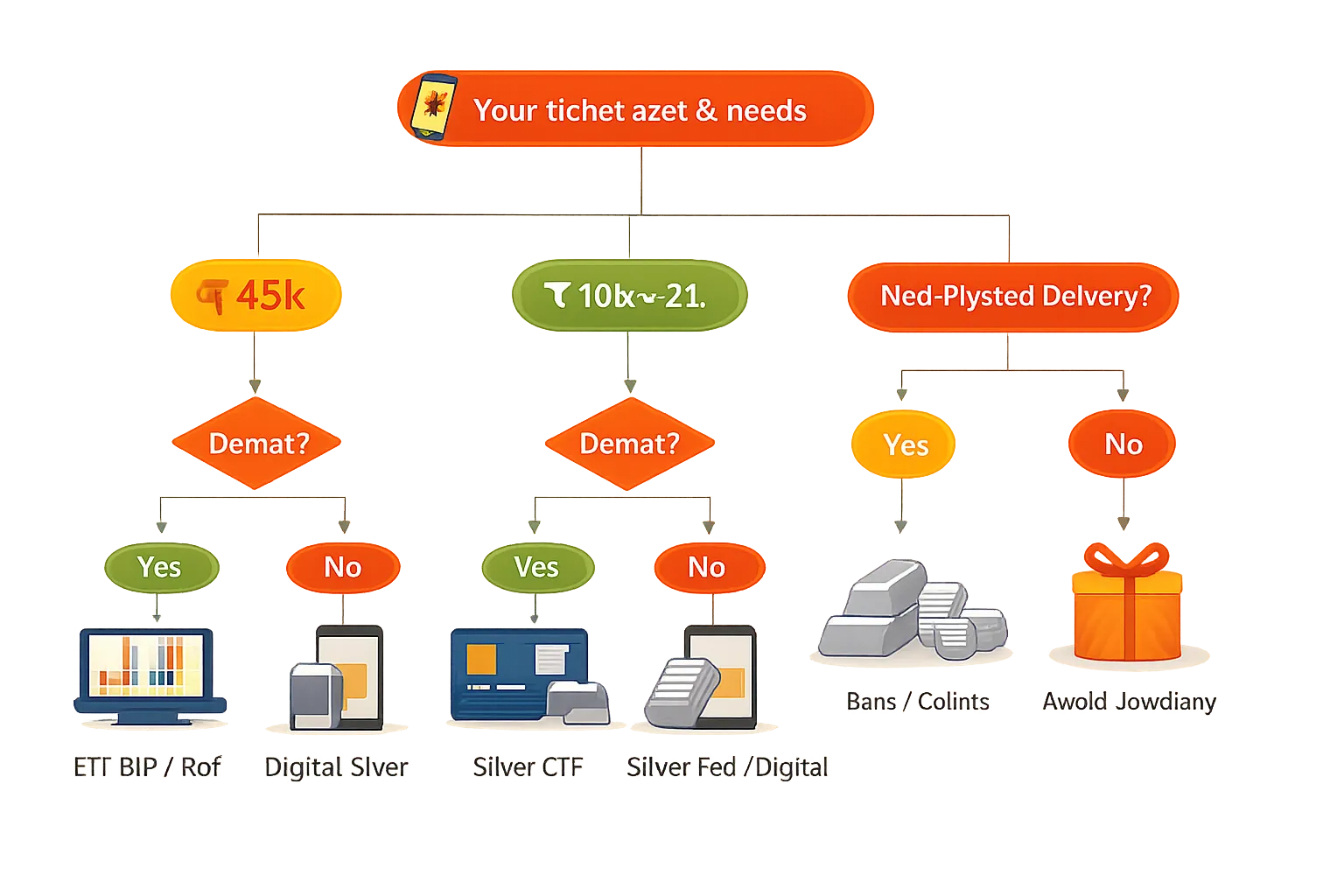
Small tickets (<₹5,000): Digital silver with low/zero making charges plus rewards is often the lowest effective cost. On OroPocket, you can start from ₹1, pay via UPI in seconds, and earn Bitcoin cashback – so your net price per gram can be meaningfully lower after rewards.
-
Mid tickets (₹10,000–₹2,00,000): Silver ETFs frequently win on total cost if you already have a demat. Expense ratios are low, purity is standardized (99.9%), and spreads on exchanges can be competitive. Factor in brokerage and DP charges.
-
Gifting/rituals: Bars/coins make sense (accept the 3% GST and premium). To reduce cost, prefer larger denominations (lower premium/gram), buy from reputable LBMA-accredited partners, and check verified buyback policies.
How to compare apples-to-apples in 2 minutes
-
Check the premium over spot, the GST implication, and the sell-back spread.
-
Add recurring costs (expense ratios, locker, platform fees) and subtract rewards/cashback.
-
Decide based on your ticket size and planned holding period:
-
Short-term or frequent rebalancing: prioritize liquidity and tight spreads (ETFs or high-liquidity digital platforms).
-
Long-term and gifting: consider bars/coins in larger sizes to lower per-gram premiums.
-
Ready to start with low effective cost and instant UPI payments – plus free Bitcoin on every silver buy? Download the OroPocket app: https://oropocket.com/app
All The Ways To Buy Silver In India – Ranked By All‑In Cost
“SEBI’s Framework for Silver ETFs (2021) requires Silver ETFs to invest in physical silver (99.9% purity) and hold metal with a custodian.” – Source
The buying routes
-
Digital silver (app-based, vaulted)
-
Silver ETFs (exchange-traded; 99.9% purity backing)
-
Silver FoFs (mutual funds of silver ETFs; SIP-friendly)
-
Physical bullion (bars/coins)
-
Jewellery (high making charges; buy for tradition, not returns)
-
Futures (speculative; not for buy‑and‑hold investors)
Our ranking method
-
Weigh entry premium, ongoing fees, taxes, liquidity/spread, and rewards
-
Ticket-size sensitivity and holding period assumptions
Where each route tends to be cheapest
-
Micro buys: digital with rewards
-
Portfolio allocation: ETFs/FoFs
-
Tangible/gifting: bars over jewellery
Quick pros/cons snapshot
-
Convenience: Digital and ETFs score high; jewellery is lowest
-
Purity assurance: ETFs/FoFs (99.9%) and reputed bullion brands are strong
-
Regulation: ETFs/FoFs are SEBI-regulated; digital is platform-driven
-
Vaulting: Digital and ETFs have professional custody; physical needs your own storage
-
Demat need: Required for ETFs; not for digital/physical
-
Redemption options: Digital often allows sell-back or physical redemption; ETFs sell on exchange; physical via jeweller/buyback
Planning to start with micro-tickets and keep your effective cost low – while earning free Bitcoin on every silver buy? Download the OroPocket app: https://oropocket.com/app
What Really Makes Silver ‘Cheap’: Premiums, GST, Spreads, Storage & Liquidity
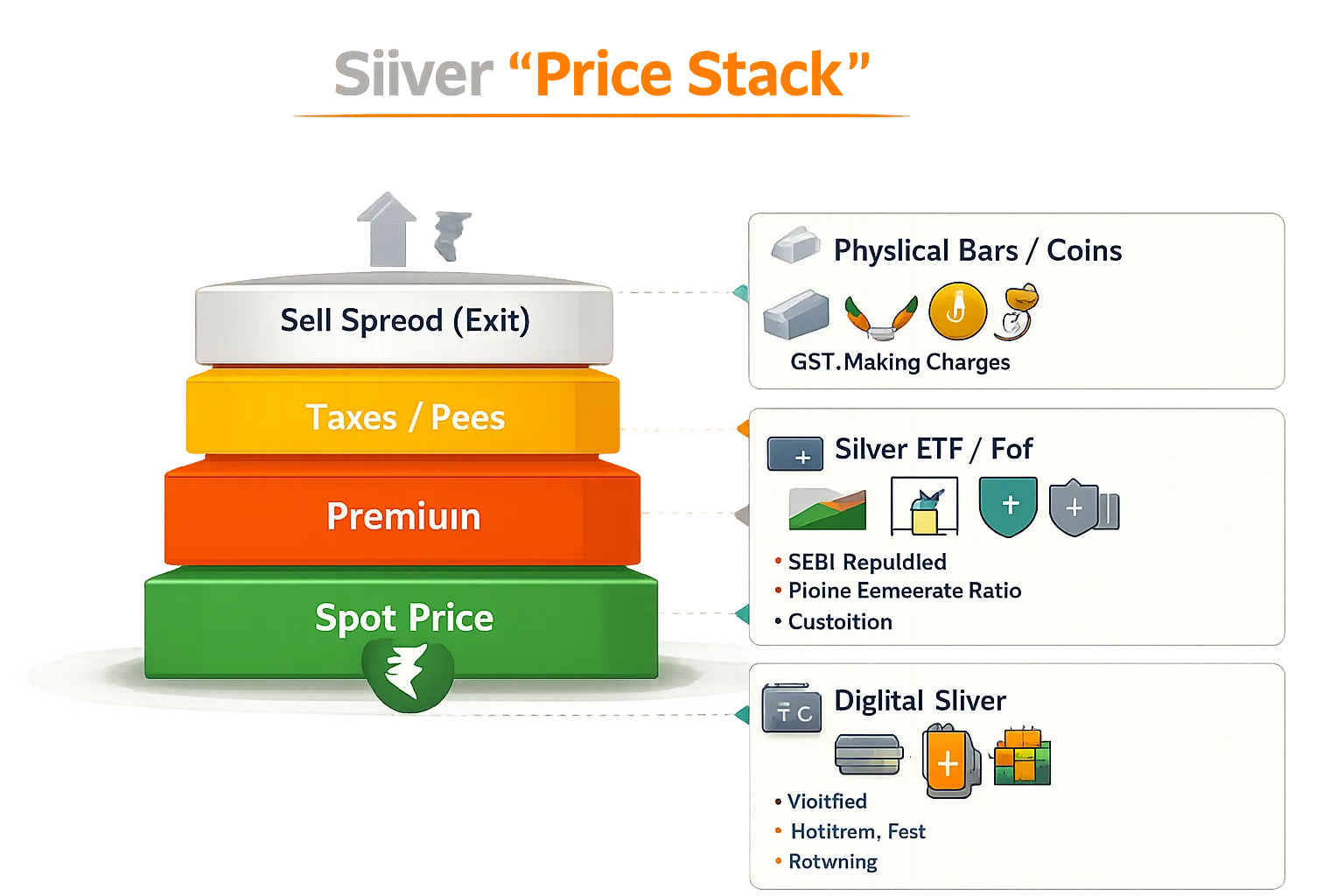
Price stack explained
-
Spot price vs premium: Spot reflects global market pricing. Premium covers minting/manufacturing, distribution, brand, and logistics. It’s lowest on larger bars/ETFs/digital; highest on jewellery and tiny denominations.
-
Taxes: Physical silver attracts 3% GST (jewellery also has making charges where 5% GST applies on the making component). ETFs/FoFs don’t levy GST on units; some platform/brokerage/DP charges may include GST.
-
Platform/brokerage/expense ratios:
-
ETFs/FoFs: brokerage + DP + expense ratio.
-
Digital: platform fee/spread; some charge nominal storage.
-
Physical: making/assay costs for jewellery; shipping/insurance for delivery.
-
The silent killer: sell-back spread and liquidity
-
A low entry price can be wiped out by a wide exit spread. If you can’t sell quickly at a fair price, your effective cost balloons.
-
Spread drivers by route:
-
Digital: varies by platform depth and live quotes; best-in-class apps keep tight two-way prices.
-
ETFs: market depth on NSE/BSE, tracking difference, and intraday liquidity impact spreads.
-
FoFs: redeem at fund NAV; exit load windows may apply.
-
Physical bars/coins: jeweller buyback policies, assay needs, and brand recognition drive spreads.
-
Jewellery: high making charges rarely recovered on resale; spreads are widest.
-
Futures: bid-ask can be tight, but leverage and expiry/roll costs make it unsuitable for buy-and-hold.
-
Storage, insurance, and security
-
Self-custody (physical) = locker fees, insurance, and theft risk.
-
Vaulted custody (digital/ETF/FoF) = professional storage with insurers and custodians; costs embedded via fees/spreads/expense ratios.
Calculate your effective cost in seconds
-
Checklist to compare two offers:
-
Premium over spot today
-
GST or taxes at purchase
-
Brokerage/platform/DP/expense ratio
-
Estimated sell-back spread and liquidity
-
Storage/locker or vaulting charges
-
Rewards/cashback reducing your net cost
-
-
Choose based on ticket size and how soon you’ll sell: micro tickets + rewards favor digital; structured allocation favors ETFs/FoFs; gifting favors bars over jewellery.
All-in Cost Components by Route
|
Route |
Entry Premium |
Taxes (incl. GST applicability) |
Ongoing Costs (locker/expense ratio/platform) |
Exit Spread & Liquidity |
Typical Minimum Ticket |
Notes |
|---|---|---|---|---|---|---|
|
Digital silver |
Low–moderate; varies by platform |
No GST on units; platform fees may include GST |
Platform/storage fees embedded or nominal |
Generally tight on leading apps; instant sell-back |
Start from ₹1–₹100 |
Vaulted, insured; rewards/cashback can lower net cost |
|
Silver ETF |
Low; tracks spot with small premium |
No GST on units |
Expense ratio + brokerage/DP |
Good, depends on market depth; intraday liquidity |
1 unit (demat needed) |
SEBI-regulated; 99.9% purity backing via custodian |
|
Silver FoF |
Moderate (FoF layer over ETF) |
No GST on units |
Expense ratio (FoF + underlying) |
Redeem at NAV; lower intraday liquidity |
SIP-friendly (₹100–₹500+) |
No demat needed; convenient for SIPs |
|
Physical bars/coins |
Moderate; lower on larger bars |
3% GST on silver; delivery/insurance extra |
Locker/insurance if self-stored |
Variable; depends on brand and buyback |
Typically gram-based; higher for reputable brands |
Prefer LBMA-linked brands; check buyback/assay policy |
|
Jewellery |
High due to making charges/design |
3% GST on metal + 5% GST on making |
Locker/cleaning/maintenance |
Wide spreads; making charges rarely recovered |
Varies by piece |
Buy for tradition/usage, not returns |
|
Futures |
Low trading costs but leveraged |
No GST on contract; brokerage/charges apply |
Daily MTM/margins, rollover costs |
Exchange liquidity ok; risk of slippage |
Exchange margin requirements |
Speculative; unsuitable for long-term holding |
Summary
The “cheapest” route isn’t static. For micro amounts and frequent buys, digital with rewards can beat others on effective cost. For portfolio allocation with a demat, ETFs often win. For tangible gifting, larger bars minimize premiums versus jewellery. Choose the path that fits your ticket size, holding period, and need for quick, fair exits.
Start stacking silver the modern way – buy from ₹1 via UPI and earn free Bitcoin on every purchase. Download the OroPocket app: https://oropocket.com/app
Bars vs Coins vs ETFs vs Digital: Break‑Even Scenarios (By Ticket Size)
When bars beat coins
-
Lower per‑gram premium on standard weights (e.g., 100g, 1kg) compared to small coins.
-
Brand recognition and simple designs typically mean tighter buyback spreads.
-
Designer/collectible coins carry higher premiums you rarely recover at resale.
When ETFs beat physical
-
No GST on purchase of units; purity and custody handled by SEBI‑registered parties.
-
Ongoing cost is mainly the TER; spreads on NSE/BSE are often tight due to liquidity.
-
Ideal for portfolio allocation and SIP‑style accumulation if you already have a demat.
When digital wins
-
No making charges; vaulting is built‑in.
-
Micro‑investing friendly (start from ₹1 on OroPocket via UPI).
-
Rewards/cashback can offset platform fees and reduce your net effective cost. OroPocket adds free Bitcoin (Satoshis) on every silver buy.
Holding period sensitivity
-
Short holds: Prioritize tight buy‑sell spreads and low exit friction (ETFs, high‑liquidity digital).
-
Long holds: One‑time premiums (bars) may be preferable to ongoing TER; digital rewards can compound via streaks/cashback.
-
Demat availability, ticket size, and gifting needs tilt the decision.
Example walk‑through
-
Effective entry price (per gram):
-
Entry_effective = Spot × (1 + Premium%) + Taxes/Fees − Rewards
-
-
Expected exit proceeds (per gram):
-
Exit_effective = Spot_exit × (1 − Sell_Spread%) − Exit_Fees
-
-
Breakeven return needed:
-
Breakeven% ≈ Premium% + Taxes/Fees% + Ongoing_Costs% + Sell_Spread% − Rewards%
-
Use these to compare any two options side‑by‑side before you buy.
Ticket‑Size Matrix & Example Effective Cost
|
Ticket |
Digital (fees − rewards) |
ETF (brokerage + TER) |
FoF (TER + SIP flexibility) |
Physical Bars (premium + 3% GST) |
Coins/Jewellery (premium + making + GST) |
|---|---|---|---|---|---|
|
₹1k |
Entry: Spot × (1 + p_d) + fee_d − reward_d; Exit: ×(1 − s_d) |
Entry: Spot × (1 + p_m) + brokerage + DP; Ongoing: TER; Exit: spread_e |
Entry at NAV; Ongoing: TER_f (FoF + underlying); Exit: NAV/exit load |
Entry: Spot × (1 + p_b) + 3% GST; Exit: buyback spread_b |
Entry: Spot × (1 + p_c + making) + 3% GST (+5% on making); Exit: wide spread_c |
|
₹10k |
As above; rewards may meaningfully offset fees at this size |
Lower brokerage impact; TER dominates over time |
SIP convenience; slightly higher layered costs |
Premium improves with larger bar sizes; GST applies |
Premium and making remain relatively high |
|
₹1L |
Platform fees dilute; rewards still reduce net cost |
Tight spreads likely; TER becomes key driver |
Similar to ETF but with FoF layer; good for SIP discipline |
Best per‑gram premium on standard bars; GST still applies |
High design/making costs; poor recovery at resale |
|
Formula row |
Entry_effective = Spot × (1 + p_d) + Fee_d − Reward_d; Exit_effective = Spot_exit × (1 − s_d) − Exit_fee_d |
Entry_effective = Spot × (1 + p_m) + Brokerage + DP; Total_cost ≈ TER + spreads |
Total_cost ≈ TER_f + underlying TER + exit policy |
Entry_effective = Spot × (1 + p_b) + 3% GST; Exit: Spot_exit × (1 − spread_b) − assay |
Entry_effective = Spot × (1 + p_c + making) + 3% GST (+5% on making); Exit: Spot_exit × (1 − spread_c) − charges |
-
p_d/p_m/p_b/p_c = premium components; s_d = digital sell spread; spread_e/b/c = exit spreads.
Want the lowest effective cost for micro to mid‑tickets – plus free Bitcoin on every silver purchase? Start with OroPocket. Buy from ₹1 via UPI in under 30 seconds. Download the app: https://oropocket.com/app
How To Buy Physical Silver Cheaper In India (Bars, Coins, Jewellery)
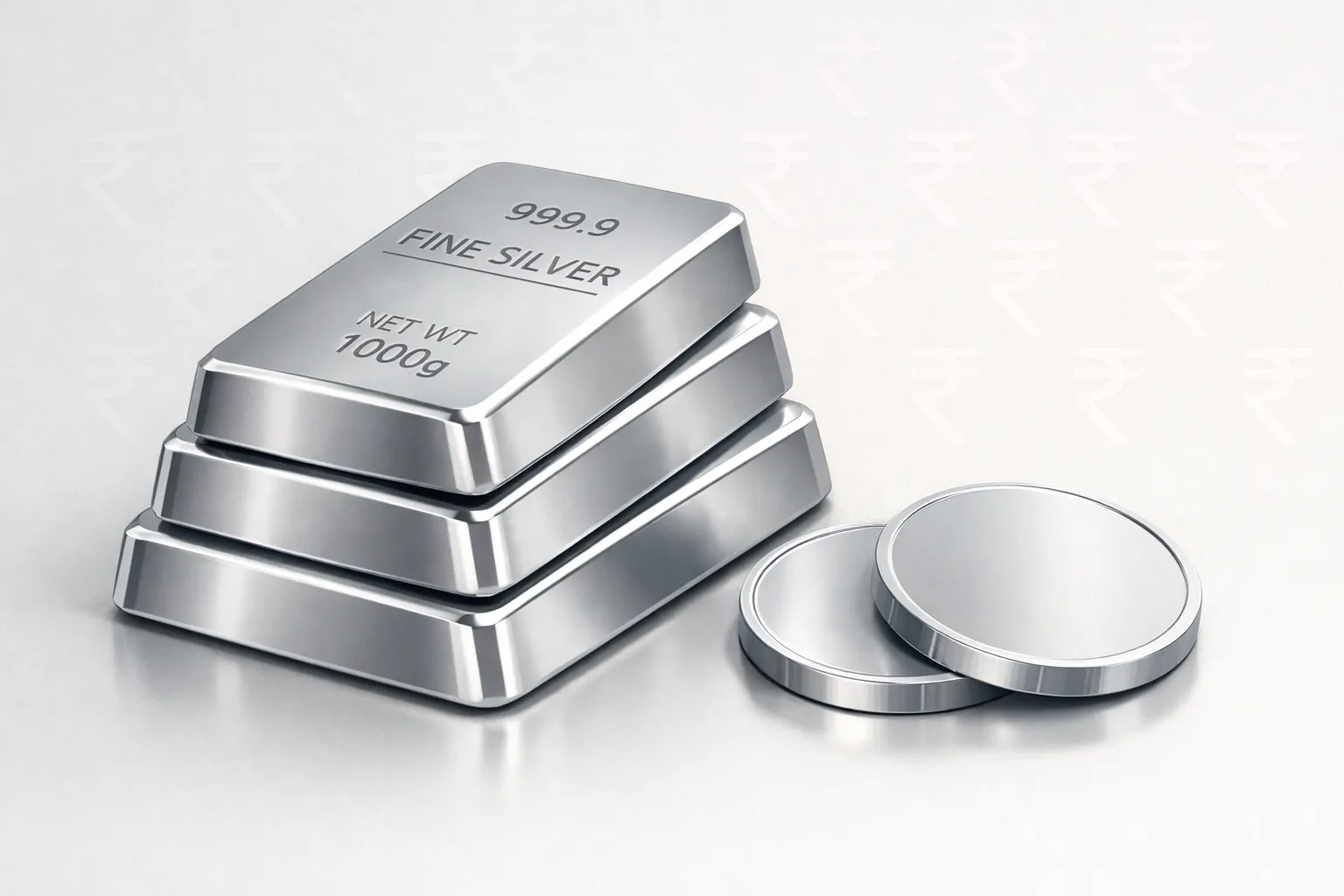
Reduce premiums up front
-
Prefer standard-weight bars (e.g., 100g, 250g, 1kg) over fancy coins or jewellery – lower per‑gram premiums and tighter buyback spreads.
-
Compare LBMA‑accredited or reputed refinery brands; pick simple, non‑collectible designs to avoid paying for aesthetics you won’t recover at resale.
Purity and paperwork
-
Look for 999 or 999.9 purity markings and proper assay certificates/hallmarks.
-
Always retain invoices with quantity, purity, and GST details – many buyers require this for buyback and it strengthens your resale price.
Storage and security
-
Decide between a bank locker (recurring fee) and insured home storage (safe + insurance rider).
-
Keep items in tamper‑evident packaging; avoid frequent handling to reduce assay disputes at resale.
Smart selling
-
Check buyback terms and spreads before you purchase: brand acceptance, assay requirements, deductions, and timelines.
-
Avoid distress selling. If possible, sell to the same brand’s outlet or a reputed bullion dealer that honors transparent, real‑time pricing.
When physical makes sense
-
Ideal for gifting, rituals, heirlooms, or when you specifically want tangible assets.
-
For investment-led purchases, prefer larger bars to minimize premiums and confirm clear buyback policies.
Want to stack silver digitally first (from just ₹1), then convert to physical later – and earn free Bitcoin on every buy? Download OroPocket: https://oropocket.com/app
Silver ETFs & Silver FoFs: Costs, Demat, Tracking Error, Tax
Silver ETFs
-
What they are and how they track price:
-
Silver ETFs aim to mirror domestic silver prices by holding 99.9% purity physical silver in custodian vaults. Prices move with live market quotes, adjusted for fund expenses and cash positions.
-
Liquidity is on NSE/BSE; you buy/sell units during market hours like a stock.
-
-
Costs you pay:
-
Brokerage and DP charges (applies to each buy/sell).
-
TER (Total Expense Ratio) deducted within the fund; shows up as tracking difference vs spot.
-
Potential premium/discount to iNAV due to intraday demand/supply.
-
-
Tracking difference and volatility:
-
Returns may deviate from spot due to TER, cash balances, and operational costs. Intraday volatility and spreads can widen in low-volume periods.
-
-
Demat requirement and execution tips:
-
You need a demat and trading account.
-
Use limit orders to avoid paying the widest spread.
-
Trade during peak liquidity (mid‑session), watch the bid‑ask and volumes.
-
Prefer larger, more liquid ETFs; check historical tracking difference and AUM.
-
Avoid chasing gap‑ups/gap‑downs at the open/close; align orders near iNAV if disclosed.
-
Silver FoFs
-
What they are:
-
A mutual fund that invests primarily in an underlying Silver ETF – giving you ETF exposure without a demat.
-
SIP‑friendly; units are allotted at end‑of‑day NAV (no intraday trading).
-
-
Costs you pay:
-
Typically higher all‑in TER than buying the ETF directly (FoF layer + underlying ETF costs).
-
Exit load may apply for short holding periods (check scheme documents).
-
No brokerage/DP since there’s no exchange trade; but platform/AMC transaction charges may apply via your distributor/app.
-
-
Practical trade‑offs:
-
FoFs simplify SIPs and automate allocations, but you give up intraday execution and may accept slightly higher cost versus a direct ETF.
-
Tax snapshot (as of 2024–26)
-
Silver ETFs:
-
STCG (held ≤ 12 months): taxed as per your income tax slab.
-
LTCG (held > 12 months): 12.5% plus applicable surcharge & cess.
-
-
Silver FoFs:
-
STCG (held ≤ 24 months): taxed as per your income tax slab.
-
LTCG (held > 24 months): 12.5% plus applicable surcharge & cess.
-
-
Always verify the latest rules before investing, and consult a tax advisor for your situation.
Prefer micro‑investing without demat – and want rewards that cut your effective cost? Buy digital silver on OroPocket from ₹1 via UPI and earn free Bitcoin on every purchase. Download the app: https://oropocket.com/app
Digital Silver: Can It Be The Cheapest? What To Check (And How OroPocket Stands Out)
Due diligence checklist
-
Purity and custody: Confirm 99.9%+ purity, identify the vaulting partner, check insurance coverage and third‑party audit frequency.
-
Pricing and transparency: Live two‑way quotes, clearly disclosed platform/storage fees, and an unambiguous redemption/buyback policy.
-
Operational trust: Track record of on‑time settlements, customer grievance options, and clear T&Cs on spreads and redemption thresholds.
Regulation & risk
-
Digital silver isn’t uniformly regulated in India. Reduce risk by choosing platforms operating with RBI‑compliant practices, authorized bullion partners, and 100% insured custody with reputed vaults.
Where digital shines
-
Micro‑investing from small tickets without making charges.
-
UPI‑native convenience with near‑instant settlement windows.
-
App‑based liquidity with visible buy/sell prices and low friction.
Why OroPocket is different
-
Start from ₹1 via UPI in under 30 seconds – no paperwork, no demat.
-
Earn free Bitcoin (Satoshis) on every silver purchase; daily streaks and spin‑to‑win boost your rewards, lowering your effective cost.
-
RBI‑compliant operations with authorized bullion partners and 100% insured vaults.
-
Mobile‑first experience on iOS and Android with gifting and instant sell‑back.
Ready to try the lowest‑friction way to stack silver – plus free Bitcoin on every buy? Download OroPocket: https://oropocket.com/app
Playbook: Get The Lowest Effective Price On OroPocket (Step‑By‑Step)
Step 1: Set your ticket size and cadence
-
Use micro-buys (₹1–₹500) to build streaks and unlock habit bonuses without overcommitting.
-
Switch to higher tickets on bonus or promo days when rewards are boosted, so the same rupee buys you more net value.
-
Align buys to times with tighter spreads (typically high-liquidity hours) for a better effective entry.
Pro tip: Turn on notifications so you don’t miss streak continuation windows or limited-time boosts.
Step 2: Max your Bitcoin rewards
-
Understand the tiered cashback structure: higher tiers = more Satoshis per rupee.
-
Cluster larger purchases when you qualify for a higher tier (or when a temporary boost is live).
-
If you’re close to a higher tier, add a small top‑up to cross the threshold before placing a big order.
Pro tip: Rewards are an instant reduction in your net effective cost – treat them like a “discount” you’ve earned for smart timing.
Step 3: Stack gamified boosts
-
Maintain 5‑day streaks to unlock bonus rewards. Use micro-buys to keep streaks alive on light days.
-
Spin to Win daily for a chance at extra Satoshis or gold bonuses. Use spins before placing your main buy.
-
Combine streak bonuses + spins + tiered cashback for the tightest effective cost.
Pro tip: Plan your weekly cadence (e.g., four micro-buys + one larger buy on the day you expect the best boost).
Step 4: Refer a friend strategically
-
Earn 100 Satoshi + a free spin when your friend joins with your referral.
-
Time referrals just ahead of your larger buys to apply the extra spin/bonus the same day.
-
Encourage your referrals to start their own streaks – mutual activity can unlock more frequent boosts.
Pro tip: Batch referrals (e.g., during festivals or paydays) to stack additional spin outcomes before your monthly big ticket.
Step 5: Optimize exits
-
Track live spreads and avoid urgency exits whenever possible.
-
Prefer high‑liquidity hours for selling back to minimize the spread you pay.
-
If you plan to gift physically later, accumulate digitally first (to earn Bitcoin rewards), then check redemption fees/policies for timing your conversion.
Pro tip: Build a small buffer so you never have to sell during illiquid or volatile hours.
Worked example (formula)
-
Net effective cost = Buy Price − (Sats value + streak bonus + spin bonus + referral bonus) − (any promo)
-
Expanded:
-
Entry_effective = Silver Buy Price per gram − Total Bitcoin Rewards Value per gram − Promo Credits per gram
-
Total Bitcoin Rewards Value = Cashback Sats + Streak Bonus Sats + Spin Bonus Sats + Referral Sats (converted to ₹ at prevailing BTC/₹ reference)
-
Realized Effective Cost at Exit = Entry_effective × (1 + holding costs, if any) − Sell Spread − Exit Fees (if any)
-
How rewards reduce all‑in cost without touching the silver price:
-
The spot price and platform quote remain market‑driven.
-
Your rewards (Satoshis, bonuses, promos) are additive value that lowers your net outlay.
-
By timing buys for higher reward tiers and keeping streaks alive, you shift your effective price downward – especially on micro to mid‑ticket purchases.
Ready to put the playbook to work and buy silver at a lower effective cost – while earning free Bitcoin on every purchase? Download OroPocket now: https://oropocket.com/app
Taxes, Documentation & Quick FAQs (India 2026)
Taxes: fast refresher (verify latest rules)
-
Physical bars/coins
-
Purchase: 3% GST on silver; jewellery also carries GST on making charges.
-
Sale: Capital gains as per current rules; 12.5% LTCG if held beyond applicable period (no indexation as per latest Finance Act updates). STCG taxed per slab.
-
-
ETFs
-
Purchase: No GST on units; brokerage + DP + TER apply.
-
Tax: 12.5% LTCG after 12 months; STCG as per income tax slab; surcharge & cess extra.
-
-
FoFs
-
Purchase: No GST on units.
-
Tax: 12.5% LTCG after 24 months; STCG per slab; surcharge & cess extra.
-
-
Digital silver
-
Purchase: Platform/storage fees (if any) may include GST; no GST on the investment unit itself.
-
Tax: Capital gains per slab (STCG) or 12.5% LTCG beyond 24 months (verify current treatment and platform T&Cs).
-
-
Always verify the latest circulars and consult a tax advisor for your situation.
KYC & payments
-
PAN and basic KYC are standard; keep purchase invoices and statements for tax/reporting.
-
On OroPocket: instant UPI payments, mobile‑first onboarding, downloadable statements for record‑keeping.
Risk checklist
-
Purity & custody: Look for 99.9%+ purity, reputed vaulting partners/custodians, and insurance coverage.
-
Pricing hygiene: Check premiums over spot, platform fees, and especially sell‑back spreads/liquidity.
-
Product fit: Avoid leverage unless you fully understand futures, margins, and roll costs.
-
Documentation: Save invoices, contract notes, and statements; use FIFO consistently for your own records if applicable.
Who should pick what?
-
First‑timers: Digital silver micro‑buys + rewards for lowest friction and habit‑building.
-
Demat users allocating >₹10k: Silver ETF (intraday liquidity) or Silver FoF (SIP without demat).
-
Gifting/tradition: Physical bars over jewellery (lower premiums, better resale vs ornate pieces).
Have 2 minutes? Start with the simplest path – buy silver from ₹1 via UPI and earn free Bitcoin on every purchase. Download OroPocket: https://oropocket.com/app
Conclusion: The Cheapest Way To Buy Silver – Start Stacking Smart With OroPocket
The bottom line
-
“Cheapest” isn’t just today’s price/gram – it depends on your ticket size, taxes, spreads, and the rewards you capture.
-
For micro and habit‑building, digital silver with Bitcoin rewards often delivers the lowest effective net price – especially when you stack streaks and bonuses.
-
If you already have a demat and larger tickets, Silver ETFs can be the most cost‑efficient. For gifting and rituals, choose plain, standard‑weight bars over jewellery to minimize premiums.
Your next step
-
Download OroPocket, start with ₹1 via UPI, and earn free Bitcoin on every silver purchase. Build streaks, spin daily, and watch your effective cost drop while you stack real, securely vaulted precious metals.
Call to action: Download the OroPocket app now at https://oropocket.com/app