
What is the highest gold-to-silver ratio ever recorded?

Quick answer: the highest gold-to-silver ratio ever recorded
The headline number
-
The gold-to-silver ratio (GSR) hit its modern all-time high around 125–127:1 during the March 18–19, 2020 liquidity crunch.
-
Why the spike: global panic selling, a collapse in silver’s industrial demand expectations, and a flight to gold as a safe haven.
“On March 18, 2020, gold closed at $1,477.30 and silver at $11.74 – implying a gold-to-silver ratio of ~125.9:1, a modern record.” – Source
What “highest ever” really means
-
Intraday vs daily close: records can differ by source and whether they quote intraday highs or end-of-day closes.
-
Different data feeds (LBMA, CME/COMEX, Bloomberg) will show slightly different prints – but the story is the same: March 2020 marked the record extreme.
Why you should care (in 30 seconds)
-
High ratio = gold is expensive relative to silver; low ratio = silver is expensive relative to gold.
-
Extremes tend to mean-revert over time. That can inform tactical allocation tilts between gold and silver. Not advice, not guarantees – just a useful signal.
TL;DR
-
Highest recorded GSR: ~125–127:1 in March 2020. That’s the benchmark.
Ready to stack gold and silver the smart way – and earn free Bitcoin on every purchase? Download OroPocket now: https://oropocket.com/app
Gold-to-silver ratio 101: meaning, formula, and why it matters
What is the GSR?
The gold-to-silver ratio (GSR) tells you how many ounces of silver it takes to buy one ounce of gold. It’s a simple way to compare the relative value of the two metals at any moment.
How to calculate it (it’s simple)
-
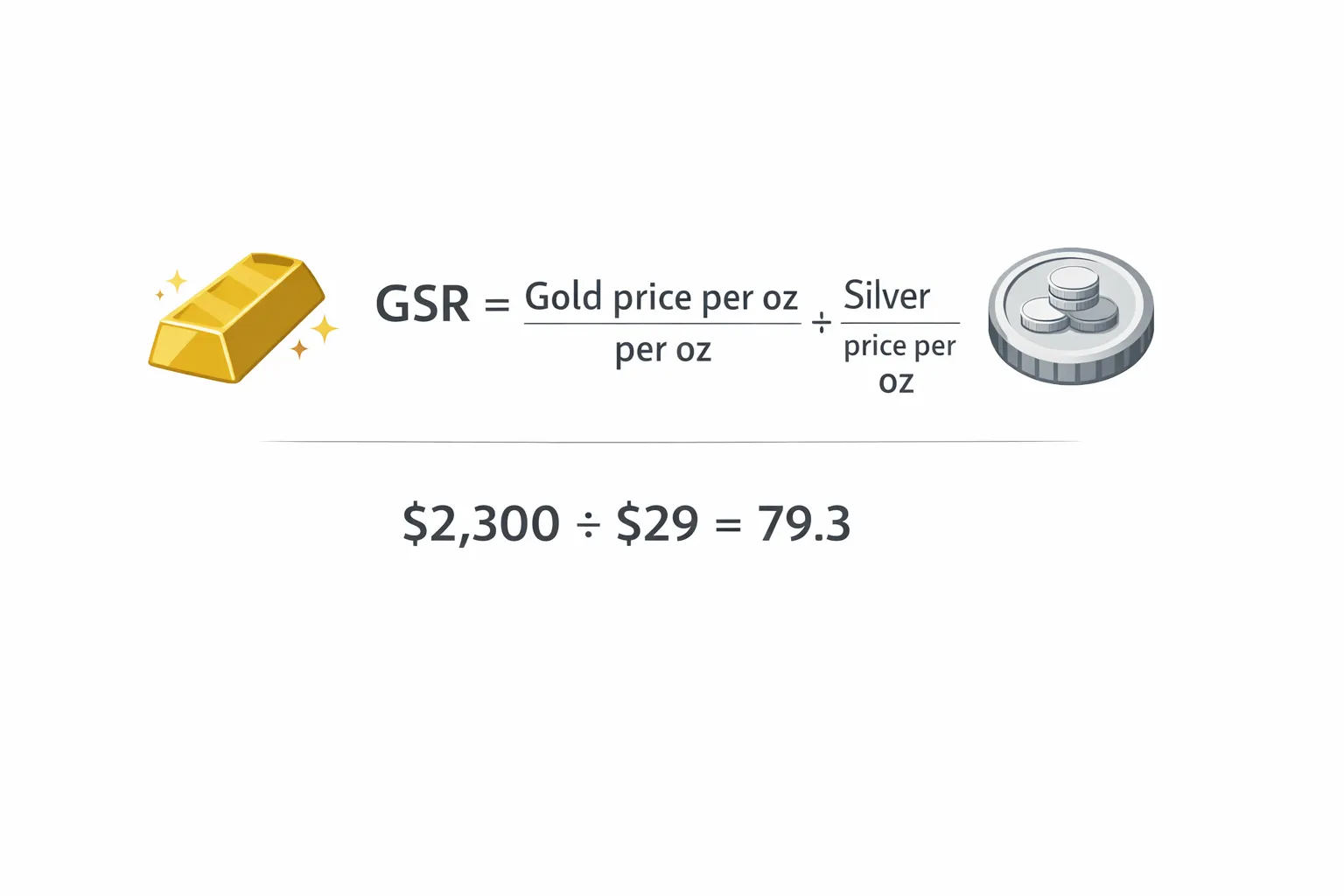
Formula: GSR = Gold price per oz ÷ Silver price per oz
-
Quick example: If gold is $2,300/oz and silver is $29/oz, then GSR = 2,300 ÷ 29 ≈ 79.3
Why investors track it
-
Spot mispricing: Identify when one metal looks rich or cheap versus the other.
-
Plan hedges: Traders hedge gold with silver (and vice versa) based on relative moves.
-
Time allocation shifts: Long-term allocators tilt toward the “cheaper” metal on extremes.
-
Typical bands: Historically, the GSR has often floated in the ~40–80 range. Readings above 100 or below 40 tend to be outliers driven by unusual macro shocks.
“Traders use the ratio to gauge the relative value of the two metals and to structure trades accordingly.” – Source
Decadal snapshot (at a glance)
These are broad approximations to frame the macro context – actual levels can swing widely within each decade.
|
Decade |
Approx. average/typical range |
Macro backdrop (simplified) |
|---|---|---|
|
1970s |
~40–55 |
High inflation, gold bull market, silver spike late in decade |
|
1980s |
~55–75 |
Post-1980 silver crash, disinflation, strong USD periods |
|
1990s |
~60–75 |
Tech-led growth, subdued inflation, steady range |
|
2000s |
~55–70 |
Commodity supercycle, 2008 crisis whipsaw |
|
2010s |
~60–80 |
QE era, low rates, occasional risk-off spikes |
|
2020s |
~70–100+ |
Pandemic shock (record spike), tightening then renewed gold strength |
Limits to the ratio
-
It’s a guide, not a guarantee. Macro regimes (inflation, rate cycles, recessions) can keep the ratio elevated or depressed for years.
-
Industrial demand matters: Silver’s heavier industrial use can decouple it from gold in recessions or booms.
-
Execution costs count: Switching between metals has spreads, taxes, and timing risk – build discipline, not hero trades.
Want a simple way to put this into action? Buy gold or silver from ₹1 and earn free Bitcoin on every purchase – only on OroPocket. Download now: https://oropocket.com/app
A century of extremes: how the ratio behaved across market cycles
Key turning points to know
-
Early 1930s–40s: Major policy shifts (gold standard changes), Depression-to-war economy turbulence, and government interventions in bullion markets pushed the ratio around in big steps.
-
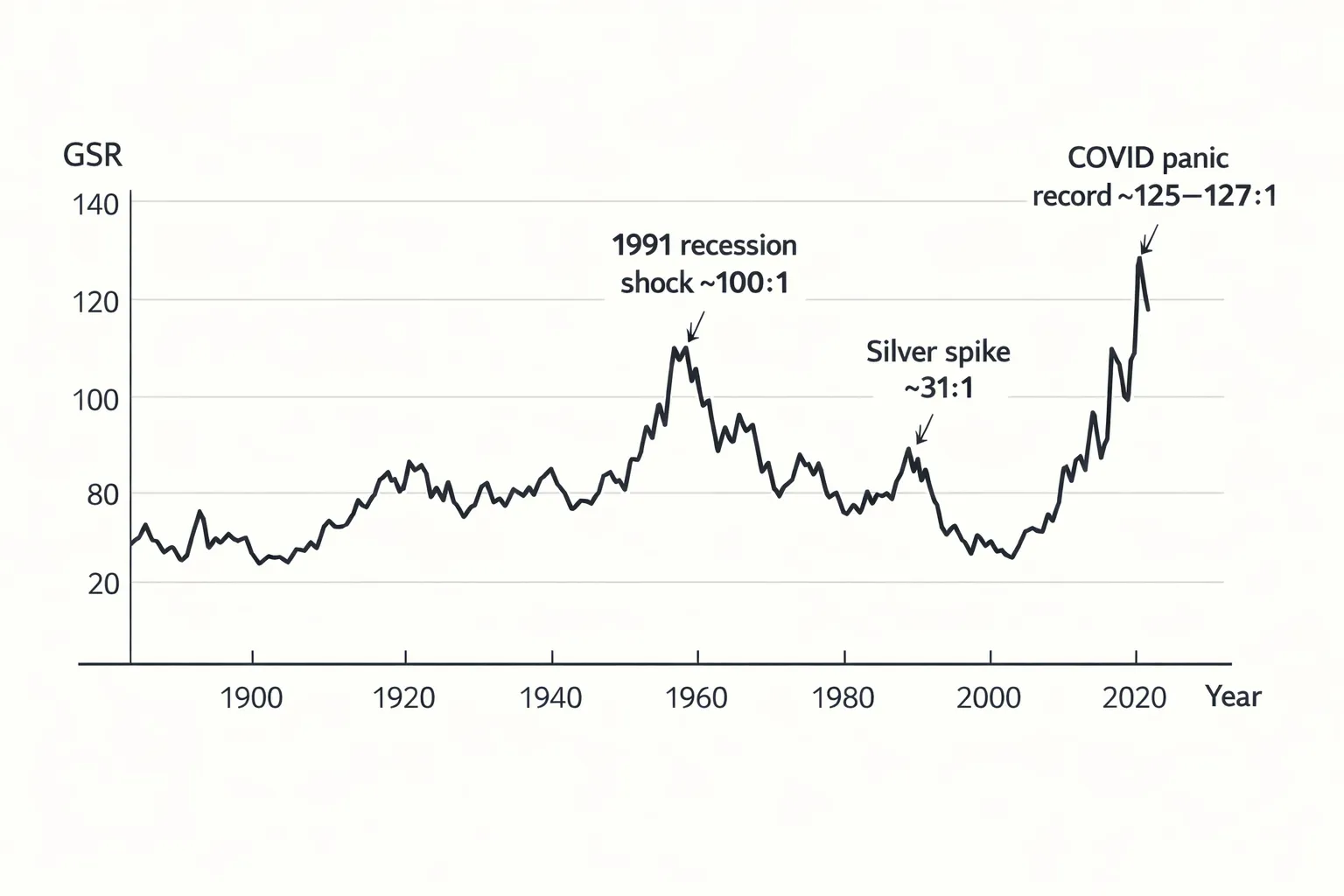
1991: The ratio briefly neared or exceeded ~100:1 amid recession, a strong USD, and pressure on silver.
-
April 2011: A parabolic silver rally drove the ratio down to a modern-cycle low near ~31:1.
-
March 2020: Liquidity crisis and flight to safety sent the ratio to a modern record ~125–127:1.
“In late April 2011, the gold‑to‑silver ratio fell to roughly 31:1 as silver surged to near-record levels.” – Source
Intraday vs closing debate
-
Different highs/lows: Some sources quote intraday spikes (momentary prints), others use end-of-day closes or monthly averages. Each method tells a slightly different story.
-
Data feeds vary: LBMA fixes, COMEX futures, and spot aggregates (Bloomberg, Refinitiv) can differ by ticks. That’s why you’ll see 31 vs 32 (2011) or 123 vs 127 (2020) depending on the dataset and timestamp.
What this history really says
-
Extremes happen around stress or mania: 1991 recession, 2011 silver bubble, 2020 COVID shock.
-
Mean reversion is slow: After blow‑offs or panics, the ratio usually drifts back toward its long-term bands rather than snapping back overnight.
-
Context matters: Policy shifts, USD strength, inflation cycles, and industrial demand for silver can stretch the ratio far from “normal” for months – even years.
Build a smarter stack with OroPocket: start with ₹1, choose gold or silver, and earn free Bitcoin on every buy. Get the app: https://oropocket.com/app
What pushes the ratio to extremes? Key macro drivers
Safe-haven flows and risk-off shocks
When fear hits, capital runs to gold first. Silver, with heavier industrial exposure, often sells off as growth expectations drop. The result: gold outperforms, pushing the GSR higher.
Monetary policy and real yields
Real yields are gravity for precious metals. When they rise, gold and silver both feel pressure – but silver typically more, due to its growth sensitivity. Conversely, easy policy and QE can compress the ratio over time as liquidity hunts for cyclical and industrial beta.
Industrial demand and supply quirks
Silver is a workhorse metal: electronics, solar, EVs. Demand booms can pull silver up faster than gold, lowering the ratio. Supply is quirky too – much of silver is a byproduct of other mining, so output doesn’t always respond cleanly to price.
Investor flows and positioning
Large ETF creations/redemptions, hedge fund futures positioning, and retail rushes can move the GSR fast. Heavy silver inflows tend to compress the ratio; panic redemptions do the opposite.
India lens
Rupee moves and import duties don’t change the global ratio, but they do change local affordability. A weaker INR or higher duties can delay Indian buying on rallies and create better entry points on dips.
Driver-to-ratio impact map
|
Driver |
Typical short-term effect on GSR (up/down) |
Why it happens (one-liner) |
Investor takeaway (what to watch) |
|---|---|---|---|
|
Global risk-off shock |
Up |
Flight to safety lifts gold; silver sells off with cyclical assets |
Volatility index (VIX), credit spreads, equity drawdowns |
|
Safe-haven USD surge |
Up |
Stronger dollar pressures commodities, silver more than gold |
DXY, EM FX stress, dollar funding indicators |
|
Real yields up (tightening) |
Up |
Higher real rates weigh more on silver’s growth beta |
10Y TIPS yield, policy guidance, CPI/PCE surprises |
|
Real yields down (easing/QE) |
Down |
Liquidity tailwinds favor silver beta over gold |
Central bank balance sheets, rate cuts, QE signals |
|
Inflation scare (early phase) |
Mixed to Down |
Both rally; silver’s cyclicality can outpace gold initially |
Breakevens, commodity breadth, PMI inflection |
|
Recession scare (late cycle) |
Up |
Growth fears crush silver demand more than gold |
ISM/PMI contraction, earnings revisions, energy demand |
|
Industrial demand surge (solar/EV) |
Down |
Silver’s use spikes, it outperforms |
Solar installs, EV sales, green capex policies |
|
Industrial slowdown |
Up |
Silver underperforms on weaker manufacturing |
Global PMIs, semiconductor/electronics orders |
|
Supply disruption (silver) |
Down |
Tighter silver supply boosts silver vs gold |
Mine outages, refining bottlenecks, sanctions |
|
Supply disruption (gold) |
Up |
Gold tightness lifts gold vs silver |
Producer guidance, geopolitical mine risks |
|
ETF creations in silver |
Down |
Inflows amplify silver price gains |
SLV/other silver ETF AUM changes |
|
ETF redemptions in silver |
Up |
Outflows pressure silver disproportionately |
Daily/weekly ETF flow reports |
|
Futures net-long build in silver |
Down |
Speculative demand chases upside |
CFTC positioning (COT), options skew |
|
Futures net-short build in silver |
Up |
Speculative selling accelerates declines |
CFTC positioning (COT), funding rates |
|
Retail mania in silver (“squeeze” narratives) |
Down (temporarily) |
Crowded upside flows compress ratio quickly |
Social chatter, options volume, spreads/widening |
|
Geopolitical conflict escalation |
Up |
Classic gold bid; industrial risk dents silver |
Headline risk, energy shocks, safe-haven flows |
|
China growth re-acceleration |
Down |
Silver benefits from cyclical and industrial rebound |
China PMIs, credit impulse, infrastructure spend |
|
India: INR depreciation |
Neutral globally; local tilt to delay buys |
Costlier imports curb local demand at the margin |
USD/INR, RBI stance, gold/silver landed cost |
|
India: import duty hikes/cuts |
Neutral globally; local timing effect |
Duties change affordability, not the global ratio |
Budget announcements, customs notifications |
Want to put this playbook to work without overthinking the timing? Start stacking gold or silver from just ₹1 – and earn free Bitcoin on every buy. Download OroPocket: https://oropocket.com/app
What the 2020 record means for investors today (and how to read extremes)
Mean reversion – useful but not a promise
The 2020 spike to ~125–127:1 was a panic extreme. Such blow-offs often cool over time, but the “when” is unknowable. Treat mean reversion as a guidepost, not a clock.
Practical reading guide
-
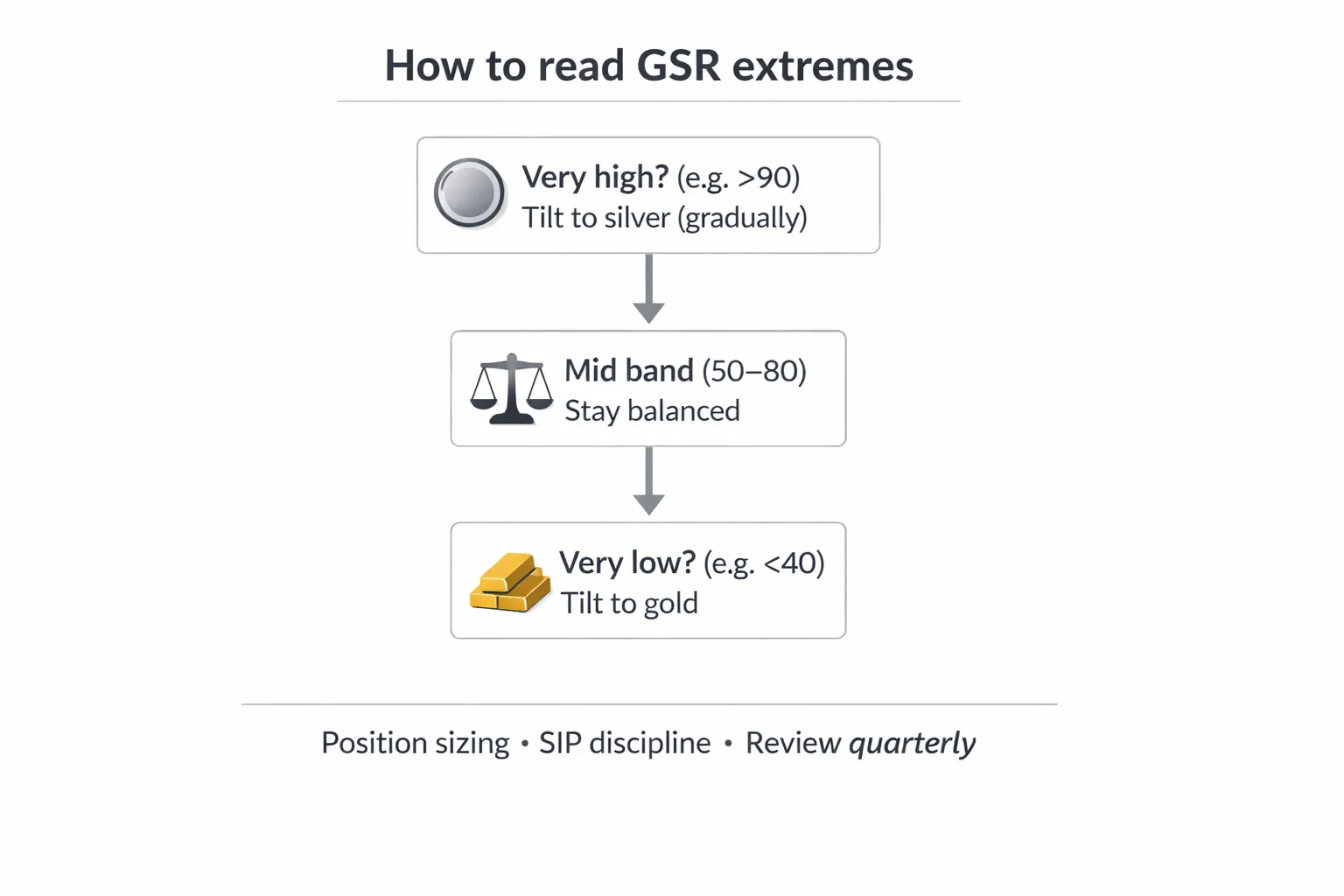
Very high ratio (e.g., >90): Silver looks relatively cheap. Consider gradual tilts toward silver – small, staged buys rather than lump sums.
-
Mid band (e.g., 50–80): Stay broadly balanced across gold and silver.
-
Very low ratio (e.g., <40): Gold looks relatively cheap. Consider tilting toward gold.
Indian investor angle
-
Use SIP-style buying to average in. Add small tilts based on the band you’re in, instead of trying to call the exact top or bottom.
-
Take advantage of UPI convenience to automate habits and keep costs low.
Guardrails
-
Avoid leverage and over-concentration.
-
Size positions to your risk tolerance; review quarterly and rebalance if bands change.
-
Respect taxes, spreads, and execution costs – they add up.
Put this framework into action in minutes. Start with ₹1, buy gold or silver, and earn free Bitcoin on every purchase – only on OroPocket. Download the app: https://oropocket.com/app
How to track and act on the ratio in India – without trading futures
Tracking the ratio
-
Where to check: LBMA daily prices, trustworthy market data portals, or dedicated GSR calculators that update intraday.
-
Set simple alerts for key bands (e.g., 60 / 80 / 100) in your portfolio app so you don’t need to watch the screen all day.
-
Keep it apples-to-apples: use spot prices (per troy ounce) for both metals and a consistent timestamp (intraday vs closing).
Acting on insights with micro-investing
-
Build two SIPs – one in gold, one in silver. Let your base allocation run automatically.
-
When alerts hit:
-
If GSR breaks above your “high” band (say 90 or 100), nudge new SIP contributions slightly toward silver.
-
If GSR drifts into the “mid” band (50–80), keep allocations balanced.
-
If GSR drops below your “low” band (e.g., <40), tilt new contributions toward gold.
-
-
Think in small moves (5–10% tilts), not all-or-nothing bets. Review once a quarter, not every spike.
Make it painless via UPI and mobile-first platforms
-
Consistency beats timing. Instant UPI payments and zero paperwork remove friction so your SIPs actually run.
-
A mobile-first app means you can fund, rebalance small tilts, and track progress in seconds – no demat, no futures, no leverage.
“UPI processed over 100 billion transactions in 2023.” – Source
Start now with OroPocket: set up gold and silver SIPs from just ₹1, pay via UPI in seconds, and earn free Bitcoin on every purchase. Download the app: https://oropocket.com/app
Why OroPocket is built for gold–silver ratio investors
The OroPocket edge (quick hits)
-
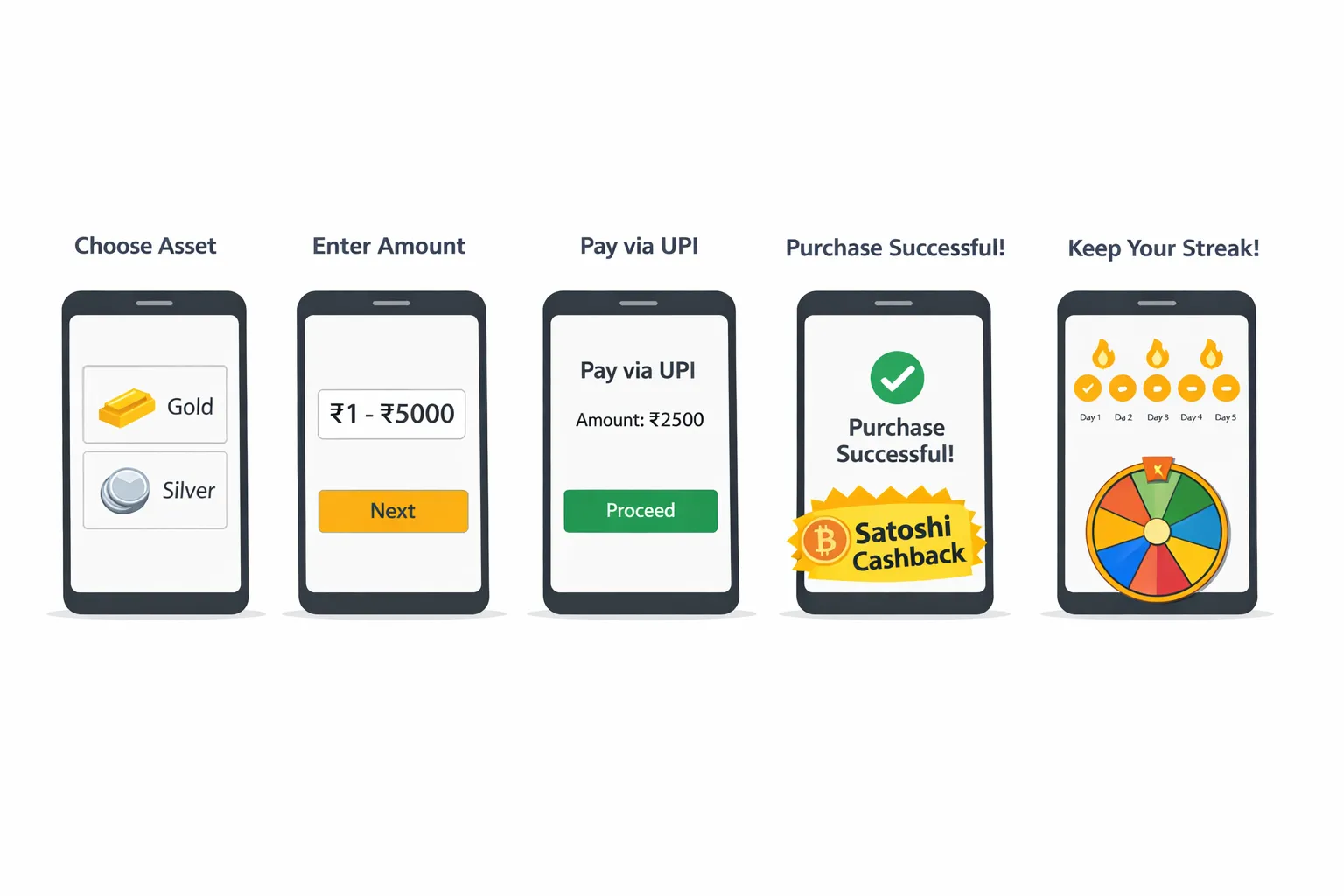
Start with ₹1, no minimums – act on ratio signals immediately.
-
Earn free Bitcoin (Satoshis) on every gold/silver purchase – two assets for the price of one.
-
Daily streaks, Spin to Win, and referral rewards – habit-building meets rewards.
-
24K pure gold, 100% insured vaults, RBI-compliant partners.
-
Instant UPI checkout, send gold to friends.
Turn insights into action
-
High GSR environment? Nudge more ₹ toward silver on OroPocket.
-
Low GSR? Nudge toward gold.
-
Keep a balanced core; automate SIPs and review monthly.
Ready to act on GSR signals the instant they pop? Download OroPocket and start from ₹1 – plus earn free Bitcoin on every buy: https://oropocket.com/app
Simple, sustainable strategies you can run on OroPocket
Band-based tilting (hands-on but simple)
-
Set three clear bands and let them guide your next buys:
-
Below 40: Tilt to gold (e.g., 70% gold / 30% silver for new contributions)
-
40–80: Stay balanced (e.g., 50% gold / 50% silver)
-
Above 80: Tilt to silver (e.g., 30% gold / 70% silver)
-
-
How to run it on OroPocket:
-
Keep two SIPs (one gold, one silver). Adjust just the next month’s SIP split when the band changes.
-
Reassess monthly. Don’t chase every intraday move – bands work best on closing or monthly averages.
-
-
Example: If your monthly total is ₹3,000 and the ratio is 85, direct ~₹900 to gold and ~₹2,100 to silver that month. If it drops to 60 next review, revert to ~₹1,500 each.
Core-and-tilt SIP
-
Keep 80% “always on” and split it equally across gold and silver.
-
Use the remaining 20% to tilt toward the metal that’s “cheaper” per the band.
-
Example (₹5,000/month):
-
Core: ₹4,000 → ₹2,000 gold + ₹2,000 silver
-
Tilt: ₹1,000 → if GSR > 80, send to silver; if GSR < 40, send to gold; if 40–80, split.
-
-
Why this works: You stay invested (no FOMO), but still respond to extremes without taking big bets.
Ratio rebalancing
-
Pick target weights (e.g., 50/50). Only rebalance when the ratio crosses a band or at set intervals (quarterly/half-yearly).
-
Use new contributions first to “rebalance by cash” before selling – this helps minimise taxes and spreads.
-
Keep it light: move 5–10% at a time; avoid frequent in-and-out moves.
Boost with rewards
-
Daily streaks and Spin to Win can top up your position without extra budget – treat rewards as “bonus SIP.”
-
Bitcoin cashback (Satoshis) on every purchase adds a growth kicker alongside your gold/silver stack.
-
Referral perks = more free Satoshis and spins – allocate them back into gold/silver for compounding effect.
Ready to put these strategies on autopilot? Start SIPs from ₹1, pay via UPI in seconds, and earn free Bitcoin on every purchase – only on OroPocket. Download now: https://oropocket.com/app
Risks, myths, and best practices
Key risks to respect
-
The ratio can stay extreme for years
-
Don’t assume quick mean reversion. Macro regimes (inflation, rates, growth) can keep the GSR elevated or depressed longer than you expect.
-
-
Silver is more volatile
-
Daily and intramonth swings are larger than gold’s. Size positions so a bad month doesn’t blow up your plan.
-
-
Liquidity, spreads, and taxes matter
-
Bid–ask spreads, execution slippage, and taxes affect net outcomes. Fewer, better-timed adjustments often beat frequent switches.
-
-
Data differences can mislead
-
Intraday prints vs daily closes, spot vs futures, and different data feeds (LBMA/COMEX) may show slightly different ratios. Be consistent in what you track.
-
-
Behavior risk > market risk
-
Chasing every move, using leverage, or panic-selling after tilting can turn a smart framework into losses.
-
Myths to avoid
-
“The ratio must go back to 16:1 because of geology”
-
Markets price demand, policy, and liquidity – not just earth’s crust. Geology isn’t a trading signal.
-
-
“One perfect band works forever”
-
Bands are guide rails, not gospel. As regimes change, your bands and tilt sizes may need updates.
-
-
“Silver always outperforms gold in bull markets”
-
Often, but not always. The path depends on growth, real yields, and industrial demand.
-
-
“ETFs or digital prices always match spot perfectly”
-
Tracking differences and execution costs exist. Expect small gaps and plan accordingly.
-
Best practices
-
SIP > timing
-
Small, steady buys beat heroic predictions. Use SIPs to build core positions, then make modest tilts.
-
-
Diversify and avoid leverage
-
Keep a balanced core. No margin, no options – let compounding and discipline do the work.
-
-
Predefine your playbook
-
Set your bands, tilt sizes (e.g., 5–10%), and review cadence (monthly/quarterly). Write it down to reduce emotional overrides.
-
-
Use consistent data and triggers
-
Track the same data source and act only on closes or monthly averages to cut noise.
-
-
Mind taxes and costs
-
Prefer rebalancing with fresh contributions over selling. Tax rules change – review periodically or consult a professional.
-
-
Use compliant, insured platforms only
-
Choose RBI-compliant partners, 24K purity, and fully insured vaults for safety and peace of mind.
-
Build your stack the disciplined way with OroPocket: start SIPs from ₹1, tilt modestly when bands shift, pay via UPI in seconds, and earn free Bitcoin on every purchase. Download the app: https://oropocket.com/app
Conclusion: The record, the takeaway, and your next step with OroPocket
The record, in one line
-
The gold-to-silver ratio’s modern record sits around 125–127:1 (March 2020). It’s a signal of extreme stress and an opportunity to think in tilts.
Your move
-
Start small (₹1 is enough), stay consistent with SIPs, and tilt thoughtfully when the ratio flashes extremes.
-
Do it the modern, UPI-native way and collect free Bitcoin on every purchase.
Call to action
-
Download OroPocket now on iOS or Android and put the ratio to work: https://oropocket.com/app