
Does gold price drop during war?


Does gold price drop during war? The real answer (and what smart investors do next)
War headlines usually make people assume one thing: gold will go up.
But real markets are messier. In many wars, gold does spike – then it can drop sharply, trade sideways, or become wildly volatile depending on inflation, interest rates, the US dollar, and investor liquidity.
So if you’re wondering “Does gold price drop during war?” – the honest answer is:
Yes, it can. And understanding why is how you stop guessing and start growing.

Why gold usually rises in war (but not always)
Gold is called a “safe haven” for three reasons:
-
Fear money flows into safety (investors reduce equity exposure)
-
Inflation risk rises (oil, shipping, supply chain shocks)
-
Currency confidence falls (people want something “real”)
That’s the classic playbook.
But here’s what most articles miss: during war, gold is not only driven by fear. It is also driven by rates, dollar strength, and liquidity – and those can overpower the safe-haven effect.
If you track the online gold rate daily, you’ll often see contradictory movement: war escalates, but gold falls. That’s not “abnormal” – that’s macroeconomics at work.
If you want live tracking without noise, follow OroPocket’s live gold prices and build the habit of observing price + reasons, not just headlines.
The forces that can make gold drop during war
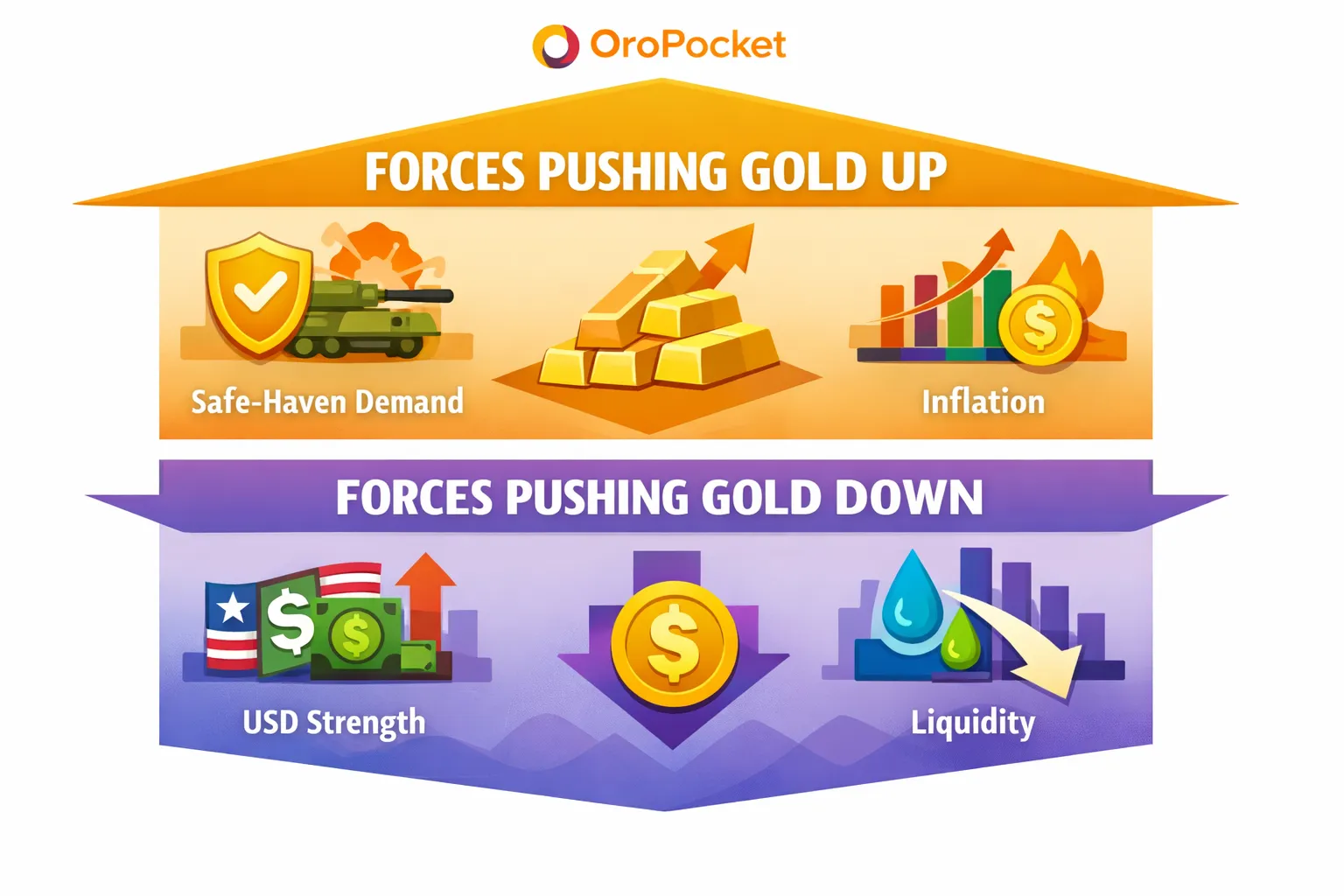
1) A stronger US dollar can push gold down
Gold is priced globally in USD. In many conflicts, investors rush into the dollar for safety too – especially institutions.
When the dollar strengthens, gold can fall even if fear is rising.
2) “Higher for longer” interest rates hurt gold
Gold doesn’t pay interest. So when bond yields rise, gold becomes less attractive in comparison.
Wars can increase inflation expectations → central banks stay hawkish → yields rise → gold pressure.
3) Investors liquidate gold to cover losses elsewhere
This is the sneaky one. During crises, funds may sell what they can sell – even “safe” assets – to meet margin calls or rebalance.
That can cause sudden drops.
4) The market may “price in” the war quickly
Sometimes gold spikes immediately after the first shock… and then fades once the event becomes “known,” even if conflict continues.
5) Demand shocks in key buying regions
If war disrupts incomes, trade, or consumer demand in major gold-consuming regions, physical demand can weaken – dragging prices.
A simple war-time gold checklist (use this before you buy)
When war breaks out, don’t ask only “Will gold rise?” Ask these 5 questions:
|
Question |
If the answer is “YES” |
What it often does to gold |
|---|---|---|
|
Is the USD strengthening? |
Risk-off dollar bid |
Pushes gold down |
|
Are bond yields rising? |
Hawkish rates |
Pushes gold down |
|
Is oil surging sharply? |
Inflation fear |
Pushes gold up |
|
Are equities crashing hard? |
Panic + liquidation |
Gold can go up or down (volatile) |
|
Are central banks buying gold? |
Structural demand |
Supports gold up |
This is how pros think. Retail investors usually just react.
What history shows: gold often wins in crises – but can be volatile
Gold has historically performed strongly in major crisis windows, but the path is rarely straight.
“Between 2008 and 2011, gold prices jumped 50.6%, reaching an all-time high of $1,917.90 per ounce in August 2011.” – Source
And for Indian investors, the long-term trend has stayed supportive:
“Over the past five years, gold has demonstrated strong performance in India, delivering an approximate compound annual growth rate (CAGR) of 13.5%.” – Source
Translation: Gold can drop during war – but over time, it has still done its job as a store of value.
So… should you buy gold during war?
If you’re buying because you want to “trade the war,” that’s risky.
But if your goal is to beat inflation, build a safety cushion, and grow wealth slowly and consistently – then war-time volatility is not a reason to stop. It’s a reason to invest smarter:
The smarter approach: average in (micro-buy) instead of timing
Instead of betting big on one day’s “digital gold rate,” spread your buys. Small, consistent purchases reduce regret and improve discipline.
That’s exactly why OroPocket is built for micro-investing.
OroPocket: the modern way to invest in gold (even during uncertainty)

Most people delay investing because it feels like a “big decision.” OroPocket removes that friction:
-
₹1 entry point: start instantly, no minimums
-
Instant UPI payments: buy in under 30 seconds
-
24K gold, secure vault storage: fully insured, compliant, transparent
-
Gamified investing: streaks + spin-to-win rewards to build a daily habit
-
Free Bitcoin on every purchase: you get Satoshi cashback on every gold/silver buy
-
Referral rewards: both sides earn 100 Satoshi + a free spin
This isn’t just investing. It’s building a system that keeps you consistent.
And if you’re comparing against legacy products (like mmtc pamp gold rate based buying), remember: the real win isn’t only the rate – it’s the habit + cost averaging + security + rewards.
To track prices before you buy, use OroPocket’s gold rate today in India page.
Final verdict: Yes, gold can drop during war – so stop timing and start building
Gold doesn’t move in one direction just because a war starts.
It reacts to rates, dollar strength, inflation expectations, liquidity, and positioning – sometimes all at once.
The winning move for most Indians isn’t predicting tomorrow. It’s building wealth one smart step at a time.
If you want the stability of gold plus the growth optionality of Bitcoin rewards – without the complexity of trading crypto – OroPocket is your edge.
Stop watching. Start growing.
Download OroPocket, start with ₹1, and let your investing habit compound – day after day.
Track the gold price chart, buy when it fits your plan, and collect Bitcoin rewards while you do it.