
Compounding Interest Explained (2026): Formula, Examples & How to Start Building Wealth Faster

Compounding Interest Explained (2026): Formula, Examples & How to Start Building Wealth Faster
Compounding interest is the quiet reason some people “suddenly” look rich at 35 – while others with the same salary still feel stuck. It’s not magic. It’s math + time + consistency.
If you’re a student, salaried professional, small business owner, or first-time investor in India, compounding is the simplest “wealth hack” you can actually control – especially when you invest in assets that can grow over time and you don’t break the cycle with withdrawals.

What Is Compounding Interest (in simple words)?
Compounding interest means you earn returns on:
-
your original money (principal), and
-
the returns that principal already earned.
So your money starts making money… and then that money starts making more money. That’s the “snowball.”
Simple interest vs compound interest (quick comparison)
|
Feature |
Simple Interest |
Compounding Interest |
|---|---|---|
|
Return is calculated on |
Only principal |
Principal + past returns |
|
Growth shape |
Straight line |
Exponential curve |
|
Best for |
Short durations |
Long-term wealth building |
|
Your biggest lever |
Rate |
Time + consistency |
How Compounding Works (the mental model)
Compounding becomes powerful when three things work together:
-
Time: more years = more compounding cycles
-
Rate: higher return rate = faster growth
-
Consistency: regular investing keeps increasing the base amount

The Compounding Interest Formula (and what each term really means)
Compound amount formula
A = P × (1 + r/n)^(n×t)
Where:
-
A = final amount after compounding
-
P = principal (starting amount)
-
r = annual rate of return (in decimal; 10% = 0.10)
-
n = compounding frequency (monthly = 12, daily = 365, yearly = 1)
-
t = time in years
Compound interest earned
Compound Interest = A − P
Investor reality check: in real life (mutual funds, gold, equity), returns vary. But the compounding principle still applies when gains are reinvested and time stays on your side.
Rule of 72: the fastest way to estimate doubling time
Want a quick mental shortcut?
Years to double ≈ 72 ÷ annual return (%)
Example:
-
At 12% return → 72/12 = 6 years to double (approx.)
“By dividing 72 by the annual interest rate (as a percentage), you can approximate the doubling time.” – Bankrate
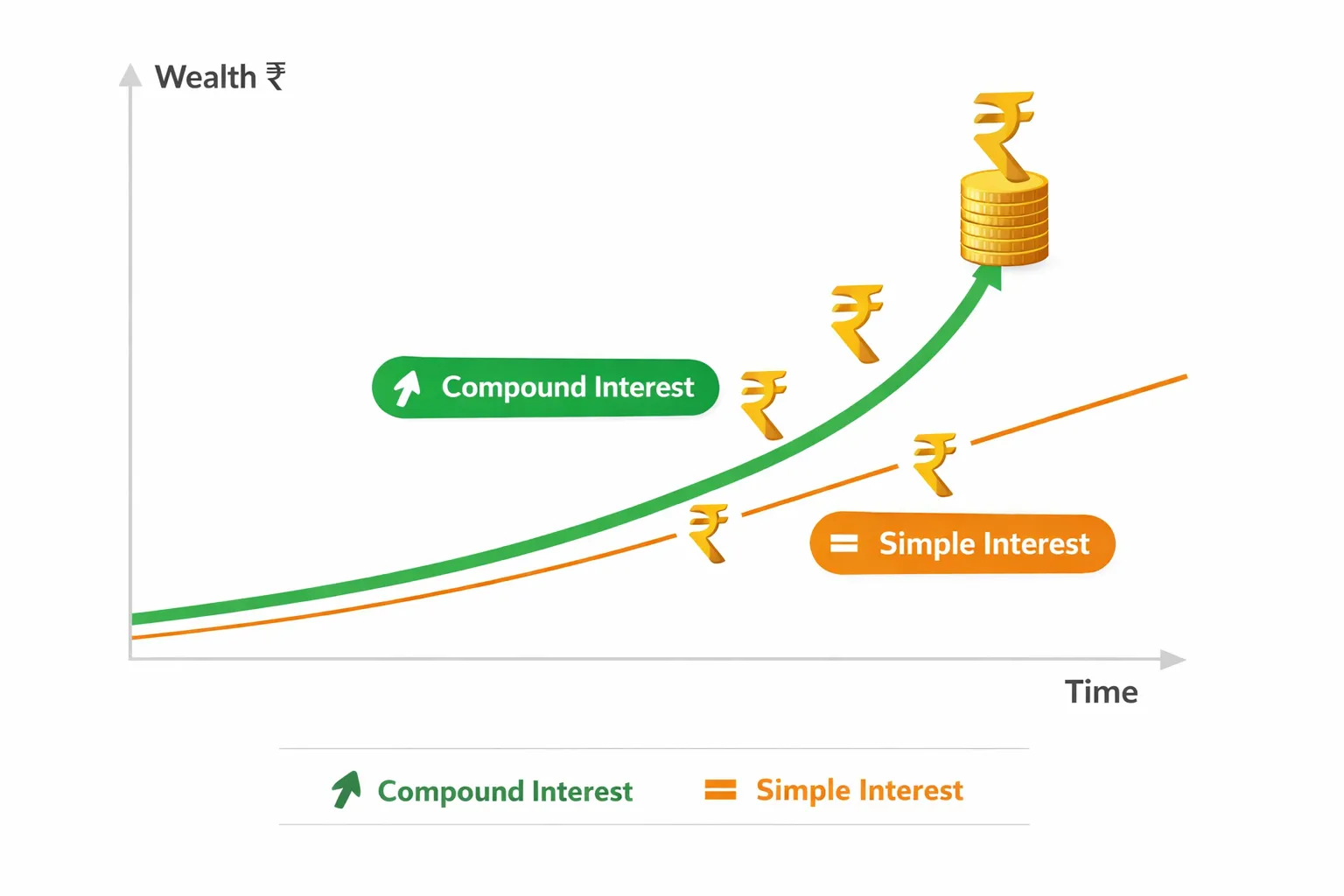
The “Compounding Curve” Visual (why early matters more than big)
This is the part most people miss: compounding rewards early action more than late intensity.
Starting with small amounts early often beats starting with large amounts late.
Real-Life Compounding Examples (India-focused)
Example 1: Savings account compounding (safe, but usually slow)
Most savings accounts compound interest, but after tax and inflation, the “real” growth can feel weak.
Takeaway: savings accounts are for emergency funds – not long-term wealth.
If you want to track gold’s movement (often used as an inflation hedge), keep an eye on the live gold price in India before buying.
Example 2: SIP-style monthly investing (mutual funds / long-term assets)
When you invest monthly (like a SIP), compounding doesn’t just happen on your initial money – it happens on each month’s contribution over time.
Why it works:
-
you keep increasing the principal base
-
you reduce timing risk with regular buying
-
reinvested returns compound on themselves
Pro move: increase your monthly investment by 5–10% every year (salary hike = compounding fuel).
Example 3: Digital Gold compounding (how it behaves in reality)
Gold doesn’t pay “interest” like a bank account. But gold can still compound wealth if:
-
you invest regularly (accumulate more grams)
-
the gold price rises over years
-
you reinvest/keep adding instead of cashing out
Over the long run, gold has shown meaningful appreciation in India:
“In 2019, 24K gold was ~₹35,220 per 10 grams and by 2024 ~₹79,610 per 10 grams (CAGR ~17.2%).” – CAGRCalculator.net
Track price movement visually using a gold price chart to understand trends and volatility.
The biggest compounding accelerators (most blogs gloss over these)
1) Frequency matters – but consistency matters more
Daily/monthly compounding helps, but the larger impact usually comes from:
-
staying invested longer
-
contributing regularly
-
not interrupting the cycle
2) Taxes can slow compounding
Taxes reduce what you can reinvest. Use tax-efficient structures where possible and avoid unnecessary churn.
3) Inflation is the silent compounding enemy
If inflation is 6% and your savings earns 4%, you’re compounding… but your purchasing power is compounding down.
This is why long-term assets (gold, equity, quality funds) matter.
Common mistakes that kill compounding
|
Mistake |
Why it hurts |
|---|---|
|
Starting “after things settle” |
Time is the compounding engine you can’t buy back |
|
Withdrawing frequently |
Breaks the snowball before it grows |
|
Chasing “hot” returns |
Often leads to bad timing + panic selling |
|
Ignoring fees |
Small fees compound against you |
|
Investing only when “extra money” exists |
Compounding needs automation, not moods |
How OroPocket helps you actually benefit from compounding (without the usual friction)
Most people don’t fail because they don’t understand compounding. They fail because investing feels hard, expensive, or boring.
OroPocket is built to remove those blockers:
Why OroPocket is different (designed for habit + growth)
-
₹1 entry point: start instantly, no “minimum investment” excuse
-
Instant UPI buying: invest in under 30 seconds
-
Gamified investing: daily streaks, spin-to-win, tiered rewards – so consistency becomes automatic
-
Gold + Bitcoin combination: stability of gold + upside exposure via rewards
-
Free Bitcoin on every purchase: you stack two assets while building one habit
-
100% secure & compliant: RBI-compliant flows, insured vault storage, authorized partners
-
Referral rewards: both referrer and referee earn 100 Satoshi + a free spin

And if you’re the kind of investor who checks prices before buying, use the current gold price view to stay sharp.
Final verdict: Compounding is a habit game – win it early
Compounding interest isn’t reserved for finance experts. It’s for anyone who can do three things:
-
start small,
-
invest consistently,
-
stay invested long enough.
That’s it.
Stop watching. Start growing.
Download OroPocket, start with ₹1, buy digital gold via UPI, and earn free Bitcoin on every purchase – because building wealth should feel simple, rewarding, and in your control.


Join the Conversation
Be the first to share your thoughts.