
Do I need to pay tax if I sell digital gold?


Do I need to pay tax if I sell digital gold?
You tapped “Sell” and cash hit your bank. Now the tax bit.
Short answer: Yes – profits from selling digital gold are taxed as capital gains.
Why this matters in 2025–26: India’s rules were updated recently. For many types of gold (including digital), long-term classification now kicks in after 24 months, with LTCG taxed at 12.5% (without indexation). STCG (≤24 months) is taxed at your slab. A lot of older guides still say “3 years and 20% with indexation” – that’s outdated for FY 2024–25 onwards.
“UPI purchases of digital gold in India rose from INR 8 billion in January to INR 21 billion in December 2025 – nearly tripling in a year.” – Source
What this guide covers:
-
STCG vs LTCG on digital gold under the updated 2025–26 rules
-
GST impact on buy vs sell
-
How to calculate gains correctly
-
Which ITR forms and schedules to use
-
Smart timing strategies to cut your tax bill
-
How OroPocket helps you stay compliant – while earning free Bitcoin rewards on every gold purchase
What taxes apply when you sell digital gold in India?
-
If you book a profit, it’s capital gains. Hold ≤24 months: STCG taxed at your income slab. Hold >24 months: LTCG at 12.5% (plus cess/surcharge), no indexation. Losses can be set off as per Income Tax rules.
Digital gold tax rules 2025–26 (updated)
-
FY 2024–25 onwards: 24-month holding period threshold for LTCG; LTCG rate 12.5% without indexation for gold forms including digital.
-
Many websites still mention “36 months, 20% with indexation” – double-check dates when you read tax advice.
Is GST charged on selling digital gold?
-
GST applies when you buy gold (commonly 3% on the gold value). There’s no GST on selling digital gold; your sale is a capital gains event for income tax, not a GST event.
How to report digital gold capital gains in ITR
-
Report gains in the Capital Gains schedule of your ITR (commonly ITR-2 for most salaried/non-business individuals).
-
Keep transaction records (date-wise buys/sells, amounts, fees). OroPocket makes this easy with transparent, downloadable statements.
Want tax-smart gold investing with instant UPI and free Bitcoin rewards on every purchase? Download OroPocket now: https://oropocket.com/app
Digital gold tax in 2025–26: the updated rulebook
The quick framework (up-to-date):
-
Holding period threshold: 24 months (not 36 months)
-
STCG (≤24 months): taxed at your income tax slab
-
LTCG (>24 months): taxed at 12.5% (no indexation), plus cess/surcharge as applicable
-
GST: 3% applies only on purchase, not at sale
-
TDS: generally not applicable on retail sale of digital gold; PAN may be required for large transactions
“Union Budget 2024–25 reduced the long-term holding period for gold to 24 months and set LTCG at 12.5% without indexation.” – Source
Old vs new: why older blogs still say 36 months + 20% with indexation – and why that’s outdated
-
Before the FY 2024–25 changes, long-term on gold meant 36+ months with 20% tax after indexation.
-
From FY 2024–25 onward, long-term kicks in after 24 months and is taxed at 12.5% without indexation. Many older posts haven’t been updated – always check the financial year on any tax guide.
Edge note: paper gold vs digital gold
-
Paper gold (ETFs, gold funds, SGBs) can have different holding periods or exemptions (e.g., SGBs held to maturity are LTCG-exempt). This article focuses on digital gold (vaulted bullion purchased via platforms).
Digital Gold – Tax at a Glance (2025–26)
|
Item |
STCG (≤24 months) |
LTCG (>24 months) |
|---|---|---|
|
Holding period |
24 months or less |
More than 24 months |
|
What it’s called |
Short-Term Capital Gain |
Long-Term Capital Gain |
|
Tax rate |
As per your income tax slab |
12.5% + cess/surcharge |
|
Indexation (Yes/No) |
No |
No |
|
GST at sale (Yes/No) |
No (GST applied only at purchase) |
No (GST applied only at purchase) |
|
Where to report in ITR |
ITR-2, Schedule Capital Gains (most individuals) |
ITR-2, Schedule Capital Gains (most individuals) |
STCG tax on digital gold
-
If you sell within 24 months, profits are added to your total income and taxed at your slab rate.
-
Keep platform fees/charges handy – eligible selling costs can be adjusted when computing gains.
LTCG tax on digital gold without indexation (2025 rules)
-
Hold longer than 24 months: gains are taxed at 12.5% (plus cess/surcharge).
-
Indexation is no longer available for gold under the updated regime.
Digital gold holding period: 24 months explained
-
Count from the purchase date to the sale date.
-
If you make multiple purchases, apply FIFO (first-in, first-out) when computing holding periods and gains lot-wise.
-
No GST on sale; it’s purely a capital gains event for income tax. PAN may be required for large transactions.
Pro tip: OroPocket auto-tracks your holding periods, lets you download clean statements for ITR, and rewards every purchase with free Bitcoin. Invest tax-smart and get rewarded – download the app: https://oropocket.com/app
Step-by-step: Calculate capital gains on digital gold
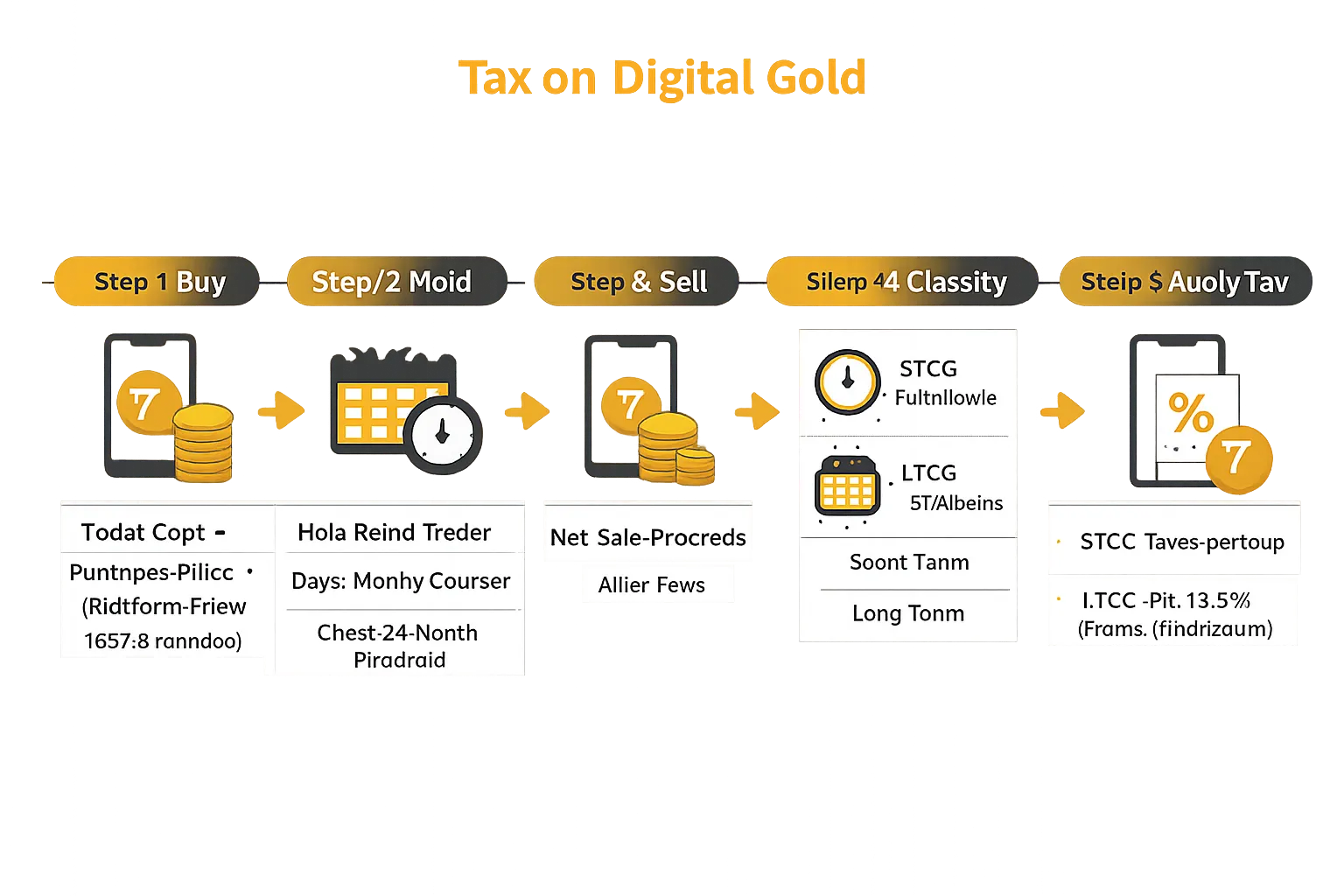
What counts as your cost:
-
Purchase price + platform charges/fees
-
Exclude GST for gain calculation logic (GST you paid is part of your outflow but does not change the taxable gain formula)
What counts as sale consideration:
-
Net sale value you receive after deducting any platform/sell charges
STCG formula (≤24 months):
-
STCG = Net sale proceeds – Total cost
-
Tax at your income slab
LTCG formula (>24 months) under 2025 rules:
-
LTCG = Net sale proceeds – Total cost
-
Tax at 12.5% + cess/surcharge (no indexation)
Digital gold profit calculator example
Example A: STCG for a 10-month hold
-
Buy (Feb 2026): ₹20,000 worth of digital gold; platform fee ₹100; GST paid at purchase ₹600 (3% of ₹20,000). Total outflow ₹20,700; Total cost for capital gains = ₹20,100 (purchase + fee; GST excluded for gain calc).
-
Sell (Dec 2026): Gross sale value ₹22,000; platform sell fee ₹50 → Net sale proceeds ₹21,950.
-
STCG = ₹21,950 – ₹20,100 = ₹1,850.
-
Tax: Added to your total income and taxed at your slab.
Example B: LTCG for a 26-month hold
-
Buy (Jan 2024): ₹50,000 purchase; platform fee ₹150; GST at purchase ₹1,500. Total outflow ₹51,650; Total cost for gains = ₹50,150.
-
Sell (Mar 2026): Gross sale value ₹62,000; sell fee ₹100 → Net sale proceeds ₹61,900.
-
LTCG = ₹61,900 – ₹50,150 = ₹11,750.
-
Tax: 12.5% of ₹11,750 = ₹1,468.75 (+ cess/surcharge as applicable). No indexation under 2025 rules.
Example C: Multiple tranches using FIFO to determine holding period and gains
-
Tranche 1: Buy 5 g @ ₹5,000/g on Jan 10, 2025; platform fee ₹50 → Cost = ₹25,050.
-
Tranche 2: Buy 3 g @ ₹5,500/g on Aug 5, 2025; platform fee ₹30 → Cost = ₹16,530.
-
On Mar 20, 2027, you sell 6 g at gross ₹6,200/g = ₹37,200; sell fee ₹80 → Net sale proceeds = ₹37,120.
Apply FIFO:
-
First 5 g come from Tranche 1 (held >24 months as of Mar 20, 2027 → LTCG).
-
Next 1 g comes from Tranche 2 (held <24 months as of Mar 20, 2027 → STCG).
Allocate costs:
-
Tranche 1 per-gram cost = ₹25,050 / 5 g = ₹5,010/g → Cost for 5 g = ₹25,050.
-
Tranche 2 per-gram cost = ₹16,530 / 3 g = ₹5,510/g → Cost for 1 g = ₹5,510.
Allocate sale value:
-
Per-gram net sale value = ₹37,120 / 6 g = ₹6,186.67/g.
-
For 5 g (LTCG lot): Sale value = ₹30,933.35 → Gain = ₹30,933.35 – ₹25,050 = ₹5,883.35 (tax @ 12.5% + cess/surcharge).
-
For 1 g (STCG lot): Sale value = ₹6,186.67 → Gain = ₹6,186.67 – ₹5,510 = ₹676.67 (taxed at slab).
Note:
-
Always use the net sale proceeds (after fees).
-
Keep purchase/sale statements handy – OroPocket lets you download clean statements and lot-wise breakdowns for ITR.
FIFO method for multiple digital gold purchases
-
Use FIFO to match sells against the earliest purchases.
-
Compute per-gram costs including platform fees for each lot.
-
Split the sale across lots, classify each lot as STCG or LTCG based on its own holding period, then apply the correct tax rate.
GST, buy–sell spread, and your break-even math
“Typical digital gold buy–sell spreads in India range roughly between 2.5% and 5.0% across leading providers, covering custody, insurance, and ops.” – Source
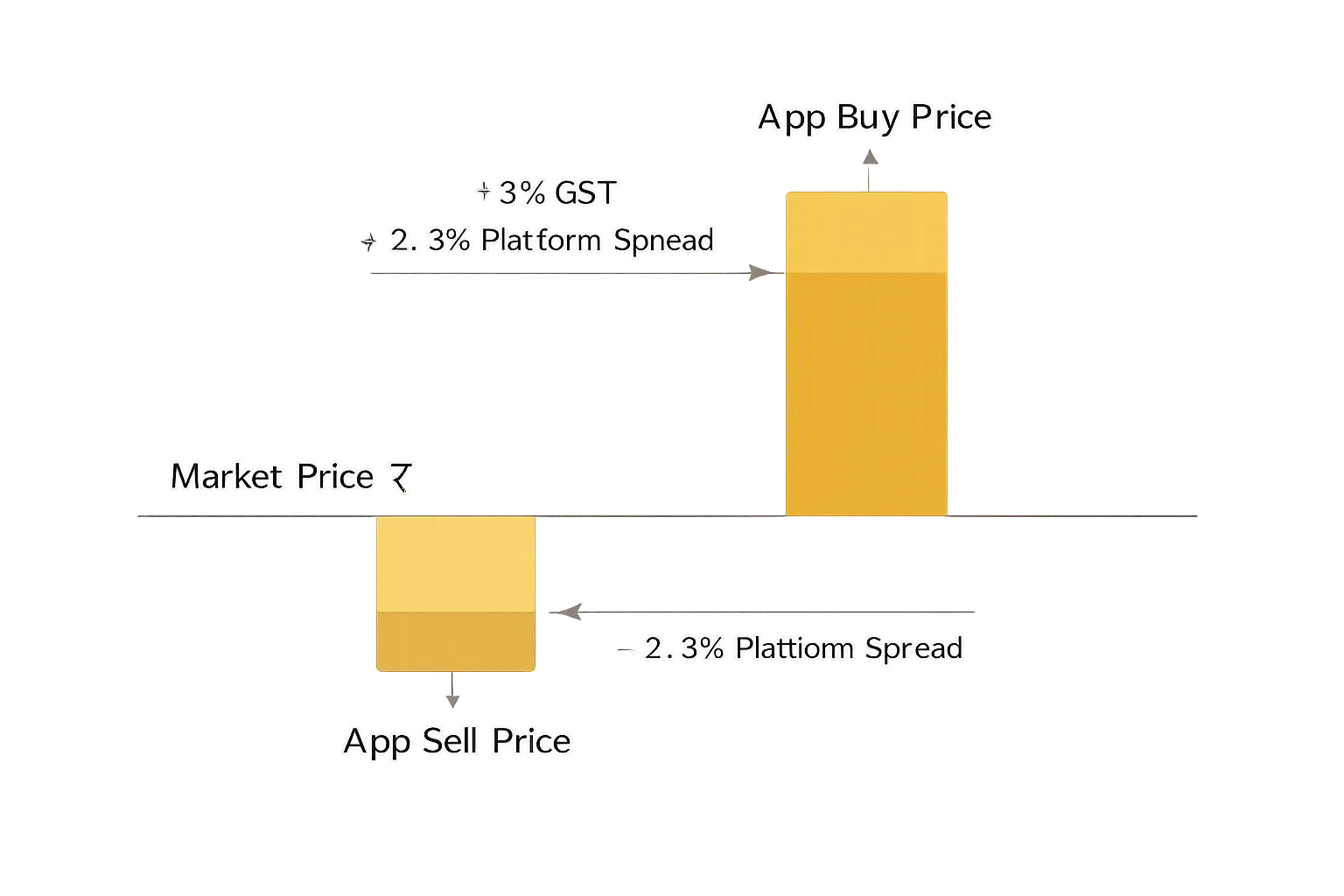
GST reminder: 3% charged on purchase, not on sale
-
GST at 3% applies when you buy digital gold, increasing your initial effective cost.
-
There’s no GST when you sell; sale is an income-tax event (capital gains), not a GST event.
Platform buy/sell spread: why the buy price is higher than the sell price
-
The spread covers vaulting, insurance, hedging, and platform operations.
-
That’s why you’ll see “Buy” higher than the market reference, and “Sell” slightly below.
Putting it together: your all-in break-even
-
Add ~3% GST at purchase + ~2–3% buy–sell spread impact.
-
Typical break-even range sits around ~5–6% price appreciation before you start seeing green on net proceeds.
Is GST charged when selling digital gold?
-
No. GST is charged only at purchase (commonly 3% on the gold value). Selling digital gold doesn’t attract GST.
What is the digital gold spread?
-
It’s the gap between “Buy” and “Sell” prices on the app, often ~2–3% in normal conditions. It funds insured vaulting, logistics, hedging, and ops.
How much should gold price rise to break even?
Worked ‘break-even’ example (live-like prices)
-
Market reference price: ₹7,500/g
-
App buy price example: ₹7,725/g (includes ~3% GST + partial spread/fees)
-
App sell price example: ₹7,275/g (market minus spread)
-
If you buy 1 g at ₹7,725 and immediately sell at ₹7,275, you’re down ₹450 (~5.8%).
-
To break even, the market price would need to climb so that the app sell price reaches your effective buy level (~₹7,725). With a 2–3% spread on sell, that implies roughly a 5–6% market move from your entry.
Practical tips to improve your odds
-
Buy the dips: add when prices pull back 2–3%.
-
Stagger purchases (Rupee Cost Averaging): smooths out entry prices.
-
Avoid frequent churning: spreads and GST can erode returns on short holding periods.
OroPocket advantage
-
Start from ₹1 with instant UPI, track your effective break-even, and earn free Bitcoin on every purchase – offsetting part of spread/GST drag over time. Download now: https://oropocket.com/app
How to report digital gold gains in ITR (and the documents you need)
“Report capital gains from sale of gold in ITR‑2 under Schedule CG; follow the official form instructions for AY 2025–26.” – Source
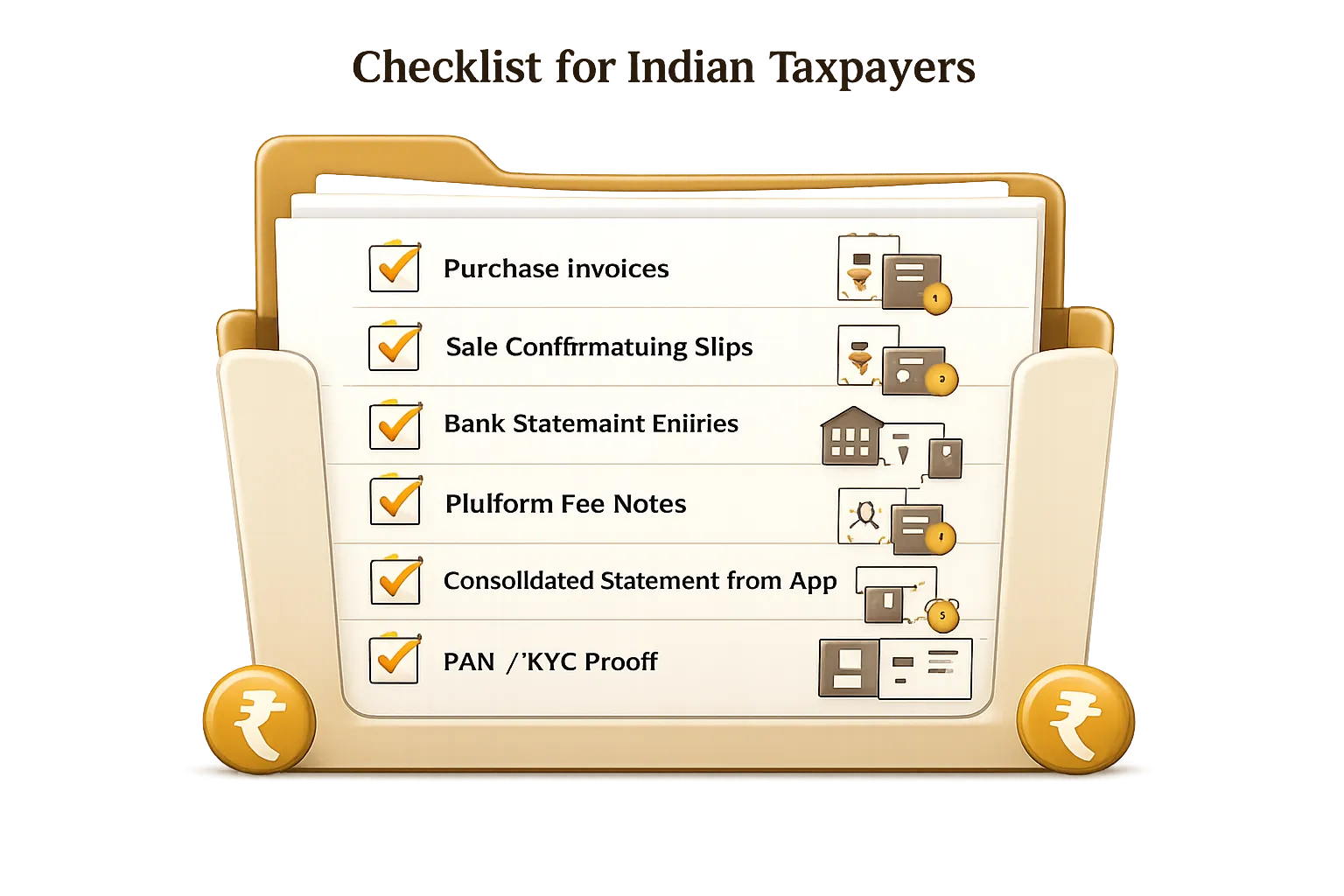
What to store
-
Purchase invoices/contract notes
-
Sale confirmations/slips
-
Bank statement entries for buy/sell
-
Platform fee/charge notes
-
Consolidated statement from the app (lot-wise)
-
PAN/KYC proof (for higher-value transactions)
ITR forms: where to show capital gains
-
Individuals without business income typically use ITR‑2.
-
Report in Schedule CG (Capital Gains). Use separate rows/sections for STCG vs LTCG.
High-level walkthrough: filling Schedule CG
-
STCG (≤24 months): Enter sale consideration (net of selling charges), cost of acquisition (purchase + platform fees; exclude GST for gain calc), and transfer expenses. The resulting STCG is taxed at slab rates.
-
LTCG (>24 months): Enter net sale consideration and total cost similarly. Under 2025 rules for gold/digital gold, apply the 12.5% rate (no indexation).
-
If you sold multiple lots, compute gains lot-wise using FIFO and aggregate within STCG/LTCG sections.
PAN/thresholds notes
-
PAN/KYC may be required by platforms for larger transactions or cumulative thresholds.
-
Cash limits under the Income-tax Act don’t apply to UPI-based app purchases; keep digital trails intact.
Timeline and compliance
-
Advance tax: If total tax (after TDS/TCS credits) is ≥₹10,000, pay advance tax by quarterly due dates to avoid interest.
-
Return due date: Typically 31 July following the financial year (unless extended).
-
E-verification: Verify your ITR within the prescribed timeline (e.g., 30 days) via Aadhaar OTP, bank account, or other modes.
Where to show digital gold in ITR-2 (Schedule CG)
-
Schedule CG → Capital assets other than listed equity. Use the appropriate STCG/LTCG sub-tables and provide date-wise details.
Do you need PAN to sell digital gold?
-
For high-value transactions, platforms may require PAN/KYC and may restrict activity without it. Keeping PAN linked ensures smooth payouts and accurate AIS/CRS reporting.
Record-keeping checklist for digital gold taxes
-
Invoices and sale slips saved as PDFs
-
Bank credit/debit proofs for each transaction
-
Platform fee notes and consolidated statements
-
Lot-wise FIFO worksheet for your records
-
A copy of the filed ITR and acknowledgment
Ready to keep it clean and compliant – without the headache? OroPocket lets you download tax-ready statements, track holding periods automatically, and earn free Bitcoin on every gold purchase. Get the app: https://oropocket.com/app
Special situations that change your tax outcome
Life isn’t one-size-fits-all. These edge cases can change how much tax you pay – and when.
Is gifted/inherited digital gold taxable?
-
Receiving gold from “specified relatives” (parents, spouse, children, siblings, lineal ascendants/descendants) is tax-exempt at receipt. Gifts from non-relatives above ₹50,000 in a year are taxable as “Income from Other Sources.”
-
When you sell gifted/inherited digital gold, capital gains apply:
-
Cost of acquisition: usually the original buyer’s cost (the donor/previous owner).
-
Holding period: generally includes the previous owner’s holding to determine STCG (≤24 months) vs LTCG (>24 months).
-
Tax rate: STCG at slab; LTCG at 12.5% (no indexation) under the updated 2025–26 rules.
-
Practical tip: Keep any documents you can obtain from the previous owner (purchase proof, dates). If unavailable, consult a tax professional for a reasonable method and disclosure.
NRI tax rules for selling digital gold
-
The same STCG/LTCG framework applies to NRIs:
-
≤24 months: STCG at slab rates.
24 months: LTCG at 12.5% (plus cess/surcharge), with no indexation.
-
-
Residency matters: Determine your residential status for the financial year; it governs your tax scope in India.
-
DTAA: If you are tax-resident in a treaty country, DTAA provisions may influence credit/relief rules. Seek advice.
-
Cross-border flows: Depending on payout methods and thresholds, TCS/TDS or FEMA compliance can arise – speak to a CA before large redemptions.
Switching/transfer between platforms
-
Selling on Platform A and re-buying on Platform B is a taxable sale and fresh purchase. You’ll realize gains/losses on the sale date.
-
A pure “custodian change” without a sale is typically not available in consumer digital gold; even if a transfer were possible, ensure documentation proves no change in beneficial ownership.
Does redemption to coins trigger tax?
-
Redeeming digital gold into coins/jewellery is not a sale for income tax; it’s a conversion. However:
-
You may incur making/delivery/packaging fees and fresh GST on making.
-
Your original holding period continues after conversion; it doesn’t reset.
-
If you later sell the physical coin/jewellery, capital gains apply. Your cost becomes your original digital gold cost plus any eligible conversion/making/delivery charges.
-
Practical tip: Keep every invoice – digital purchase, redemption/making, and any delivery slips – so you can compute accurate gains later.
–
Want clean paperwork and fewer headaches? OroPocket gives you downloadable, tax-ready statements, auto-tracks holding periods, and rewards every purchase with free Bitcoin. Start now: https://oropocket.com/app
Sell now or wait? Timing your sale for lower tax
The 24-month cliff matters. Sell at month 20 and your profit is STCG taxed at your slab. Cross month 24 and the same profit becomes LTCG at 12.5% (no indexation). Waiting even a few weeks can change your after-tax rupees – unless you need liquidity now.
When waiting makes sense – and when it doesn’t
-
Waiting makes sense if:
-
You’re close to 24 months (e.g., month 22–23).
-
You’re in a higher slab (20% or 30%); switching to 12.5% can save a lot.
-
You don’t need the cash immediately and price risk feels manageable.
-
-
Selling now makes sense if:
-
You need liquidity for a goal or emergency.
-
You’re in the 5% slab (LTCG at 12.5% could be worse).
-
You’re worried about near-term price drops that could wipe out tax savings.
-
Averaging strategy: stagger exits
-
If you’re far from 24 months, consider partial sells over time.
-
Closer to 24 months? Sell some now (to meet cash needs), roll the rest past 24 months to capture LTCG at 12.5%.
Tax planning before you sell digital gold
-
Check each lot’s purchase date (FIFO applies) and see which ones cross 24 months soon.
-
Estimate your slab for the year (salary, bonuses, other gains). If you’re near a slab jump, timing can also avoid creeping into a higher slab.
-
Don’t ignore spreads and GST already paid at purchase – short-term churning often underperforms holding.
How long should you hold digital gold?
-
Under the updated rules, the 24-month threshold is the key.
-
If you’re at month 22, waiting two months can reduce your tax rate from your slab (possibly 20–30%) to 12.5%.
-
If you’re at month 27, you’re already in LTCG territory – focus on price objectives and cash needs.
Examples: tax if you sell in month 20 vs month 26
Assumption for illustration: Same sale value; figures below compare tax on a ₹1,00,000 gain. “Post-tax proceeds” = gain after tax.
|
Scenario |
Holding period |
Gain amount |
Tax rate |
Tax payable |
Post-tax proceeds |
Incremental benefit of waiting |
|---|---|---|---|---|---|---|
|
Month 20 vs Month 26 (5% slab) |
20 m now; 26 m if wait |
₹1,00,000 |
STCG 5% vs LTCG 12.5% |
₹5,000 vs ₹12,500 |
₹95,000 vs ₹87,500 |
−₹7,500 (waiting worse) |
|
Month 20 vs Month 26 (20% slab) |
20 m now; 26 m if wait |
₹1,00,000 |
STCG 20% vs LTCG 12.5% |
₹20,000 vs ₹12,500 |
₹80,000 vs ₹87,500 |
+₹7,500 (waiting better) |
|
Month 20 vs Month 26 (30% slab) |
20 m now; 26 m if wait |
₹1,00,000 |
STCG 30% vs LTCG 12.5% |
₹30,000 vs ₹12,500 |
₹70,000 vs ₹87,500 |
+₹17,500 (waiting better) |
Decision snapshots
-
Approaching month 22:
-
High slab (20%/30%): Waiting to month 24+ likely pays. Sense-check price risk and cash needs.
-
5% slab: Selling earlier may be better; waiting can raise your tax rate.
-
-
At month 27:
-
You already qualify for 12.5% LTCG. Time your sale to market moves and your liquidity plan rather than tax.
-
Want automated lot tracking and tax-ready statements? OroPocket shows your 24‑month milestones, helps you plan exits, and gives free Bitcoin on every gold buy. Get the app: https://oropocket.com/app
Myths about digital gold taxes – busted
-
“Digital gold profits are tax-free because it’s not physical” → False
Fact: Digital gold is treated like any other capital asset. Profits are taxed as capital gains – STCG at your slab if you sell within 24 months, LTCG at 12.5% (no indexation) if you sell after 24 months. -
“No tax if I sell and instantly buy back (wash sales)” → Risky
Fact: Selling and rebuying realizes a taxable event. Re-purchases start a fresh holding period. If your intent is solely to avoid tax, anti-avoidance (GAAR) scrutiny is possible. Don’t count on a “reset” loophole. -
“Indexation still applies if I hold 3+ years” → Outdated
Fact: The updated rules use a 24-month threshold and remove indexation for gold/digital gold. LTCG is taxed at 12.5% without indexation. -
“GST is charged on selling digital gold” → False
Fact: GST (typically 3%) applies on purchase, not on sale. Selling is an income-tax event (capital gains), not a GST event. -
“There’s TDS on selling digital gold” → Generally no for retail
Fact: Platforms typically don’t deduct TDS on retail sale proceeds of digital gold. PAN/KYC may be required for higher-value transactions. Always check platform policies and thresholds.
Is digital gold tax-free in India?
No. Digital gold gains are taxable:
-
STCG (≤24 months): added to income and taxed at your slab.
-
LTCG (>24 months): taxed at 12.5% plus cess/surcharge, without indexation.
Do old indexation rules still apply to gold?
No. Older guides citing “36 months + 20% with indexation” are outdated. Under the updated framework, long term is >24 months with a 12.5% LTCG rate and no indexation.
What is the wash-sale myth in India?
A same-day or quick sell-and-rebuy of digital gold does not erase tax. The sale crystallizes a gain/loss; the new buy starts a new holding clock. If the pattern appears tax-motivated, GAAR/anti-avoidance rules can apply. Plan exits with genuine investment intent and proper records.
Want clean statements, auto-tracked holding periods, and free Bitcoin on every gold purchase? Invest the modern way with OroPocket: https://oropocket.com/app
Stay compliant, grow smarter: Why OroPocket
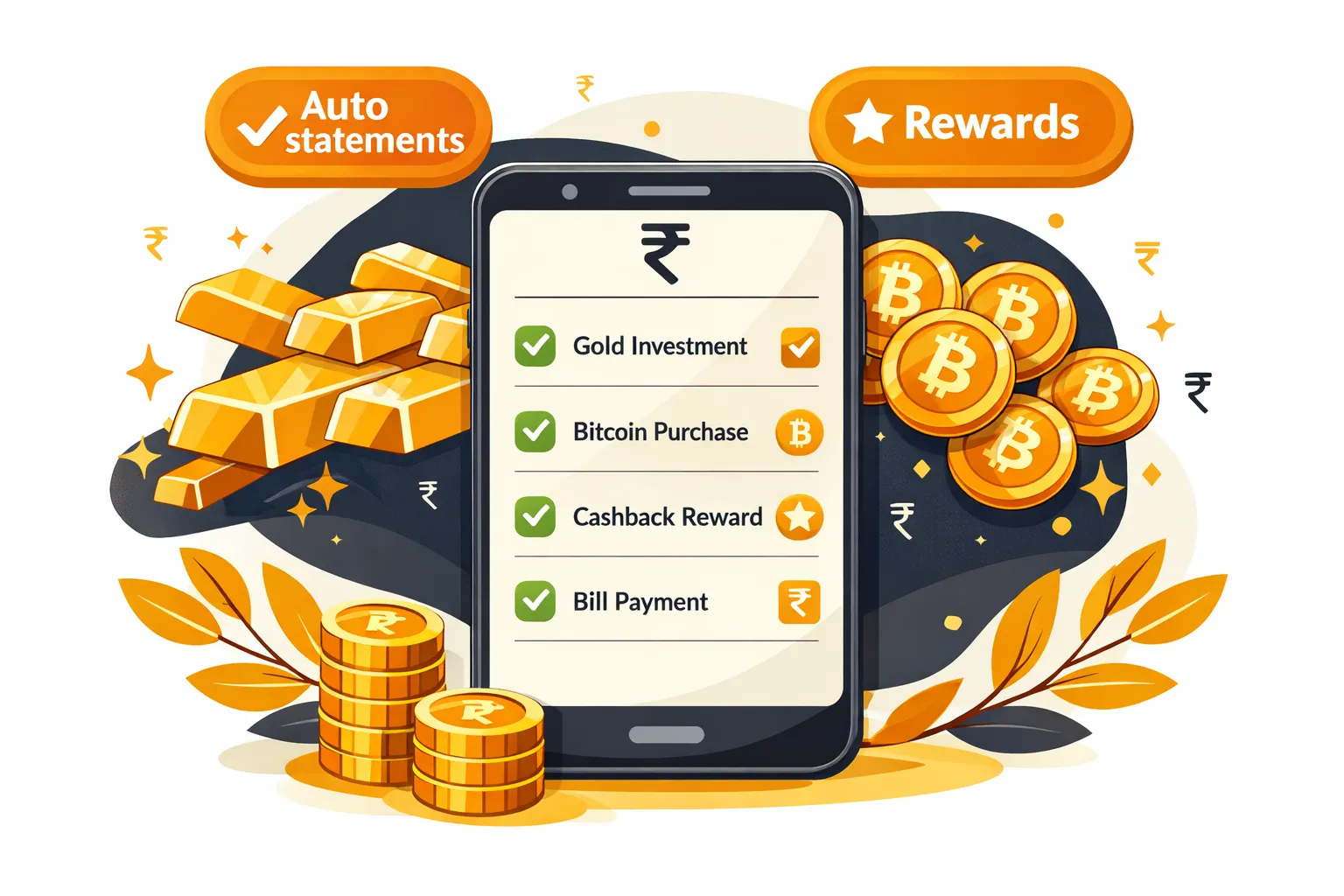
Tax-smart investing shouldn’t feel like homework. With OroPocket, you buy, track, and file – without the chaos.
-
Instant UPI buys from ₹1 – micro-investing that fits your tax plan (no minimums)
-
Automated statements and clear transaction history – easy ITR reporting
-
24K, 100% insured, RBI-compliant vaulting with authorized bullion partners
-
Free Bitcoin rewards (Satoshi cashback) on every gold/silver purchase – two assets for the price of one
-
Gamified habits: daily streaks, spin-to-win, referral bonuses
-
Send gold to friends/family instantly; perfect for gifting (with clear records for tax)
OroPocket features that simplify taxes
-
Downloadable, clean statements with lot-wise details and timestamps
-
Auto tracking of 24‑month holding periods for STCG vs LTCG
-
Net proceeds and fee visibility for accurate gain calculations
Earn Bitcoin on every gold buy
-
Get Satoshi cashback on each purchase – stack sound money alongside sound money.
-
Streaks, spins, and referrals amplify your rewards over time.
Secure, compliant, and instant via UPI
-
24K pure gold, fully insured, vaulted with authorized partners
-
RBI-compliant framework; transparent processes and audits
-
UPI-native checkout – buy gold in under 30 seconds
Level up your gold game: stay compliant, get rewarded, and invest from just ₹1. Download OroPocket now: https://oropocket.com/app
Conclusion: Yes, you owe tax on profits – plan it right with OroPocket
Selling digital gold triggers capital gains tax. Under the updated rules:
-
STCG (≤24 months): taxed at your income tax slab
-
LTCG (>24 months): taxed at 12.5% (no indexation), plus cess/surcharge
-
GST applies only on purchase, not on sale
What to do next:
-
Keep clean records: purchase invoices, sale confirmations, bank entries, and platform fee notes
-
Use FIFO to compute gains across multiple tranches
-
Check your holding period before you sell – crossing 24 months can lower your tax rate
-
File under Schedule CG in ITR‑2 with accurate lot-wise details
Honest note: Markets move. Don’t force a sale just to save tax if you need liquidity. Consider staggered exits to balance cash needs and taxes.
Start building gold the modern way – buy from ₹1, track holding periods automatically, and earn free Bitcoin on every purchase.
Download OroPocket now: https://oropocket.com/app