
Gold Price Chart (2026): Read Trends Before You Buy Gold

Gold Price Chart (2026): Read Trends Before You Buy Gold
If you’re searching for a gold price chart, you don’t need “predictions.” You need a simple way to tell:
-
Is this a real trend or just short-term noise?
-
Should you buy now, wait, or buy gradually?
-
What levels matter so you don’t panic-buy at peaks?
This guide breaks gold charts down for everyday Indian investors – students, salaried folks, small business owners, and first-time savers – so you can make confident decisions without becoming a full-time trader.

Why gold charts matter more in 2026 than “tips”
Gold in 2026 is not moving in a straight line. It’s reacting to:
-
inflation expectations,
-
interest rates,
-
geopolitical risk,
-
currency moves (USD/INR),
-
and big investor flows.
And that means one thing: price swings.
Your edge isn’t predicting headlines – it’s reading the chart well enough to avoid the two most common retail mistakes:
-
Buying only after a big rally
-
Stopping purchases after a dip (right when long-term investors accumulate)
Want a real-time reference point? Track the gold price chart alongside this guide so you can practice as you read.
The 3 timeframes you should read (and what each one tells you)
Most investors look at one chart and conclude “up” or “down.” Pros don’t. They stack timeframes.
1) Long-term chart (3–10 years): “Is gold structurally in an uptrend?”
This is where you check the big story:
-
higher highs & higher lows = long-term uptrend
-
big multi-month zones = major accumulation/distribution areas
This timeframe is perfect for investors who want gold as an inflation hedge and long-term wealth builder.
“Gold prices in India have experienced significant growth over the past six decades. In 1964, the average price of 24-karat gold was approximately ₹63.25 per 10 grams. By January 2026, this price had risen to around ₹94,630 per 10 grams.” – Source
2) Medium-term chart (3–12 months): “Where is the trend likely to pause or break?”
This is where most people get trapped. Medium-term charts show:
-
rally phases (momentum)
-
pullbacks (healthy corrections)
-
breakouts (new legs)
If you’re buying gold for 6–24 months goals, this is your primary chart.
3) Short-term chart (7–30 days): “What’s noise vs a real shift?”
Short-term charts are for timing entries (not for changing your long-term view). Use it to:
-
avoid buying right into a spike
-
place systematic buys on calmer days
The only chart concepts you need (no complicated indicators)
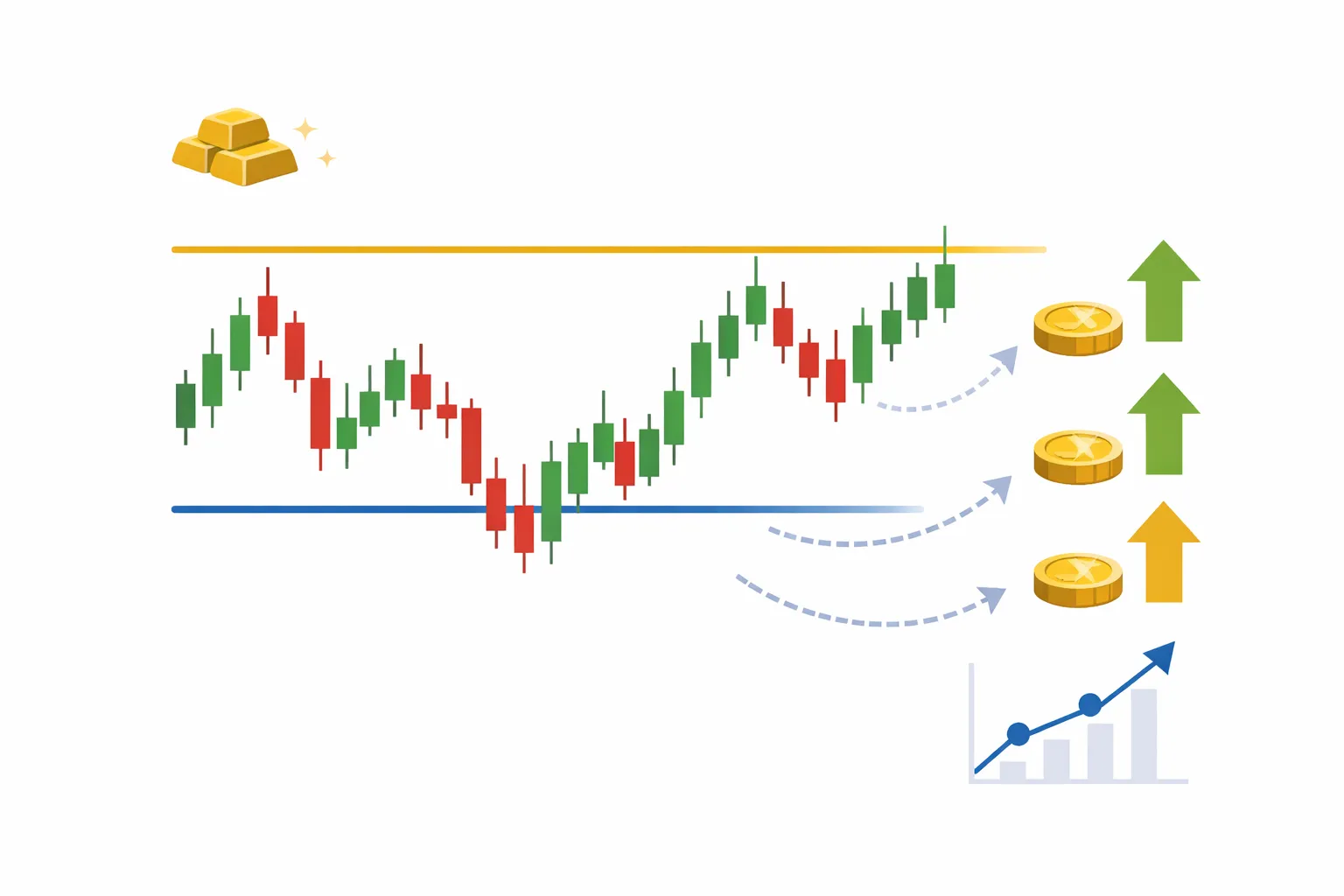
Support & resistance: your “decision zones”
-
Support = level where price repeatedly finds buyers (dips tend to bounce)
-
Resistance = level where price repeatedly faces sellers (rallies tend to pause)
How to draw them:
-
Zoom out (3–12 months)
-
Mark zones where price reversed 2–3 times
-
Treat them as areas, not exact lines
Investor action plan using zones
-
Near support: accumulate gradually
-
Near resistance: slow down buys or switch to smaller amounts
-
Breakout + retest: resume steady buying
To keep it simple, you can track levels on a live chart and compare to the gold rate today in India before placing your buy.
Trendlines (the cleanest way to spot “trend vs chop”)
-
Uptrend line connects rising lows
-
Downtrend line connects falling highs
If price respects the trendline multiple times, it’s a real trend. If it keeps slicing through it, you’re in chop (range-bound).
Volatility: when gold looks “expensive” but isn’t
Gold can look pricey because it moved fast – not because it’s overvalued.
A practical volatility check:
-
If gold has risen sharply in a few days/weeks → expect pullback or sideways consolidation.
-
If gold has been flat and boring → that’s often where smart accumulation happens.
2026 triggers that typically show up on charts first
Charts often “whisper” before headlines scream. In 2026, watch these chart-moving catalysts:
1) USD/INR moves
India imports most of its gold. A weaker rupee can lift domestic gold prices even if global prices are flat.
2) Rate cut expectations
Gold tends to strengthen when markets price in lower real yields.
3) Geopolitical risk
Risk-off flows can create sudden spikes and breakout moves.
“In 2025, gold experienced a remarkable surge, achieving over 50 all-time highs and concluding the year at approximately US$4,368 per ounce – a 67% increase from the previous year.” – Source
A simple “Do This, Not That” plan (built for retail investors)
|
If the chart shows… |
Most people do… |
Better move (2026-proof) |
|---|---|---|
|
Strong uptrend |
Lump-sum at peak |
Start/continue SIP-style buys |
|
Sharp spike |
FOMO buy |
Buy smaller or wait for consolidation |
|
Sideways range |
Lose interest |
Accumulate steadily (best zone) |
|
Dip to support |
Panic stop |
Add small extra buy (if goal is long-term) |
|
Break below support |
Average down blindly |
Pause and re-evaluate; keep buys systematic |
How OroPocket turns chart insights into action (in under 30 seconds)
Reading the gold price chart is step one. Step two is executing without friction.
With OroPocket, you can:
-
Start from ₹1 (so you never need to “time” a perfect entry)
-
Buy instantly using UPI – no bank transfer drama
-
Earn Free Bitcoin (Satoshi) on every gold/silver purchase (yes, even micro-buys)
-
Build a habit via streaks, spin-to-win, and tiered rewards
-
Invest in 24K gold, securely vaulted and insured, with compliance-first operations
The “Gold + Bitcoin” advantage (stability + upside)
Most apps give you one asset. OroPocket gives you two outcomes in one habit:
-
Gold = stability, inflation hedge, wealth protection
-
Bitcoin rewards = growth exposure without needing to trade crypto

If you want to go deeper into price movement history (and what “normal” volatility looks like), compare today with the history of gold prices.
Conclusion: Stop watching the chart. Start building the position.
A gold price chart isn’t there to entertain you – it’s there to help you act smarter:
-
Buy gradually near support
-
Don’t chase spikes
-
Use multiple timeframes
-
Let trends work for you
And if you want the easiest way to turn chart clarity into real progress: start with ₹1 on OroPocket, pay via UPI in seconds, and collect free Bitcoin rewards every time you buy gold or silver.
Stop guessing. Start growing. Download OroPocket: https://oropocket.com/app