
Gold Price Chart: How to Read Today’s Trend, 1Y/5Y Performance & Best Buy Signals

Gold Price Chart: How to Read Today’s Trend, 1Y/5Y Performance & Best Buy Signals
If you’ve ever opened a gold price chart and thought, “Is this trend real… or am I about to buy at the top?”, you’re already ahead of most investors.
Because in India, most people don’t lose money in gold due to “bad gold.” They lose money because they:
-
buy after headlines hype an “all-time high”
-
panic during dips
-
invest in one lump sum emotionally (instead of building a habit)
This guide is your shortcut to reading a gold price chart like a calm, confident investor – so you can avoid panic buying, pick smarter zones, and accumulate using rupee-cost averaging (even from ₹1).
Stop watching. Start growing.
“The average inflation rate in India across 2021–2025 is approximately 5.11%.” – Source
That’s the real enemy. Charts are simply a tool to help you stack gold systematically while inflation quietly eats cash.
What a “gold price chart” in India actually shows (and what it doesn’t)
Before you trust any chart, know what price you’re looking at.
Spot price vs “what you pay” (retail/digital/jewellery)
-
Spot price: global reference price (often USD/oz), moves 24/7.
-
India retail rate: includes import duties, local demand, INR movement, premiums.
-
Digital gold buy/sell quotes: typically show a buy price and a sell price (spread), plus GST impacts.
If you want the cleanest explanation of why “spot” and “local” never match perfectly, read spot price vs local gold rate in India.
Why INR gold can hit “all‑time highs” even when USD gold looks flat
Even if USD gold is steady, INR gold can rise because:
-
INR weakens vs USD (you pay more rupees for the same ounce)
-
import-related costs rise
-
India demand spikes (wedding season, festivals)
-
risk-off sentiment increases local buying
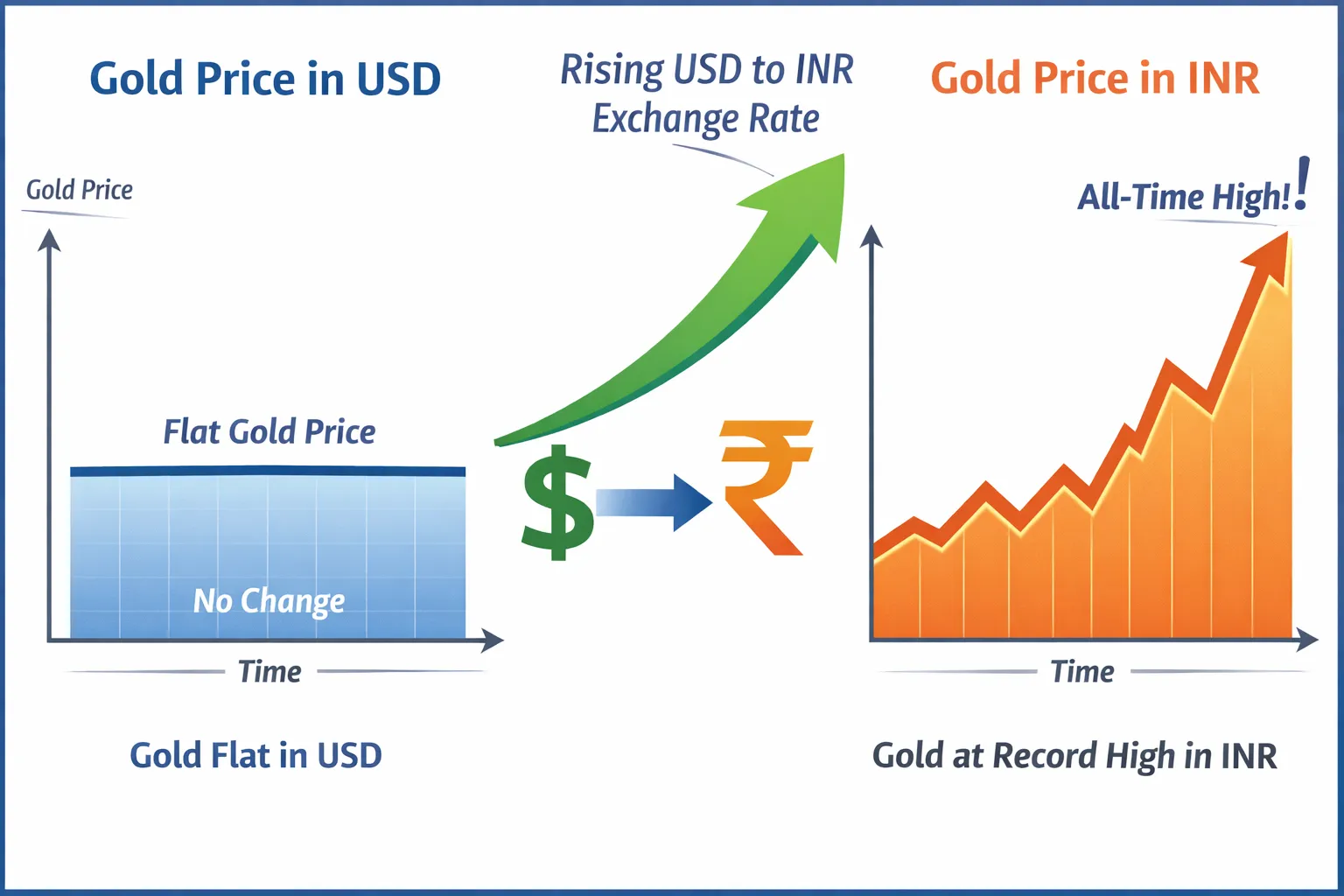
Chart-reading takeaway: Always check (1) the timeframe and (2) which currency (USD vs INR) you’re looking at before you decide “gold is expensive.”
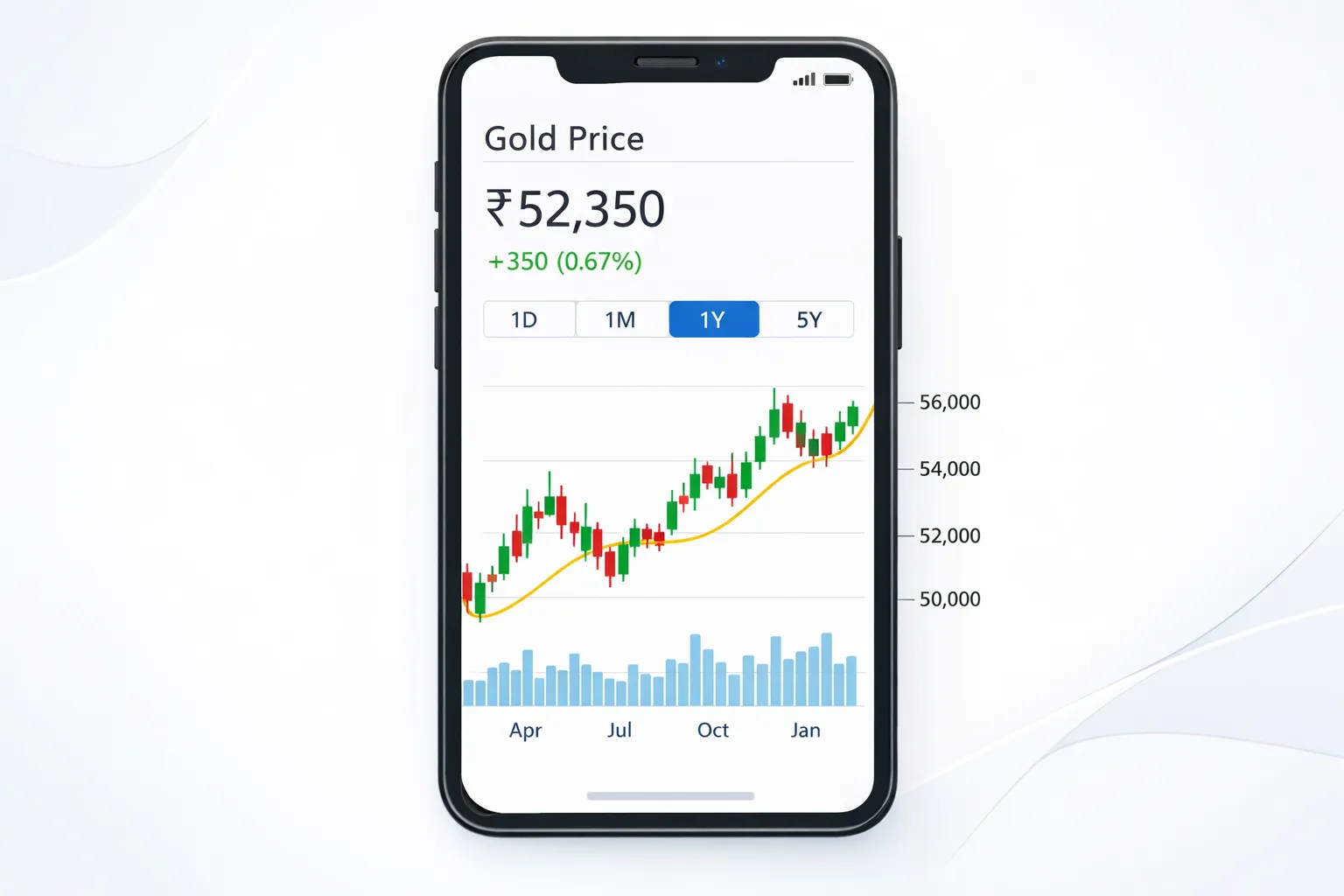
How to switch timeframes (1D, 1M, 1Y, 5Y) without getting confused
Timeframes change the story.
|
Timeframe |
What it’s best for |
Common beginner mistake |
|---|---|---|
|
1D (intraday) |
Seeing today’s direction and volatility spikes |
Overreacting to noise |
|
1M |
Short-term trend + recent support/resistance |
Treating one month as “the trend” |
|
1Y |
Real trend clarity for investors |
Buying only because it’s “up this year” |
|
5Y |
Big-picture conviction + cycles |
Assuming past returns will repeat monthly |
Rule you can trust:
If you’re an investor (not a trader), make your main decisions on 1Y and 5Y, and use 1M to plan entries in phases.
For a beginner-friendly foundation on trends, zones, and indicators, you can also refer to Gold charts explained (support/resistance + key indicators).
Step 1: Read today’s trend in 15 seconds (trend first, everything else later)
A chart has only 3 states:
Uptrend
-
higher highs + higher lows
-
dips are often buy opportunities, not threats
Downtrend
-
lower highs + lower lows
-
buy smaller, wait for confirmation, avoid going “all-in”
Range (sideways)
-
price bounces between two zones
-
ideal for phased buying near support
Fast method: On any chart, zoom out a bit and ask:
Is the slope clearly up, down, or flat?
That one question saves you from most emotional entries.
Step 2: Mark support and resistance (where smart buying actually happens)
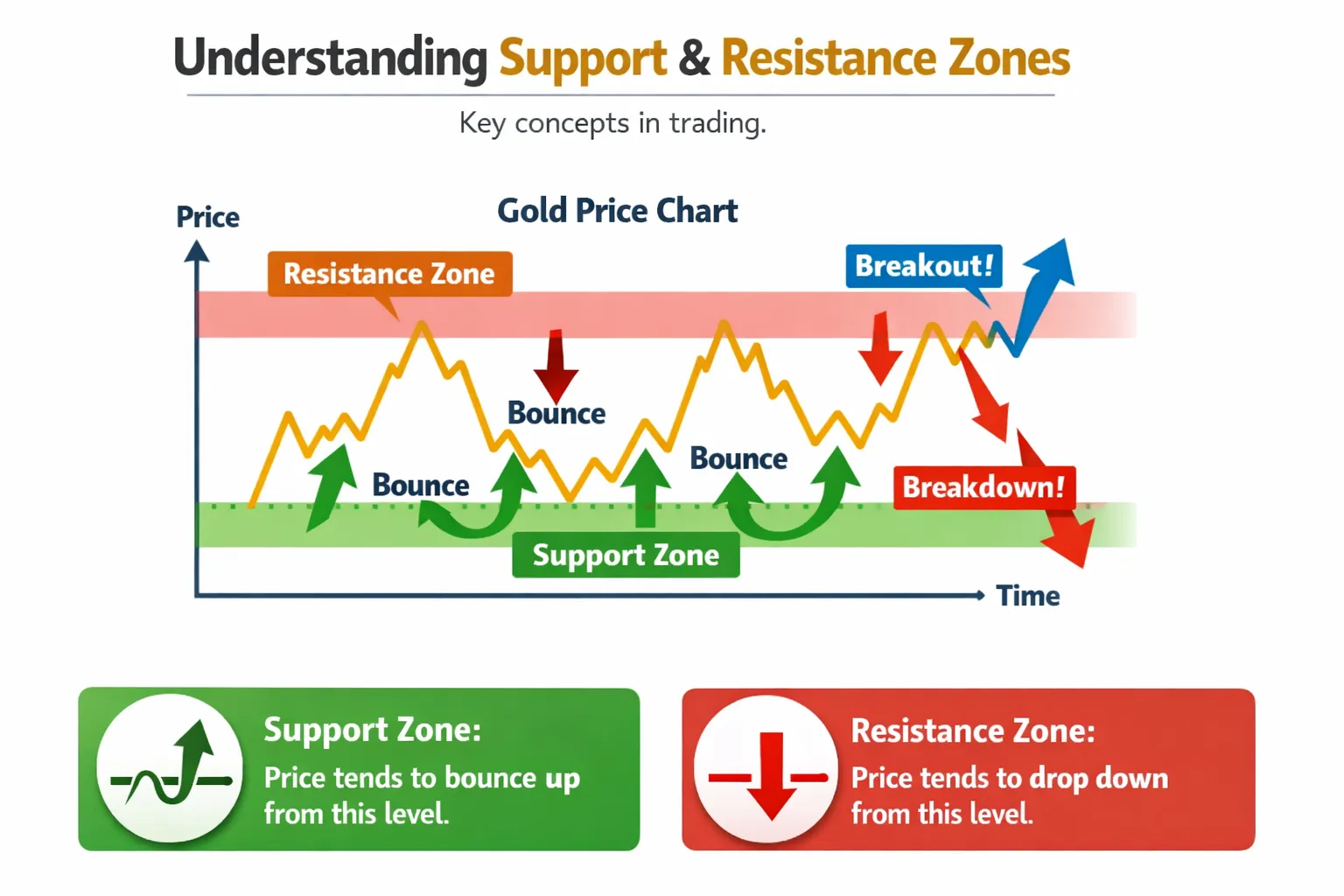
Support/resistance isn’t a “single price.” It’s a zone where decisions repeat.
-
Support = demand zone (“floor”) where buyers keep stepping in
-
Resistance = supply zone (“ceiling”) where selling pressure shows up
The 3 outcomes at a level (and what you do)
-
Bounce (support holds): buy a small tranche
-
Breakout (resistance breaks): wait for confirmation
-
Breakout + retest (best for beginners): buy the retest tranche
Beginner filter: Don’t react to wicks. Wait for a close (especially on 1D charts).
Step 3: Use only the simplest “best buy signals” (no indicator overload)
Indicators don’t predict. They help you avoid bad decisions.
Signal A: Moving Averages (50D + 200D) for “trend health”
-
Price above 50D and 200D: bullish bias
-
Price below: bearish bias
-
50D crossing above 200D (“golden cross”): trend improving
-
50D crossing below 200D (“death cross”): trend weakening
How to use this in real life:
If price is below both MAs, you can still invest – but keep buys smaller and more patient.
Signal B: Volatility spikes (the candle you should not chase)
When you see a sudden vertical move (big candle, big gap-like jump), that’s often:
-
news-driven
-
short-term emotion
-
the worst time to “lump sum” buy
Smart response: switch to phased buying, set alerts, and let price settle.
Signal C: Higher lows (the most underrated “buy signal”)
You don’t need fancy patterns. In an uptrend, a sequence of higher lows is your simplest confirmation that dips are being bought.
Step 4: How to read 1Y vs 5Y performance (without fooling yourself)
A chart can be “up a lot” and still be a bad entry today if you buy emotionally.
-
1Y view tells you: “Is gold trending this year?”
-
5Y view tells you: “Has gold protected wealth across cycles?”
“As of Feb 2026, India’s 24K gold price is about ₹1,56,709 per 10g, up from around ₹48,720 per 10g in Feb 2021 (~221% increase).” – Source
Investor takeaway: Gold’s long-term job is stability + inflation protection. Your job is to enter without FOMO.
The OroPocket way: the easiest strategy to use charts without stress
Most Indians don’t need to “time” gold. They need a system.
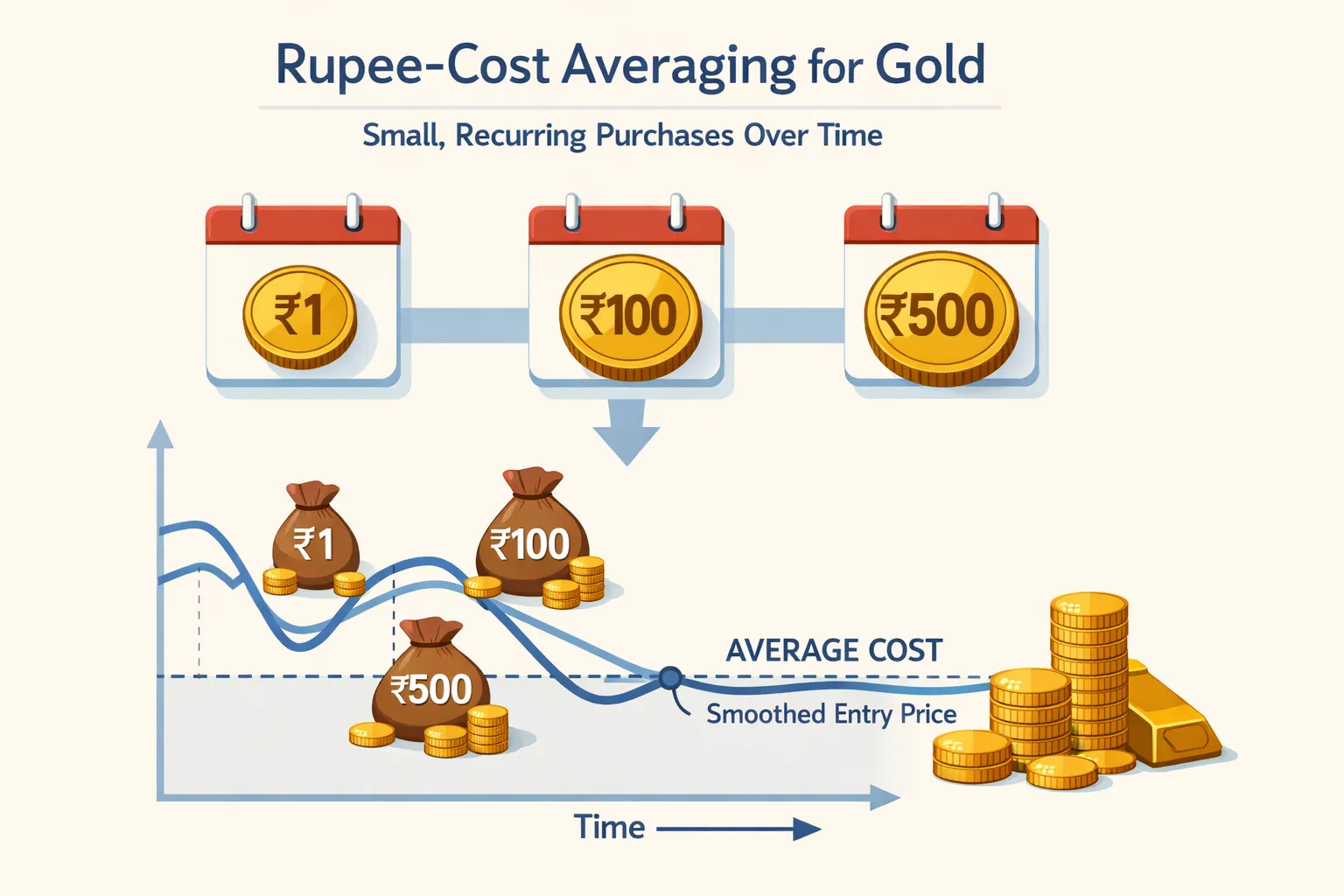
Use rupee-cost averaging (RCA) instead of guessing bottoms
You buy small amounts regularly so your average entry becomes smoother.
Example approach:
-
Buy a base amount weekly/monthly
-
Add a little extra when price is near support
-
Pause the extra buys if price is far above resistance
Set alerts, not emotions
Your alerts should be at:
-
a major support zone (accumulation area)
-
a major resistance zone (breakout watch)
-
key moving averages (trend health areas)
Track your true cost (especially in digital gold)
Returns aren’t just chart up/down. Your net outcome depends on:
-
buy/sell spread
-
GST
-
platform charges (if any)
If you’re using digital gold, read digital gold charges explained (spreads, GST, storage, selling fees) so you measure profit correctly.
Why OroPocket makes chart-based gold investing simpler (and more rewarding)
Charts give you timing. OroPocket gives you execution + habit + rewards – built for India.
What you unlock with OroPocket
|
OroPocket USP |
What it does for you |
|---|---|
|
Start from ₹1 |
No waiting for “enough money.” You start today. |
|
Free Bitcoin on every purchase |
Earn Satoshi cashback while buying gold/silver. |
|
Gold + Bitcoin combo |
Stability + upside exposure without trading stress. |
|
Gamified investing |
Streaks, spin-to-win, tiers = habits that compound. |
|
Instant UPI payments |
Buy in under 30 seconds – no friction. |
|
100% secure & compliant |
RBI-compliant, insured vaults, authorized partners. |
|
Referral rewards |
You + friend earn 100 Satoshi + a free spin. |
This isn’t just investing. It’s progress you can feel:
-
Control: “I’m finally consistent.”
-
Smart: “I buy zones, not headlines.”
-
Rewarded: “I get Bitcoin cashback for doing the right thing.”
Conclusion: Use the chart to buy calmer, not harder
A gold price chart is not there to impress you with indicators. It’s there to help you do three things:
-
Identify the trend
-
Mark zones (support/resistance)
-
Buy in phases with rupee-cost averaging
If you do that consistently, you stop panic buying – and you start building wealth like a pro.
Stop watching. Start growing.
Download OroPocket, start with ₹1, and earn free Bitcoin every time you invest in gold or silver.



Join the Conversation
Be the first to share your thoughts.