
How much of a portfolio should be gold and silver?


Introduction: How much of a portfolio should be gold and silver?
When markets turn choppy and inflation quietly nibbles at your savings, the question isn’t “Should I own gold and silver?” – it’s “How much is right for me?” Get the mix right and precious metals can smooth your returns, cushion drawdowns, and protect your INR purchasing power without derailing long-term growth.
“In 2023, central banks added a net 1,037 tonnes of gold – marking a second straight year above 1,000 tonnes and reinforcing gold’s role as a core reserve asset.” – Source
Why this question matters now (inflation, volatility, INR purchasing power)
-
Inflation keeps real returns on cash and low-yield FDs under pressure – your money buys less every year.
-
Global volatility (rates, geopolitics, slowing growth) increases the odds of sharp equity drawdowns.
-
INR purchasing power erosion is real; gold has historically preserved value during currency weakness.
-
Silver adds a cyclical kicker thanks to industrial demand (EVs, solar, electronics), but with higher volatility.
-
A disciplined metals slice – weighted to gold, complemented by silver – helps diversify across cycles.
What you’ll learn in 6 minutes
-
The ideal total allocation to precious metals for Indian investors (by risk profile)
-
How to split that allocation between gold and silver using the gold–silver ratio
-
A simple rebalancing plan you can actually follow
-
How to start with ₹1 via UPI and earn Bitcoin rewards with OroPocket
TL;DR
-
Most investors: 10–20% in precious metals; bias to gold
-
Typical split inside metals: 60–80% gold, 20–40% silver
-
Review quarterly, rebalance semi-annually or at 5% drift
OroPocket makes this easy: start from ₹1 via UPI, buy 24K digital gold or silver in seconds, and earn free Bitcoin (Satoshis) on every purchase. Build your metals allocation steadily, track progress, and rebalance without the usual friction.
Ready to put a resilient plan in place? Download the OroPocket app now: https://oropocket.com/app
Gold vs silver: Roles, behavior, and when each shines
Gold and silver aren’t duplicates. They play different roles, respond to different forces, and shine in different phases of the market cycle. Get the mix right and you’ll protect downside, participate in upswings, and keep your INR purchasing power intact.
“A strategic allocation to gold has historically improved risk-adjusted returns and reduced portfolio drawdowns across market regimes.” – Source
Gold’s job in your portfolio
-
Store of value, crisis hedge, currency hedge
-
Historically low correlation with equities and INR cash
-
Tends to do well when real rates fall, the USD strengthens against INR, or uncertainty spikes
-
High liquidity and depth: a reliable “shock absorber” when markets turn risk-off
Silver’s job in your portfolio
-
Higher volatility and beta to growth cycles
-
Dual demand (investment + industrial: solar, EVs, electronics)
-
Can lag early in stress but often outruns gold in risk-on recoveries
-
Adds cyclical upside to a metals sleeve – with greater drawdown risk than gold
Watch: Gold vs Silver: What’s the Right Mix for Indian Investors?
How they move in different markets (inflation spikes, rate cuts, risk-on phases)
-
Inflation spikes and rising uncertainty: Gold typically leads as investors seek safety; silver can participate but with sharper swings.
-
Falling real yields or rate-cut cycles: Both benefit as opportunity cost declines – gold often anchors the move; silver can accelerate later as growth expectations improve.
-
Risk-on, growth-led phases: Silver’s industrial link (renewables, electronics, autos) often drives stronger outperformance; gold may consolidate or rise modestly.
-
Strong USD vs INR and currency stress: Gold helps preserve INR purchasing power; silver follows directionally but remains more volatile.
Putting them together: smoother journey + better diversification
Gold cushions shocks; silver boosts cyclicality. Combined, they:
-
Lower overall portfolio correlation to equity and INR cash
-
Smooth drawdowns when risk-off hits (gold’s hedge) while keeping upside optionality (silver’s beta)
-
Create rebalancing opportunities – trim the outperformer, add to the laggard – to enhance long-term risk-adjusted returns
Build your metals mix the modern way: buy 24K digital gold and silver from ₹1 via UPI on OroPocket, earn free Bitcoin on every purchase, and set a simple rebalance habit. Start now: https://oropocket.com/app
How much to allocate to precious metals overall (India-focused rules of thumb)
Getting your allocation right is about balance: enough metals to cushion drawdowns and protect INR purchasing power, but not so much that you dilute long-term equity-led growth.
Quick rules by risk profile
-
Conservative: 5–10% of total portfolio in precious metals
-
Balanced: 10–20%
-
Growth/Volatility-tolerant: 15–25%
Adjust for time horizon, income stability, and equity exposure
-
Shorter horizons or unstable income favor slightly higher metals (tilt to gold) to reduce sequence risk.
-
Longer horizons with steady income can lean lower within the bands and accept more equity volatility.
-
If your equity exposure is high (70–80%+), a 15–20% metals sleeve can materially offset drawdowns.
-
If equity is modest and you hold high-quality debt, you can stay toward the lower end of the bands.
Why “too little” (≤2–3%) doesn’t move the needle in a real drawdown
-
A 2% metals slice barely offsets a 15–25% equity correction – it’s cosmetic, not protective.
-
Small allocations also reduce rebalancing benefits; you won’t have enough gains to redeploy meaningfully.
Why “too much” (>25–30%) can drag long-term growth
-
Gold and silver don’t produce earnings; oversized allocations crowd out equity compounding.
-
Multi-year flat phases are common, especially for silver. Beyond ~25%, opportunity cost rises sharply.
-
Use higher allocations temporarily only if your risk, horizon, or macro view justifies it – and rebalance.
Suggested allocations at a glance
|
Risk profile |
Typical time horizon |
Total metals % |
Suggested Gold % of metals |
Suggested Silver % of metals |
Rebalance frequency |
|---|---|---|---|---|---|
|
Conservative |
3–5 years |
5–10% |
75–85% |
15–25% |
Semi-annual or at 5% drift |
|
Balanced |
5–10 years |
10–20% |
70–80% |
20–30% |
Semi-annual or at 5% drift |
|
Growth |
10+ years |
15–25% |
60–75% |
25–40% |
Semi-annual or at 5% drift |
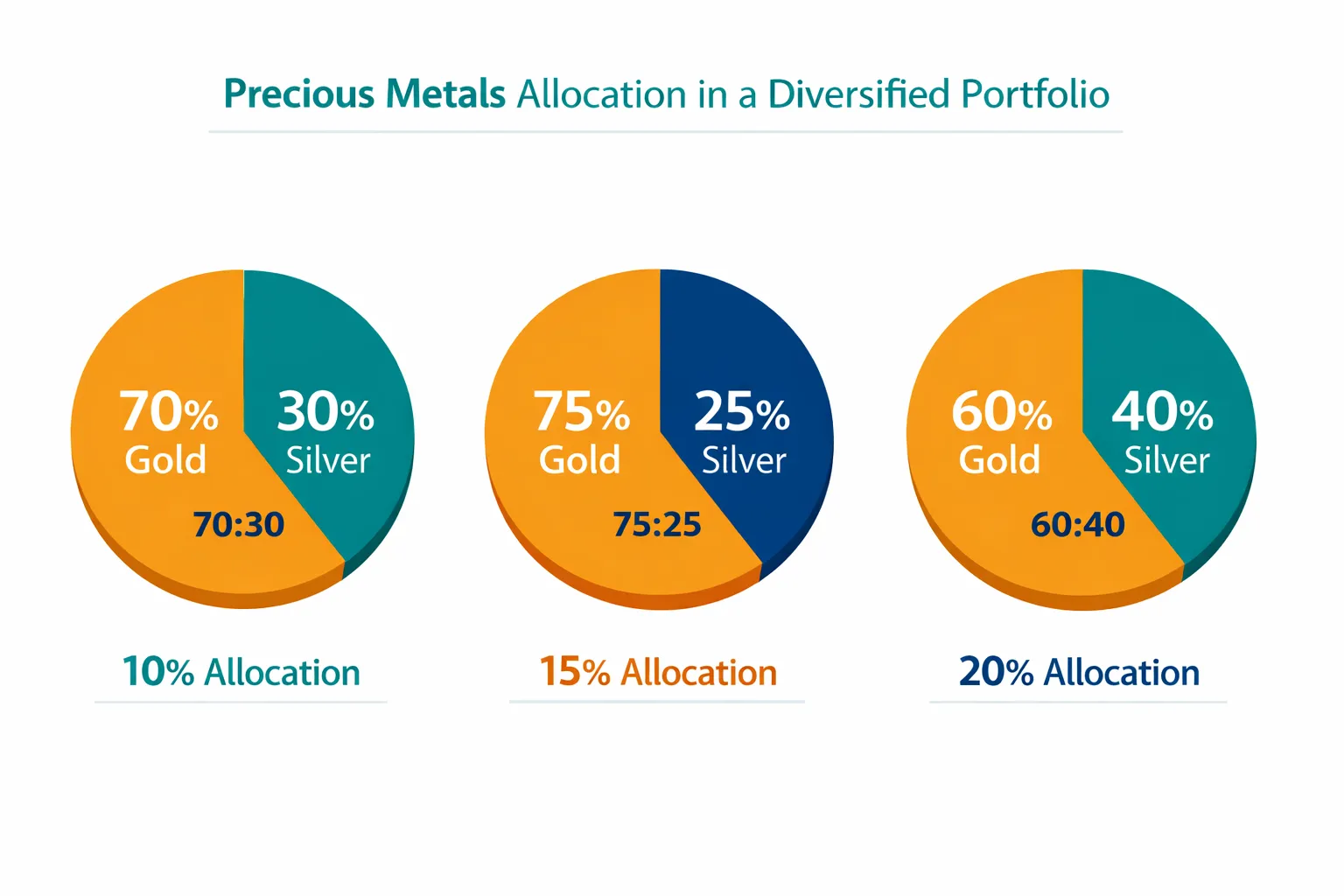
Put this plan on autopilot with OroPocket: start from ₹1 via UPI, buy 24K digital gold and silver in seconds, earn free Bitcoin on every purchase, and set a semi-annual rebalance reminder. Download now: https://oropocket.com/app
How to split between gold and silver: Use the gold–silver ratio (GSR)
“Historically the gold–silver ratio has averaged roughly 65–70 since the 1970s, often spiking above 80 in stress and dipping below 50 in strong silver cycles.” – Source
What the GSR is and why it works
The gold–silver ratio (GSR) compares the price of gold to silver – how many ounces of silver it takes to buy one ounce of gold. It works as a practical compass because:
-
In risk-off phases, gold typically outperforms and the ratio rises.
-
In growth-led, industrial upcycles, silver tends to catch up or outrun, pushing the ratio lower.
-
The ratio mean-reverts over long cycles, creating opportunities to tilt without calling exact tops/bottoms.
Simple tilt rules you can actually follow
-
GSR > 80: tilt +5–10% toward silver (within your metals sleeve)
-
GSR 60–80: stay near neutral (e.g., 70:30)
-
GSR < 60: tilt +5–10% toward gold
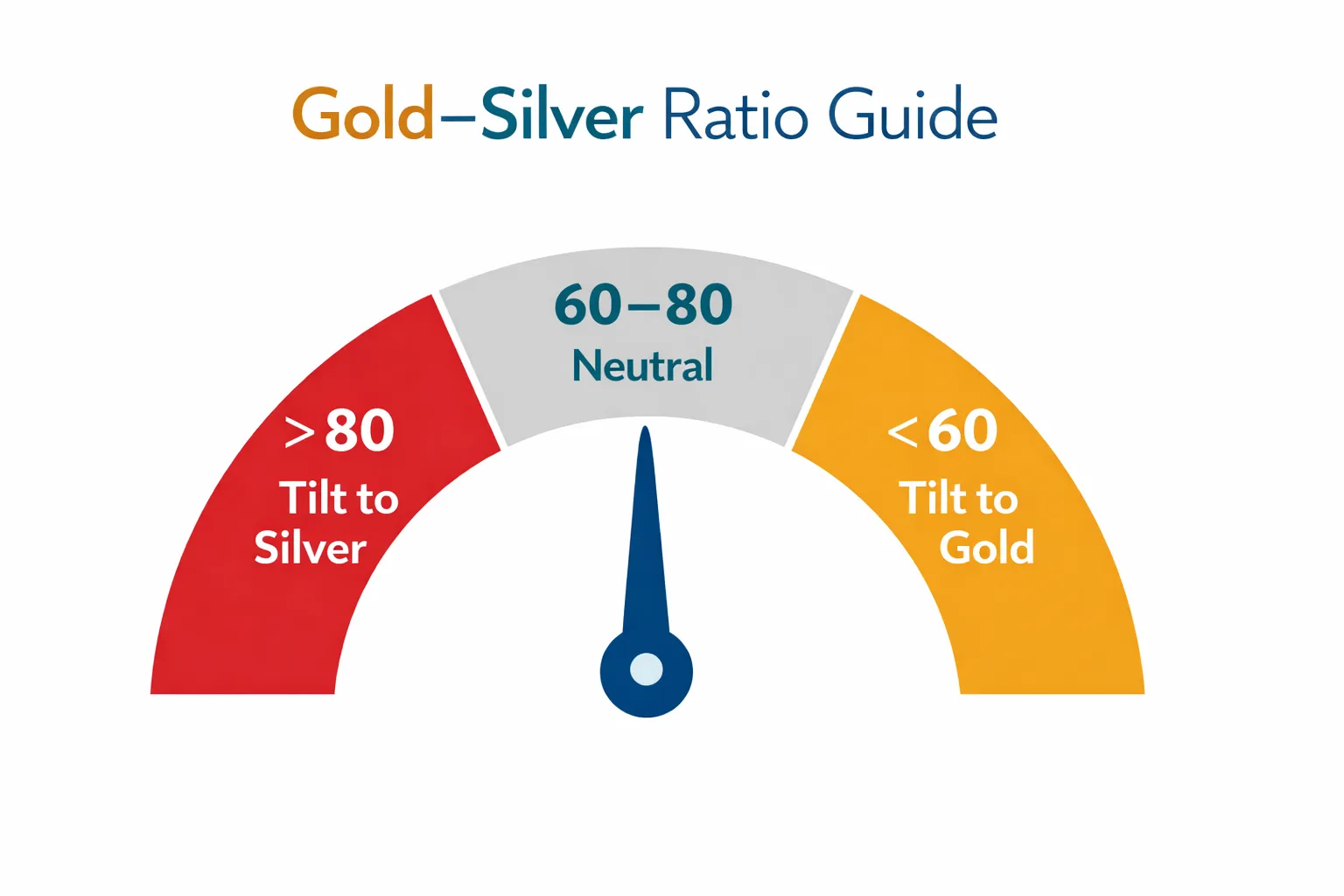
Don’t overtrade; make small, periodic, rules-based shifts
-
Check GSR monthly or quarterly; act only if it sits beyond bands for a full review period.
-
Cap tilts at ±10% inside your metals sleeve to avoid whipsaws.
-
Pair with semi-annual rebalancing or a 5% drift rule so the sleeve doesn’t creep too far.
Combine with volatility awareness (silver swings more; size accordingly)
-
Silver’s higher beta means moves cut both ways; avoid oversized silver weights if a drawdown would derail your plan.
-
Use OroPocket to execute measured tilts from ₹1 via UPI, maintain your target bands, and earn Bitcoin rewards on every buy. Download: https://oropocket.com/app
Rupee examples: What this looks like for real portfolios
Numbers make it real. Here’s how an India-focused, rules-based metals sleeve looks across common portfolio sizes, with practical monthly SIPs you can execute via UPI on OroPocket.
Example 1: ₹2 lakh starter portfolio (Conservative)
-
Target metals: 10% for stability
-
Split: 80% gold, 20% silver
-
Approach: Simple monthly SIP to reach ₹20,000 metals target in ~12 months
Example 2: ₹10 lakh balanced portfolio (Default)
-
Target metals: 15% for a strong diversification core
-
Split: 75% gold, 25% silver
-
Approach: Set a fixed SIP; rebalance semi-annually or at 5% drift
Example 3: ₹25–50 lakh growth-leaning portfolio (Higher silver tilt)
-
Target metals: 18–20% for meaningful protection plus upside
-
Split: 65–70% gold, 30–35% silver to add cyclical beta
-
Approach: Use GSR tilts (±5–10%) and stick to your rebalance cadence
Rupee allocations by portfolio size and goal
|
Total portfolio size |
Metals % |
Metals (₹) |
Gold (₹) |
Silver (₹) |
Suggested monthly SIP via OroPocket (₹) |
Notes |
|---|---|---|---|---|---|---|
|
₹2,00,000 |
10% |
₹20,000 |
₹16,000 |
₹4,000 |
₹1,700 |
Start small, automate via UPI; streak to 5 days for bonus |
|
₹10,00,000 |
15% |
₹1,50,000 |
₹1,12,500 |
₹37,500 |
₹12,500 |
Neutral split; use dips to top up; rebalance semi-annually |
|
₹25,00,000 |
20% |
₹5,00,000 |
₹3,25,000 |
₹1,75,000 |
₹41,700 |
Higher silver tilt (65:35); apply GSR rules; set 5% drift |
|
₹50,00,000 |
18% |
₹9,00,000 |
₹6,30,000 |
₹2,70,000 |
₹75,000 |
Balanced 70:30; harvest gains to equity after rallies |
How SIPs + rebalancing keep you on target even if prices swing
-
Automate discipline: A fixed monthly SIP smooths entry price and removes guesswork during volatility.
-
Review quarterly, rebalance semi-annually: If your metals sleeve drifts by 5% or more, bring it back to target.
-
Use the GSR tilt rules: When GSR > 80, nudge silver up inside your metals sleeve; when < 60, tilt back to gold – always within your preset bands.
-
Keep silver sized to your risk: Silver swings more; don’t let a hot streak push you beyond comfort.
-
Make rewards work for you: On OroPocket, buy from ₹1 via UPI, earn free Bitcoin on every purchase, maintain daily streaks for bonuses, and use Spin to Win to top up metals at no extra cost.
Build your plan in minutes – then let automation do the heavy lifting. Get started on OroPocket now: https://oropocket.com/app
Rebalancing: The habit that protects returns (and nerves)
“Disciplined rebalancing back to a strategic allocation can help maintain diversification benefits and improve risk-adjusted outcomes over time.” – Source
Two simple methods
-
Calendar: every 6 or 12 months
-
Threshold: when gold or silver drifts by ±5% from target inside your metals sleeve
How to do it step-by-step (sell partial winner, buy laggard, restore targets)
-
Check targets vs. actual weights for gold and silver (e.g., 70:30 inside a 15% metals sleeve).
-
If drift exceeds your rule (calendar date or ±5%), sell a small portion of the outperformer.
-
Buy the laggard with the proceeds (and/or a small top-up) to restore target weights.
-
Confirm totals match your sleeve target; log the trade.
-
Set the next reminder and move on – no second-guessing.
Automate discipline: reminders, SIPs, and gamification
-
Use OroPocket streaks and spin-to-win to nudge regular top-ups
-
UPI-based micro-buys (₹1+) make small trims/adds painless
-
Set semi-annual reminders; enable a fixed SIP and pair it with your GSR tilt rules
-
Keep silver sized to your risk – rebalance caps (±10% inside the sleeve) prevent overexposure
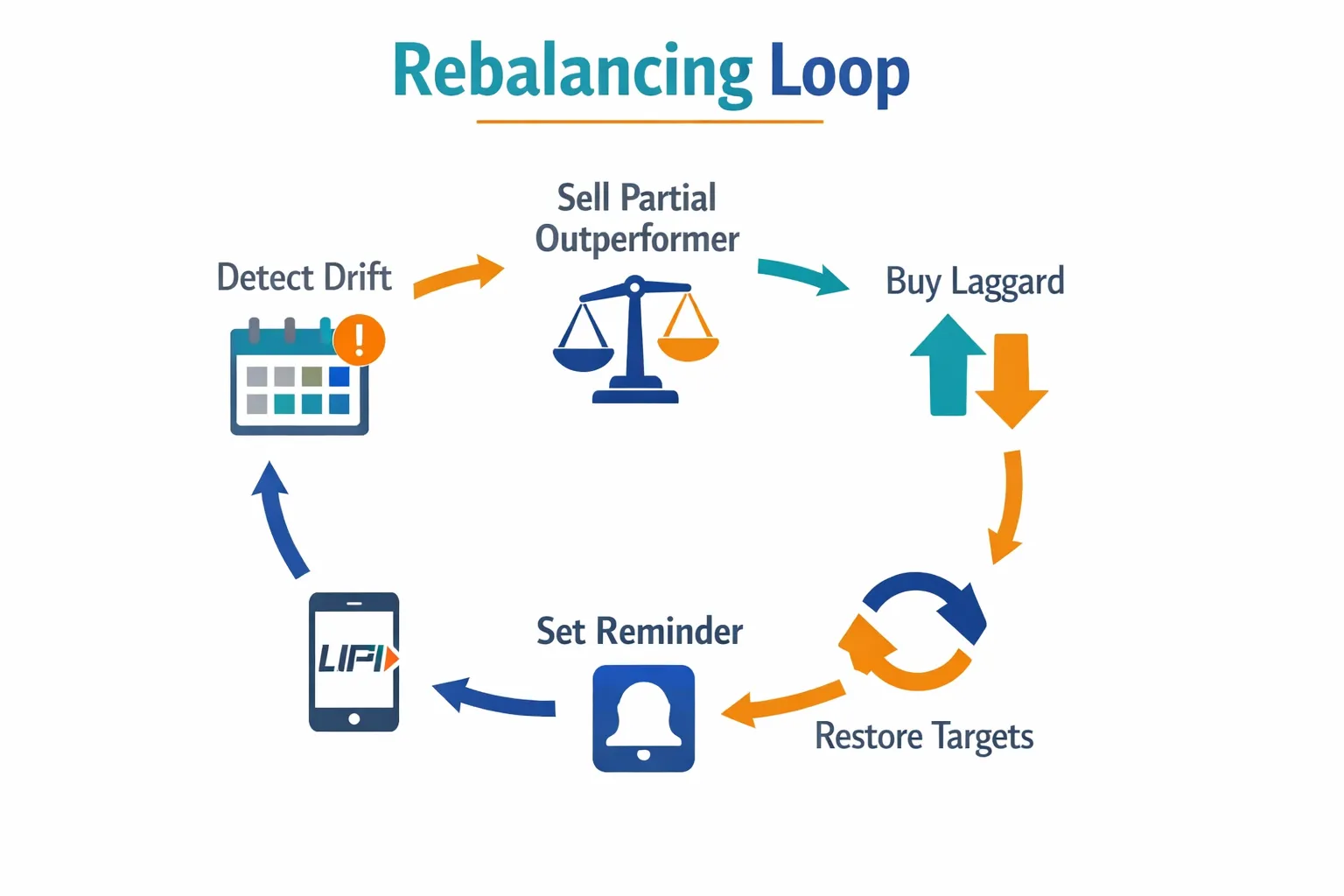
Stay calm, stay consistent. OroPocket lets you execute trims and top-ups in seconds – buy from ₹1 via UPI, earn free Bitcoin on every purchase, and keep your allocation on track. Download now: https://oropocket.com/app
Build your metals position the smart way: SIPs, dips, and micro-investing
Start small, stay consistent
-
Weekly/monthly SIPs (₹1 to ₹1,000+) via UPI
-
Add slightly more on dips instead of chasing rallies
-
Use a simple target band (e.g., 15% metals with 70:30 gold:silver) and let SIPs close the gap
Keep costs and friction low
-
Instant UPI payments, no paperwork
-
Prefer digital gold/silver for liquidity; consider vault-backed, insured holdings
-
Avoid timing stress: automate buys and pair with a 6-month rebalance reminder
Bonus: Stack Bitcoin rewards while you stack gold/silver (OroPocket)
-
Free Satoshi on every buy (tiered rewards)
-
Daily streaks and referrals boost effective yield
-
Send gift gold to family during festivals

Build the habit now – buy from ₹1 via UPI, track progress, and earn Bitcoin on every purchase with OroPocket. Download the app: https://oropocket.com/app
Risks, taxes, and common mistakes to avoid
Volatility and patience
-
Silver’s swings can be large; size accordingly
-
Expect multi‑month sideways phases after big rallies – stick to SIPs and your rebalance rules
-
Use a predefined band for silver (e.g., 20–35% of your metals sleeve) to cap turbulence
Concentration and liquidity
-
Don’t let metals creep beyond your target (e.g., >25–30% of portfolio) unless temporarily by design
-
Keep a separate emergency fund (3–6 months’ expenses) in liquid cash or high-quality debt
-
Match instrument to need: vault‑backed digital gold/silver for day‑to‑day liquidity; avoid long lock‑ins if you’ll need funds
Taxes (high-level, FYI only – not advice)
-
Selling gold/silver can attract capital gains taxes; holding period and instrument type can affect treatment
-
Maintain records: purchase date, amount, price, and any platform fees for accurate gain/loss calculation
-
Consult a qualified tax professional for your situation before large redemptions
Mistakes to avoid
-
Holding too little (≤2–3% is meaningless): Can’t offset equity drawdowns or enable useful rebalancing
-
Going all‑in on one metal: Diversification benefit drops; silver’s higher beta needs a gold anchor
-
Never rebalancing after big moves: Letting winners run unchecked increases risk and future regret
-
Ignoring costs and security of storage: Prefer insured, vault‑backed holdings; monitor spreads/fees; enable 2FA and UPI safety
-
Overtrading the gold–silver ratio (GSR): Use small, rules‑based tilts (±5–10%), not frequent swings
Build safely, grow steadily, and keep friction low. Start with ₹1 via UPI, hold insured 24K digital gold and silver, earn free Bitcoin on every purchase, and automate rebalancing nudges with OroPocket. Download now: https://oropocket.com/app
Conclusion and next steps: Start with ₹1 on OroPocket and get Bitcoin rewards
You don’t need a big lump sum or perfect timing. A disciplined plan, small consistent buys, and simple rebalancing can protect your downside and grow your stack over time.
Your 3-step plan today
-
Pick your total metals % (most Indians: 10–20%)
-
Set a starting split (e.g., 70% gold / 30% silver) and note a GSR tilt rule
-
Automate a monthly SIP via UPI and set a 6-month rebalance reminder
Why OroPocket fits this strategy
-
₹1 entry, instant UPI, 24K insured vaulting, RBI-compliant partners
-
Free Bitcoin (Satoshi) on every purchase + streak bonuses and spin-to-win
-
Gifting gold, referral rewards (100 Satoshi + free spin)
Download the OroPocket app now to start building your gold and silver stack – and earn Bitcoin while you do it: https://oropocket.com/app