
Is digital gold a good investment

You check your bank balance at the end of the month and feel responsible. Salary credited, expenses managed, some money left untouched. Then reality hits. The number in the account hasn’t fallen, but what that money can buy has.
That’s the frustration pushing many Indian savers to ask a sharper question. Not “Where can I park money?” but “Where can I store value without making it hard to access?”
Digital gold sits right in that gap. It promises the familiarity of gold, the convenience of a mobile app, and the low entry barrier of a UPI payment. That mix has caught on fast. India’s digital gold market saw major expansion in 2025, with about 13.5 tonnes purchased, helped by integration into apps like Paytm, PhonePe, and Google Pay, while the wider tokenized gold market reached US$4 billion in market capitalisation, according to Finextra’s 2025 review of digital gold adoption.
That growth alone doesn’t make it a good investment.
Convenience can hide weak regulation. Tiny ticket sizes can distract from taxes. “Instant” access can matter less than ownership structure when something goes wrong. The answer to is digital gold a good investment isn’t yes or no. It depends on what job you want it to do.
If you want a simple way to build a gold position in small amounts, digital gold can work well. If you want the strongest regulation and the cleanest long-term tax treatment, other gold products may suit you better.
Your Savings Are Leaking Is Digital Gold the Answer
A lot of first-time investors don’t begin with stocks or mutual funds. They begin with disappointment.
You save regularly. You avoid impulse spending. You leave money in a savings account because it feels safe. But after a year, that safety feels shallow. The money is still there, yet it hasn’t worked hard enough.
Why this question is showing up now
Digital gold has become popular because it fits how Indians already move money. You open an app, tap a few buttons, pay through UPI, and own a tiny slice of gold. The action feels as easy as recharging a wallet or paying a bill.
That convenience matters more than many people admit. Traditional gold buying often asks for more money, more time, and more trust in the seller. Digital gold removes much of that friction.
Here’s why the topic has become timely:
- App-based access changed behaviour: Buying gold no longer requires a jeweller visit.
- Small starting amounts matter: A beginner doesn’t need a large lump sum to begin.
- Gold feels familiar: Many Indian households already trust gold more than abstract financial products.
Practical rule: If an investment helps you start and stay consistent, it has an advantage over a “better” product you never purchase.
What digital gold does well, and what it doesn’t
Digital gold can solve one clear problem. It makes gold accumulation easy for people who think in monthly savings habits, not in large one-time purchases.
But ease isn’t the same as suitability.
A young salaried worker trying to build an emergency-adjacent inflation hedge may find digital gold useful. A long-term investor focused on tax efficiency and regulation may prefer another route. A family buying for wedding jewellery may still want physical gold. A demat-friendly investor may lean towards gold ETFs. Someone willing to lock money in for policy-backed exposure may consider SGBs.
That’s why this asset class needs a practical reading, not a marketing reading.
The strongest case for digital gold is simple. It lowers the barrier to owning gold.
The strongest case against it is just as simple. It asks you to trust a structure that isn’t regulated like the better-known alternatives.
What Exactly Is Digital Gold
Think of digital gold like a UPI transaction for a physical asset. You pay online, but instead of settling a bill or sending cash to a friend, you’re buying a fractional amount of gold.
What you own
When you buy digital gold through a platform, the core idea is that your purchase corresponds to real physical gold held on your behalf in a vault. You aren’t buying jewellery. You also aren’t buying a mining stock, a derivative, or a crypto token by default.
That distinction matters because beginners often mix up three different things:
| Asset type | What it represents | What drives its value |
|---|---|---|
| Digital gold | Claim linked to vaulted physical gold | Gold price and platform structure |
| Gold ETF | Fund exposure to gold through market instrument | Gold price, fund structure, market trading |
| Crypto asset | Blockchain-native digital asset | Network demand, speculation, utility |
Digital gold is closest to stored bullion, just broken into tiny purchasable units.
Who sits between you and the gold
The structure usually involves multiple layers, even if the app experience feels instant.
- The platform: This is the app or interface where you buy and sell.
- The gold provider: This is typically the entity sourcing and arranging storage of the metal.
- The vault and custody setup: The physical gold is stored here.
- The trustee or oversight mechanism: This is the layer meant to ensure the gold backing matches customer holdings.
For a beginner, the easiest mental model is this: you have a digital key to a very small portion of a securely stored gold bar.
That’s why provider quality matters so much. You’re not only buying gold. You’re relying on record-keeping, vaulting, reconciliation, and redemption processes.
It’s digital access, not digital fiction
A lot of confusion comes from the word “digital”. People hear it and think “virtual”, “speculative”, or “crypto-like”.
That isn’t automatically true.
If the structure is sound, digital gold is a more convenient wrapper around physical ownership. The “digital” part refers to how you buy, track, and sell, not necessarily what backs the asset.
If you want to understand how asset-backed gold can also be represented in newer financial systems, this explainer on gold tokenization gives useful context on how physical gold and digital ownership layers can interact.
The test isn’t whether an asset sits inside an app. The test is whether the ownership chain behind that app is clear.
Why the model appeals to new investors
Digital gold works for beginners because it removes the awkward parts of gold investing.
You don’t need to think about locker fees. You don’t need to verify a coin at a jeweller. You don’t need to wait until you’ve saved enough for a larger purchase. You can start small and build gradually.
That simplicity is the reason so many first-time investors ask, “is digital gold a good investment?” The product feels modern, but the underlying asset is something Indian savers already understand.
The Case for Digital Gold in Your Portfolio
Digital gold earns its place in a portfolio when you treat it for what it is. A liquid, small-ticket, app-first way to build gold exposure. It is not a miracle product. It is a practical one.
Accessibility is the biggest strength
The strongest feature isn’t return. It’s access.
You can start from ₹1, which means digital gold works for students, first-job earners, freelancers with irregular income, and cautious savers who want to begin before they feel “ready”. That matters because investing habits often form through repetition, not through one perfect decision.
Gold’s 2025 performance also pulled more savers toward the category. Gold surged over 30% in 2025, set 53 new all-time highs, and stood out at a time when many Indian bank accounts were still offering only 3% to 4% annually, according to Interactive Brokers’ analysis of gold’s historic 2025 surge.
For someone with small monthly surplus cash, that changes the psychological equation. Gold stops feeling like something you buy only during weddings or festivals. It becomes something you can accumulate steadily.
It removes common friction points
Physical gold carries practical issues that investors often ignore until later. Where will you store it? How will you verify purity? What happens if you need to sell quickly? How much spread will the buyer apply?
Digital gold smooths out those pain points.
A beginner usually values four things:
- Low minimum entry: You can buy without waiting for a large spare amount.
- Convenient timing: App access makes it possible to buy when you remember to save.
- No home storage burden: You aren’t keeping coins or bars in a cupboard or locker.
- Simple exit path: Selling through the same interface is easier than negotiating with an offline buyer.
This convenience isn’t trivial. It changes whether people act at all.
Good fit for a specific role
Digital gold works best when used for the right purpose inside a broader financial life.
It can suit:
| Investor profile | Why digital gold may fit |
|---|---|
| First-time investor | Small starting amount reduces hesitation |
| Young salaried saver | Easy to automate the habit of buying regularly |
| Self-employed professional | Flexible buying and selling can help with irregular cash flow |
| Gold believer who dislikes jewellery costs | Cleaner exposure to gold than ornamental buying |
It is less suitable as the only long-term wealth vehicle. Gold preserves and diversifies. It doesn’t replace the growth role of equities or the income role of debt products.
It can help disciplined savers
People often ask whether digital gold is “worth it” as if the answer lives only in price movement. In practice, the bigger benefit is behavioural.
If a person won’t open a brokerage account, won’t study ETFs, and won’t buy physical bars carefully, then a simple digital gold habit may beat financial paralysis. Ease can be a legitimate advantage.
One useful starting point is to think of digital gold as a modern savings rail, not a complete investment strategy.
For readers comparing safety, legality, and the practical questions around platform-based ownership, this guide on digital gold safety and legality in India is a useful next read.
A good product doesn’t need to do everything. It only needs to do its own job well.
Where digital gold shines most
Its sweet spot is narrow, but real.
Digital gold is compelling when you want:
- A hedge-oriented savings habit
- Fast access without market-hours dependency
- Gold exposure without buying jewellery
- A low-friction route for small, frequent purchases
That’s the best argument in favour of digital gold. It turns gold from a bulky purchase into a repeatable action.
Digital Gold vs Physical Gold vs ETFs and SGBs
Most confusion around gold investing comes from treating all gold options as interchangeable. They aren’t.
Each route solves a different problem. One gives you tangibility. Another gives you exchange-traded access. Another gives you sovereign backing. Digital gold gives you convenience.
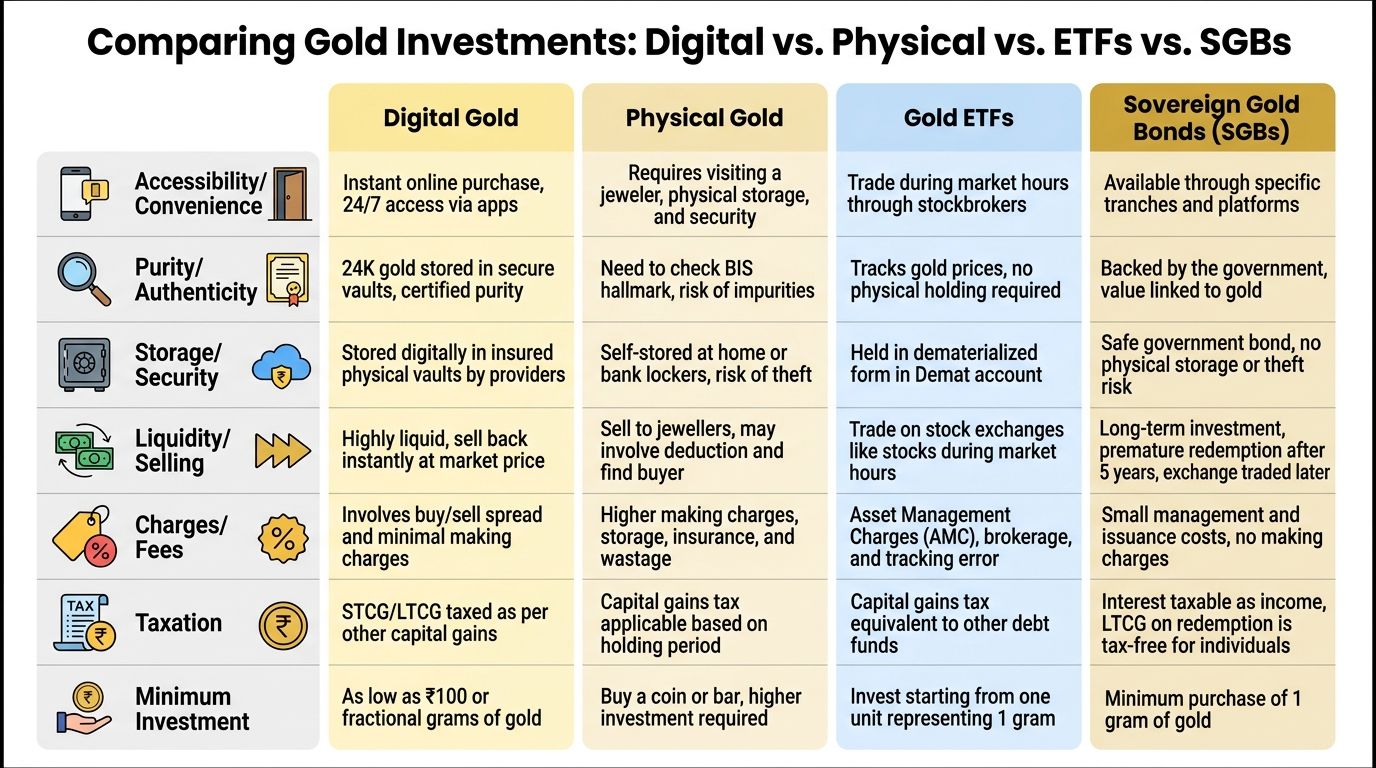
The practical comparison
| Factor | Digital Gold | Physical Gold | Gold ETFs | Sovereign Gold Bonds |
|---|---|---|---|---|
| How you buy | Through an app or platform | From jeweller or bullion dealer | Through demat and exchange | Through issue route or secondary market |
| Entry barrier | Very low, beginner-friendly | Usually higher in practice | Requires market setup | Better suited to planned allocation |
| Storage | Handled by provider structure | Your responsibility | No physical handling | No physical handling |
| Purity handling | Platform-led | Buyer must verify carefully | Fund structure handles exposure | Bond format, not physical gold |
| Liquidity feel | Usually simple in-app sale | Depends on buyer and deductions | Market-linked | Can be awkward before maturity |
| Regulation | Less formal oversight than ETFs/SGBs | Depends on purchase route | Regulated market product | Sovereign-backed instrument |
| Use case | Convenience and small accumulation | Tangible holding and gifting | Portfolio allocation via markets | Long-term gold allocation |
Physical gold still wins on one emotional factor
Physical gold has one advantage digital formats can’t copy. It feels real in the hand.
That matters for family wealth, gifting, ceremonies, and inheritance. In India, gold is not only an investment. It’s also cultural property.
But that same tangibility creates practical baggage:
- Storage concerns: You must secure it yourself.
- Purity uncertainty: Trust depends on seller and verification.
- Resale deductions: Jewellery especially can lose value on resale because making charges don’t come back cleanly.
- Inconvenience: Buying and selling are slower and less standardised.
If your goal is adornment or family transfer, physical gold may still be the right choice. If your goal is pure savings efficiency, it often isn’t.
Gold ETFs suit investors who already use markets
Gold ETFs are cleaner for people who already have a demat account and are comfortable with exchange-traded products.
They usually appeal to investors who want gold exposure inside a formal financial portfolio, alongside equity funds and debt products. That structure makes ETFs attractive for disciplined asset allocation.
They don’t feel as simple to a first-time saver, though. For someone new to investing, opening accounts, understanding order placement, and dealing with market terminology can become enough friction to delay action.
For a deeper look at where exchange-traded gold works best, this guide on gold ETF pros, costs, returns, and options in India is worth reading.
SGBs can be excellent, but only for a certain temperament
Sovereign Gold Bonds often look best on paper for patient investors.
They can appeal to people who want policy-backed exposure and are comfortable with a longer holding mindset. But that same structure can make them less useful for someone who wants easy liquidity or likes the flexibility of adding and redeeming small amounts without much planning.
This is the mistake many new investors make. They compare products by headline benefit rather than by actual usage pattern.
If you know you’ll need flexibility, don’t choose a gold product built for patience alone.
So which one is best
There isn’t one “best” gold format. There is only the best fit for your job.
Use this simple lens:
Choose digital gold when
- You want to start tiny
- You care about app convenience
- You want quick buying and selling
- You’re building a small, steady savings habit
Choose physical gold when
You want something you can hold, gift, wear, or pass down directly.
Choose ETFs when
You already invest through market products and want gold inside a more formal portfolio framework.
Choose SGBs when
You want sovereign-linked exposure and can tolerate less flexibility.
Digital gold often wins the usability test. It doesn’t always win the structure test. That difference is where many investment decisions go wrong.
The Hidden Risks of Investing in Digital Gold
The marketing version of digital gold usually focuses on three words. Easy, instant, accessible.
The risk version starts elsewhere. Who regulates it, who holds it, and what happens if there’s a problem?

The regulation gap is the biggest issue
This is the part many new investors don’t hear clearly enough. Digital gold is not a SEBI-regulated product in India in the same way Gold ETFs or SGBs are.
That means your protections depend much more on the platform’s structure, operational discipline, and partner quality. According to the referenced report, unresolved consumer complaints related to vault audits and fund safety rose 40% year over year in 2025, which underlines why this matters during stress periods and not just during smooth app usage, as discussed in this report on digital gold risks and complaints in India.
This doesn’t mean every provider is unsafe. It means the burden of due diligence falls more heavily on you.
Counterparty risk is real
When you buy digital gold, you rely on several promises working together:
- the gold has been purchased,
- records are accurate,
- storage arrangements are intact,
- redemption and sale processes function when needed.
If a platform has weak controls, poor reconciliation, or messy customer support, your risk isn’t the gold price alone. Your risk includes the system around the gold.
That’s why digital gold should never be judged only by app design. A slick interface tells you almost nothing about operational strength.
Tax can reduce long-term efficiency
A second under-discussed issue is taxation.
Digital gold may look identical to other forms of gold exposure on your app screen, but tax treatment can differ in ways that matter, especially if you buy regularly and sell later. The tax drag can change the net result enough to make another gold vehicle more sensible for long-horizon investors.
Spreads and execution matter too
Even when the gold backing is solid, your return is affected by practical trading realities. The buy price and sell price are not the same. That spread is the hidden cost most beginners notice only after they transact.
This means digital gold works better for accumulation than for constant in-and-out trading. If you treat it like a daily speculation tool, friction can eat into outcomes.
Convenience can hide cost. Always check how easily you can buy, how easily you can exit, and what gap sits between the two prices.
Fraud awareness still matters
Not every bad outcome in finance is a market problem. Some are governance problems, disclosure problems, or outright misrepresentation problems. Investors who want a broader understanding of how misconduct can appear in financial products can read this plain-language explanation of security fraud.
Digital gold isn’t automatically suspicious. But any lightly understood product deserves extra scrutiny, especially when the buyer is relying on layers they cannot physically inspect.
A sensible reading of the risk
Digital gold is not “bad” because it has risk. Every investment has risk.
The important point is that its main risks are structural, not just market-based. A new investor usually understands price volatility. They may not think enough about regulation, custody, settlement, and tax treatment.
If you still want the convenience, that’s fine. Just don’t confuse ease of purchase with completeness of protection.
How to Start Investing in Digital Gold The Smart Way
A good start in digital gold has less to do with market timing and more to do with provider selection, position sizing, and tax awareness.
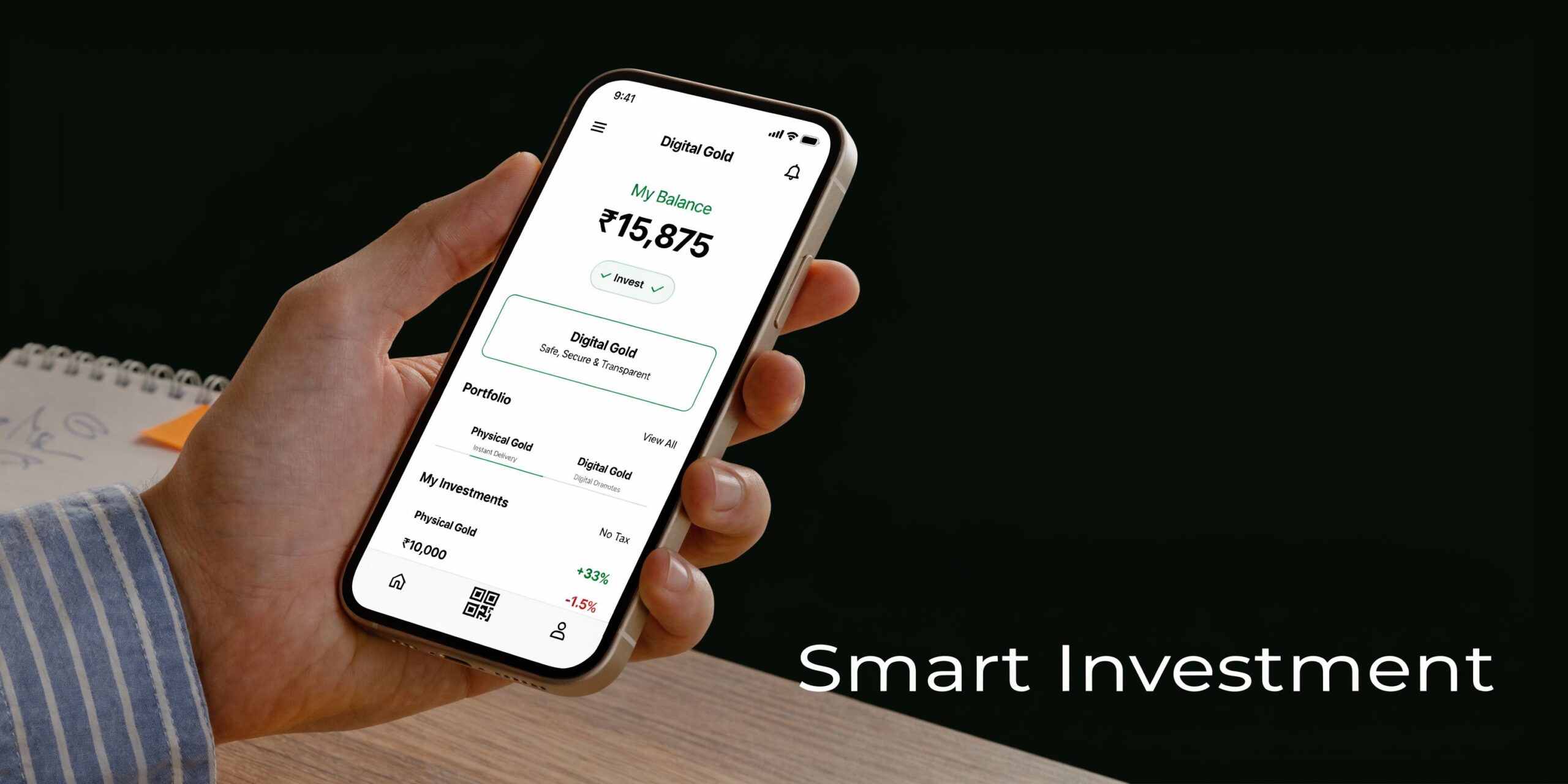
Use a provider checklist before you buy
Don’t begin with “Which app is popular?” Begin with “What can this app verify?”
Look for:
- Clear storage and vaulting disclosures: You should be able to understand where the gold sits and under whose arrangement.
- Visible partner information: The gold provider and custody setup shouldn’t be vague.
- Transparent live pricing: If buy and sell prices aren’t easy to inspect, move on.
- Straightforward redemption and sell process: You shouldn’t need to dig through support articles to understand how exit works.
- Terms you can clearly read: If the ownership language feels murky, that’s a warning sign.
A polished app is helpful. Verifiable structure is better.
Start small, then test the full cycle
Many beginners make one purchase and stop their due diligence there. That’s incomplete. You should test the process end to end.
Buy a small amount first. Observe how the price is displayed, how the holdings appear, and how records are shown. If the platform allows selling, test a small sale too. The user experience isn’t just the buy button. It’s the entire cycle.
Buy small enough that you can treat the first transaction as a systems check, not as a major financial decision.
Match the amount to your situation
Digital gold works best when the amount fits your purpose.
For a student
Use it as a disciplined savings habit. Small monthly purchases can be more useful than waiting for a “better time” that never comes.
For a young professional
Think of digital gold as one part of your broader allocation. It may suit the portion of savings you want in a liquid, gold-linked asset rather than as your entire investment plan.
For a small business owner or self-employed saver
If your cash flow is uneven, flexible buying can be more practical than committing to products that demand a fixed structure. The key is to keep business liquidity and personal investment decisions separate.
SIPs are useful, but know the tax angle
A regular monthly purchase plan can build discipline and reduce the temptation to overthink price moves. But convenience should not blind you to tax consequences.
For long-term investors, tax can become a real drag. A ₹10,000 monthly SIP over 3 years in digital gold could create a tax bill on gains that is double that of a Gold ETF, because of the difference between slab-rate treatment and the long-term structure available in ETFs, as noted in MMTC-PAMP’s discussion of digital gold pros and cons.
That single point changes how I’d use digital gold.
For short-to-medium accumulation, convenience may justify the format. For larger long-term allocations, you should compare alternatives carefully before committing.
Keep your operating rules simple
A beginner doesn’t need a complex framework. Three rules are enough:
- Use digital gold for access and flexibility, not as your whole portfolio.
- Review taxes before scaling the amount.
- Choose the provider only after understanding custody and exit mechanics.
If you want a practical walkthrough of the actual transaction process, this step-by-step guide on how to buy and sell digital gold in India with UPI can help.
The smartest way to start is boring. Small amount, careful provider check, steady habit, and no illusions.
Conclusion Your Verdict on Digital Gold
So, is digital gold a good investment?
Yes, for the right job.
It’s good when you want an easy way to build gold exposure in small amounts, buy through a familiar mobile flow, and keep access flexible. That makes it especially useful for first-time investors, young savers, and anyone who likes the simplicity of app-based accumulation.
It’s not ideal when your top priorities are the strongest formal regulation or the most efficient long-term tax treatment. That’s where products like ETFs or SGBs may deserve more attention.
The verdict is this: digital gold is a strong convenience product, a decent savings tool, and a selective investment vehicle. It works best when you use it deliberately, not blindly. If you treat it as a modern way to accumulate gold and you choose the provider carefully, it can be useful. If you treat it as the default best form of gold ownership for every goal, you’ll probably miss the trade-offs that matter.
A smart investor doesn’t ask only whether an asset is good. They ask whether it is good for this purpose, in this amount, and in this structure.
That’s the standard digital gold should be judged by.
If you want a simple way to start from ₹1, track your holdings on your phone, buy and sell with real-time access, and explore a modern gold savings experience built for Indian users, download OroPocket and start your journey.



Join the Conversation
Be the first to share your thoughts.