
Is gold a good investment if the market crashes?

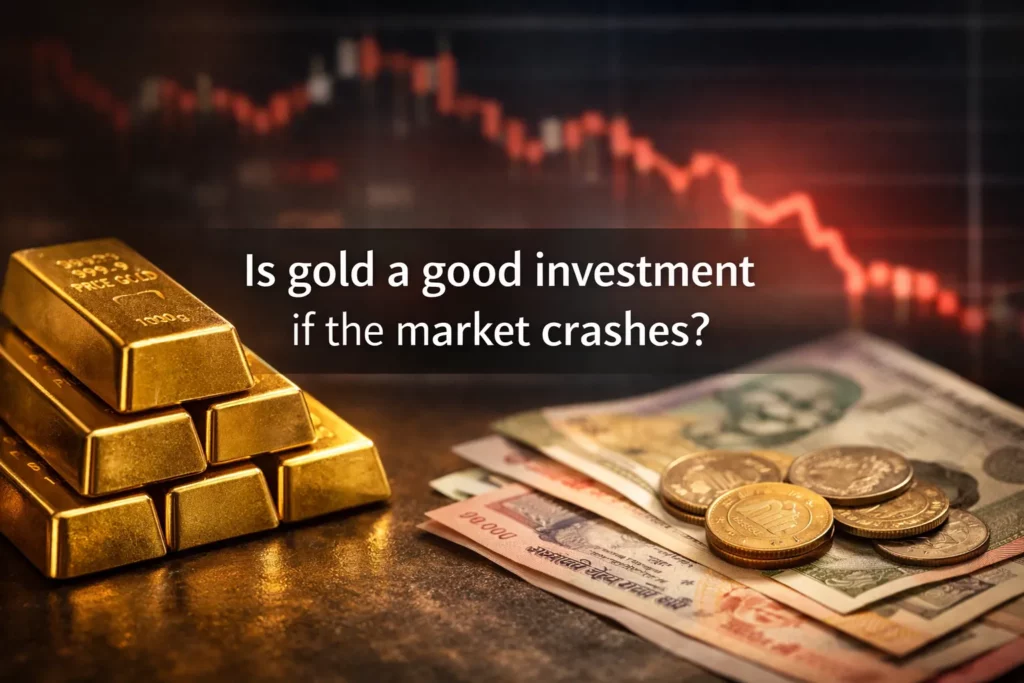
Is gold a good investment if the market crashes?
When markets crash, most Indians don’t lose money because they “picked the wrong stock.” They lose money because they didn’t have a crash cushion – an asset that tends to hold value when panic hits.
That’s where gold earns its reputation.
Gold isn’t a magic shield (it can dip briefly in liquidity crunches), but historically it’s been one of the most reliable portfolio stabilizers during equity drawdowns – especially for retail investors who need peace of mind, liquidity, and simple execution.
And in 2026, you don’t need lakhs, lockers, or jeweller mark-ups to build that cushion. You can start with ₹1 using OroPocket, buy in seconds via UPI, and earn free Bitcoin (Satoshi cashback) on every gold/silver purchase – so you’re stacking stability and upside without becoming a crypto trader.

Why gold tends to do well when markets crash (and when it doesn’t)
The core reason: gold is not “someone else’s promise”
Stocks rely on earnings. Bonds rely on repayments. Even cash relies on purchasing power staying intact.
Gold is different: it’s a globally priced asset with limited supply and centuries of acceptance. During panic, investors rotate into what they believe will still be valuable tomorrow.
The “crash pattern” you should expect
Gold’s behavior in a crash often looks like this:
|
Crash Phase |
What happens |
Why |
|---|---|---|
|
Shock (days/weeks) |
Gold may dip briefly |
Investors sell anything liquid to raise cash |
|
Stabilization |
Gold usually strengthens |
“Flight to safety” begins |
|
Policy response (rate cuts/stimulus) |
Gold often benefits |
Lower real yields make non-yielding gold more attractive |
“In late 2008, gold fell over 20% during forced selling, but finished 2008 up ~5.5% while the S&P 500 fell 37%.” – Source
What this means for you: gold is less about perfectly timing the crash day. It’s about owning a strategic allocation before the storm – and continuing to build it consistently.
If you want to go deeper into what really drives day-to-day pricing in India, read: gold market investment basics and what drives gold prices.
Gold vs equities during a crash: the “sleep at night” factor
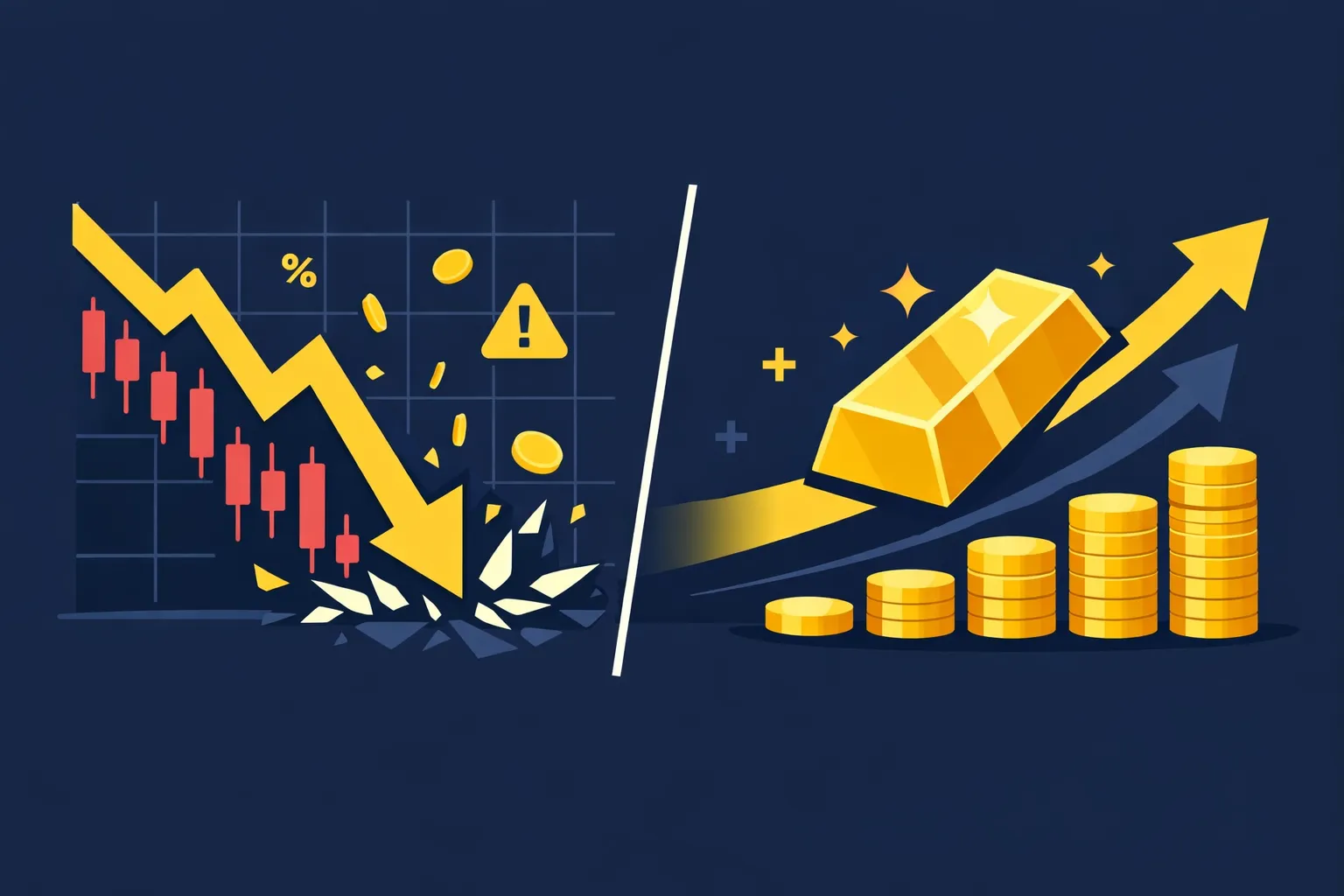
A market crash is more psychological than mathematical. The real risk is panic-selling the bottom.
Gold helps because it tends to:
-
Reduce portfolio volatility
-
Provide liquidity when you need it
-
Act as a hedge when fear rises (not always instantly, but often meaningfully)
The central bank signal: why gold demand spikes in crises
Retail investors aren’t the only ones who run to gold when uncertainty rises. Central banks do it too – because gold is a reserve asset that doesn’t depend on another country’s credit risk.
“Central banks bought 1,136 tonnes of gold in 2022 – the highest annual level on record since 1950.” – Source
That kind of institutional demand is one reason gold can hold up when risk assets crack.
How gold protects Indian investors specifically (rupee effect matters)
In India, gold returns are driven by two engines:
-
Global gold price (USD)
-
USD/INR movement
In many equity crashes, INR tends to weaken. When the rupee weakens, domestic gold prices often rise even if global gold is flat – giving Indian investors an extra layer of protection.
To understand what you’re actually paying (and why rates differ), use this: spot price vs local gold rate in India.
Physical gold vs digital gold during a crash (what’s smarter in 2026?)
Physical gold feels comforting, but it comes with friction – especially in a fast-moving market.
|
Feature |
Physical gold (coins/jewellery) |
Digital gold (OroPocket) |
|---|---|---|
|
Minimum entry |
High |
₹1 |
|
Buying speed |
Slow |
Under 30 seconds via UPI |
|
Storage risk |
Yours |
Insured vault storage |
|
Spreads/making charges |
Often high |
Transparent pricing |
|
Liquidity |
Depends on buyer/jeweller |
In-app buy/sell convenience |
|
“Extras” |
None |
Free Bitcoin cashback + gamified rewards |
If you’re deciding how to start, here’s a simple guide: how to invest in gold in India (smart options for 2026).
The best crash strategy isn’t “buy gold at the bottom” – it’s habit-building
Most people try to time gold after fear starts. That’s usually expensive and stressful.
A stronger approach:
-
Build gold gradually (micro-SIPs)
-
Keep it liquid
-
Rebalance during extremes
Why OroPocket fits perfectly for crash-proofing
OroPocket is built for the exact investor profile that gets hit hardest in crashes: students, salaried professionals, and first-time investors who want simplicity + safety + small starting amount.
OroPocket’s edge in one line:Gold’s stability + Bitcoin’s upside – without crypto confusion.
What you get (that typical gold apps don’t offer)
-
₹1 entry point: start immediately, no “save up first” barrier
-
Free Bitcoin on every buy: earn Satoshi cashback automatically
-
Gold + Bitcoin combination: stability + growth potential in one habit
-
Gamified investing: daily streaks, spin-to-win, tiered rewards – so you invest consistently
-
Instant UPI payments: no waiting, no bank transfer friction
-
100% secure & compliant: RBI-compliant, insured vaulting, authorized bullion partners
-
Referral rewards: both people earn 100 Satoshi + free spin
This isn’t just investing – it’s momentum:
-
Control: “I’m not helpless in a crash.”
-
Progress: “I’m building wealth daily.”
-
Smart: “I’m beating inflation while others wait.”
-
Rewarded: “I get Bitcoin cashback just for being consistent.”
Final verdict: is gold a good investment if the market crashes?
Yes – as a hedge and stabilizer, gold is one of the most practical investments to hold when markets crash. Not because it always spikes instantly, but because it tends to protect purchasing power, reduce portfolio drawdowns, and give you liquidity when fear is highest.
The real win is not owning gold “someday.” It’s owning it before the crash – and building it automatically in small amounts.
Stop watching. Start growing.
Start your crash cushion today with OroPocket – invest from ₹1, buy via UPI in seconds, and earn free Bitcoin cashback on every purchase.