
Is Gold the Best Investment in 2026? Compare It With Stocks, FDs, Mutual Funds & Real Estate

Is Gold the Best Investment in 2026? Compare It With Stocks, FDs, Mutual Funds & Real Estate
If you’re an Indian retail investor in 2026 – student, salaried professional, side-hustler, or first-time investor – your problem is simple:
-
Prices keep rising (your savings don’t).
-
Markets feel risky (but you don’t want to miss growth).
-
Real estate feels “out of reach” (huge ticket size, paperwork, low liquidity).
-
You want something easy, mobile-first, UPI-friendly, and ideally rewarding – so you actually stick with it.
Gold keeps showing up as the “safe” answer. But is it the best investment?
This guide gives you the real verdict: gold vs stocks vs mutual funds vs fixed deposits vs real estate – benchmarked on what actually matters: returns potential, risk, liquidity, inflation protection, and income generation. Then we’ll show you the right role of gold in a smart portfolio – and how to buy it without losing money to hidden costs.

The short verdict: Gold is not the best investment – unless you define “best” correctly
Gold is rarely the highest-return asset over long periods. But it’s one of the best at:
-
Protecting wealth during chaos
-
Reducing portfolio drawdowns
-
Holding value when inflation bites
-
Providing liquidity without needing a buyer, tenant, or “right market cycle”
So in 2026, the smartest answer is:
Gold is the best “stability + insurance” asset in a portfolio – not the best “growth engine.”
Your portfolio wins when gold works with equities, not instead of them.
If you want a deeper take on what actually moves gold prices (and why it matters for your timing), read: gold price drivers and smarter investing in 2026.
A quick reality check: gold has not been “slow” lately
Gold has had a strong run in recent years – especially in uncertain macro cycles.
“From 2021 to 2026, gold delivered a CAGR of 23.10%, resulting in an absolute return of 183%.” – Source
That’s exactly why many investors ask: “Is gold the best investment now?”
But a great recent run doesn’t change portfolio math: gold’s main job is protection + diversification.
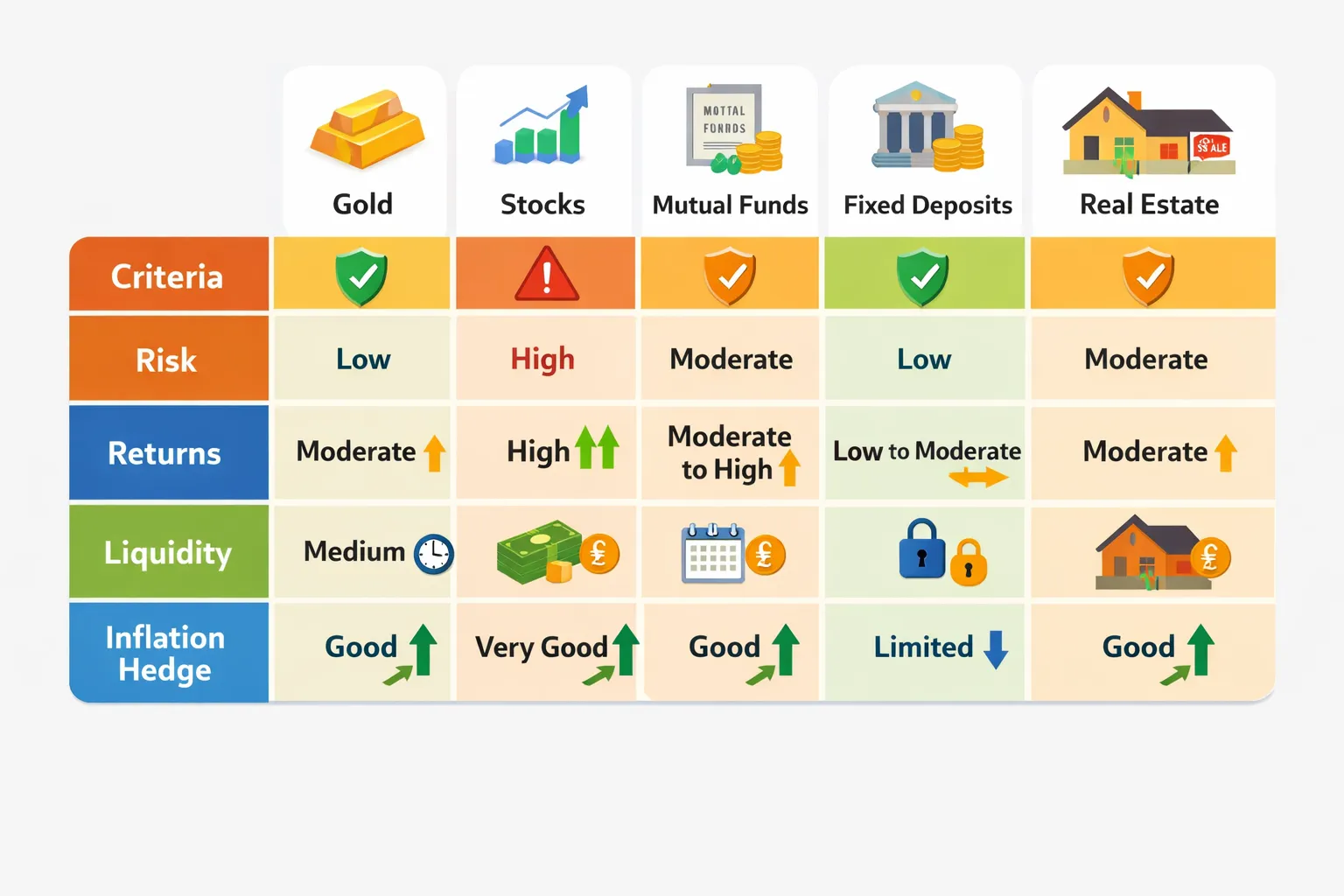
Gold vs Stocks vs Mutual Funds vs FD vs Real Estate (2026 comparison table)
Use this table as your “decision dashboard”:
|
Asset |
Return potential (long-term) |
Volatility / risk |
Liquidity |
Inflation protection |
Income generation |
|---|---|---|---|---|---|
|
Gold |
Medium |
Low–Medium |
High |
High |
No |
|
Stocks (direct equity) |
High |
High |
High |
High (long-term) |
Dividends (limited) |
|
Equity Mutual Funds / Index Funds |
High |
Medium–High |
High |
High (long-term) |
Indirect (via growth/dividends) |
|
Fixed Deposits (FDs) |
Low–Medium |
Low |
Medium |
Weak–Medium |
Yes (interest) |
|
Real Estate |
Medium |
Medium |
Low |
Medium (location-dependent) |
Yes (rent) |
Asset-by-asset: what each one is actually best for
Gold: best for downside protection + liquidity + “sleep-at-night” investing
Gold shines when:
-
markets crash,
-
uncertainty spikes,
-
inflation eats purchasing power,
-
you need a liquid asset without panic-selling equities.
But gold struggles when:
-
the economy is booming (equities often outperform),
-
you want income (no interest/dividend),
-
you buy high-cost formats (jewellery, high spreads).
If you’re choosing formats, don’t guess – use this guide: Digital gold vs Gold ETF vs SGB: which is best for you.
Stocks: best for compounding wealth (if you can handle volatility)
Stocks are the growth engine. If you want long-term wealth creation, equity exposure matters.
But the price you pay is volatility:
-
short-term falls are normal,
-
your returns depend on discipline (not timing).
If you don’t want to pick stocks, use mutual funds/index funds.
Mutual Funds: best for most people who want equity growth without stock-picking
Mutual funds (especially index funds) are the “default smart choice” for many investors because:
-
built-in diversification,
-
SIP discipline,
-
professional management (in active funds),
-
easy to scale with income.
They’re still market-linked. You need time (think 5+ years) and consistency.
Fixed Deposits: best for certainty – but not always for wealth creation
FDs are great for:
-
emergency funds (partially),
-
short-term goals,
-
retirees needing predictable income.
But for many investors, the long-term issue is real returns (after inflation + tax).
“In December 2024, if an FD offered 6.5% and inflation was 5.22%, the real return would be ~1.28%.” – Source
FDs aren’t “bad.” They’re just not designed to aggressively beat inflation over decades – especially post-tax.
Real Estate: best for long-term believers with capital + patience
Real estate can work if:
-
you have significant capital,
-
you can manage legal/maintenance overhead,
-
you’re okay with low liquidity,
-
your location selection is strong.
But for most young investors in 2026, the biggest issue is accessibility: high ticket size + slow exit + friction.
The role of gold in a portfolio (what top investors actually do)
Gold is most powerful when used as portfolio insurance. It’s there to:
-
stabilize returns,
-
reduce drawdowns,
-
give you confidence to stay invested in growth assets.
Practical allocation ranges (India, 2026)
A simple rule of thumb:
|
Investor type |
Suggested gold allocation |
|---|---|
|
Conservative / near-term goals |
15%–25% |
|
Balanced long-term investor |
10%–15% |
|
Aggressive growth (high risk tolerance) |
5%–10% |
If you’re already heavy in real estate (many Indian households are), you may not need to push gold too high – because real estate also behaves like a “hard asset” (with different risks).
The biggest mistakes investors make with gold (and how to avoid them)
1) Over-allocating to gold after it has already run up
Gold feels safest after it performs well. That’s when people over-buy.
Solution: pre-decide an allocation range and rebalance.
2) Buying the wrong product (high spreads, hidden charges)
Jewellery is emotionally valuable – but often inefficient as an “investment.”
If you’re investing digitally, understand costs clearly: digital gold charges explained (spreads, GST, storage, selling fees).
3) Ignoring taxes and exit rules
Every format has different tax treatment and redemption rules – especially SGBs vs ETFs vs digital gold.
Why OroPocket makes gold investing in 2026 unfairly easy (and more rewarding)
Most apps help you buy gold. OroPocket helps you build a habit and get paid to stay consistent.
What you get with OroPocket (built for real Indians, real budgets)
-
Start from ₹1: no “minimum investment” gatekeeping.
-
Instant UPI payments: buy gold in under 30 seconds.
-
100% secure & compliant: RBI-compliant, insured vaulting, authorized bullion partners.
-
Gamified investing: streaks, spin-to-win, tiered rewards – so you actually continue.
-
Free Bitcoin on every purchase: you earn Satoshi cashback when you buy gold/silver – two assets for the price of one.
-
Gold + Bitcoin combination: gold = stability, bitcoin = growth potential (without the stress of trading).
-
Referral rewards: both referrer and referee earn 100 Satoshi + free spin.
This is the emotional edge:
-
Control: you’re finally doing something daily for your money.
-
Progress: you see growth – even with tiny amounts.
-
Smart: you’re beating inflation while others just “save.”
-
Rewarded: you get Bitcoin cashback for being disciplined.
Stop watching. Start growing.
Final verdict: Is gold the best investment in 2026?
Gold is the best investment in 2026 only if your goal is stability, diversification, and protecting purchasing power.
If your goal is maximum wealth creation, equities and equity mutual funds still lead – but gold helps you stay invested through crashes.
The winning strategy isn’t “gold vs everything.” It’s:
-
Equity for growth
-
Gold for protection
-
FDs for certainty
-
Real estate (optional) for long-term tangibility and income
If you want to build your gold allocation the modern way – starting from ₹1, with UPI speed, and Bitcoin rewards on every buy – OroPocket is built for you.
Download OroPocket. Start with ₹1 today. Get gold + get Bitcoin.