
SIP Calculator with Inflation Rate: Real Returns


You’re probably doing what every sensible young professional is told to do. A fixed amount leaves your bank account each month. Your SIP statement looks healthier every quarter. The numbers rise, and you feel responsible, organised, and ahead of the crowd.
Yet something feels off.
Your salary has improved, but rent, travel, food, medical bills, and future goals still seem to be running away from you. The problem usually isn’t that you’re not saving. The problem is that you’re measuring the wrong number.
Why Your SIP Isn't Making You as Rich as You Think
A lot of investors look at their SIP the way they look at a savings scoreboard. If the corpus is growing, the plan must be working. On paper, that feels reasonable.
In real life, it’s incomplete.
Inflation acts like a silent tax on your money. Nobody sends you a bill for it. No app notification warns you that your purchasing power has been cut. It just shows up later, when a future expense costs far more than you expected.
The hidden gap in everyday life
A young salaried investor might start a monthly SIP, stay disciplined for years, and feel confident seeing a steadily rising portfolio value. Then they check the expected cost of a home down payment, postgraduate study, or even a family emergency fund. Suddenly the target still looks far away.
That disconnect usually comes from confusing money value with money usefulness.
If your investments grow, but the cost of the things you want grows too, your statement can look impressive while your real progress stays modest. That’s why two people with the same SIP corpus can be in very different positions. One has planned for future prices. The other has planned only for today’s numbers.
Inflation doesn’t need to wipe out your savings in one dramatic event. It does more damage quietly, year after year.
Why this catches first-time investors
New investors often focus on three inputs only:
- Monthly amount: “How much can I start with?”
- Expected return: “What will this grow to?”
- Time period: “How long should I stay invested?”
Those are important, but they don’t answer the question that matters most. What will that future amount buy?**
That’s where a sip calculator with inflation rate changes the conversation. It stops you from celebrating a number that only looks good in isolation.
The practical problem
The danger isn’t that SIPs are bad. They’re useful, disciplined, and often one of the best ways to build long-term investing habits. The danger is relying on a plain SIP estimate that ignores inflation.
If you ignore inflation, you can under-save for goals without realising it. By the time you discover the shortfall, the solution usually becomes painful. You either invest much more, delay the goal, or lower your expectation.
That’s why smart planning starts with an uncomfortable but necessary question. Not “How big will my corpus be?” but “How much of my future life will that corpus pay for?””
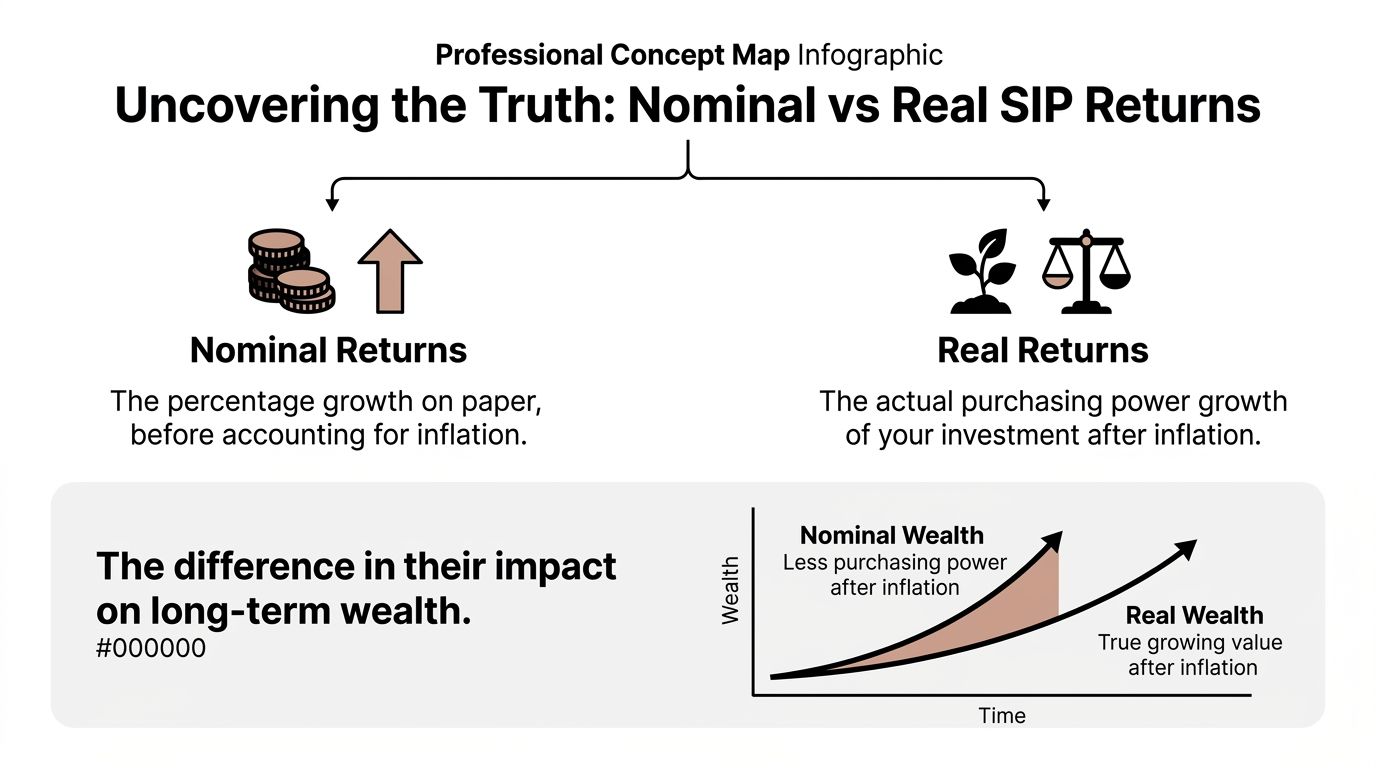
Uncovering the Truth Nominal vs Real SIP Returns
The easiest way to understand this is to separate nominal returns from real returns.
Nominal returns are the returns your investment earns on paper.
Real returns are what remains after inflation has taken its share.
The treadmill analogy
Think of investing like running on a treadmill placed on a moving truck.
You’re running. That effort is real. But if the truck is moving backwards fast enough, your actual progress is much smaller than it feels.
That’s exactly what inflation does. Your SIP may be earning returns, but inflation is constantly reducing what those returns are worth in terms of real-world buying power.
What the calculator reveals
An inflation-adjusted SIP calculator exposes that gap clearly. It tells you not just what your corpus may become, but what that corpus may be worth in today’s terms.
According to Bajaj AMC’s explanation of inflation’s impact on SIP returns, if an SIP earns a 10% nominal return and inflation runs at 5% to 6%, the real return falls to about 4% to 5%. The same analysis shows that a ₹5,000 monthly SIP for 10 years at 12% grows to a nominal maturity value of ₹11,61,695, but at 6% inflation its real purchasing power drops to about ₹7,13,180, which is a reduction of 38.6% in actual wealth.
That’s the moment most investors rethink their assumptions.
Why this matters more than the headline return
When people say, “My SIP is doing well,” they often mean the nominal number looks good. But nominal growth doesn’t pay school fees, rent, healthcare, or a down payment. Real purchasing power does.
A sip calculator with inflation rate helps you judge whether your plan is merely growing or keeping pace with life.
A better way to read your returns
Use this simple mental filter every time you review your investments:
- Nominal return asks: How much bigger is my corpus?
- Real return asks: How much stronger is my buying power?
- Inflation-adjusted planning asks: Will this amount still support the life I’m saving for?
If you want a refresher on how compound interest works, it helps to understand the growth side first. Then the inflation adjustment makes much more sense.
Practical rule: Don’t judge a long-term SIP by the final corpus alone. Judge it by the future lifestyle that corpus can still fund.
The Simple Math Behind Inflation-Adjusted Calculations
Most investors assume the calculator is doing something mysterious. It isn’t. The logic is straightforward.
First, it calculates how your monthly investments grow through compounding. Then it adjusts that future value to reflect inflation.

Step one is calculating future value
The standard SIP future value formula is:
Future Value = P × [((1 + r)^n − 1) / r] × (1 + r)
Here’s what those terms mean in plain English:
- P is your monthly SIP amount
- r is the monthly rate of return
- n is the total number of monthly contributions
This formula captures the compounding effect of monthly investing. Some instalments stay invested longer, some for less time, but together they build the nominal corpus.
If you want a simpler walkthrough of compounding before getting into inflation adjustments, OroPocket has a useful explainer on compounding interest explained with formula and examples.
Step two is adjusting for inflation
Once the calculator gets the future value, it discounts that number using inflation:
Adjusted Future Value = Future Value / (1 + Inflation Rate)^Investment Period
That second step answers the question investors often miss. “What is this future money worth in today’s rupees?”
According to DSFS Money’s breakdown of SIP calculators with inflation, this dual-calculation method first computes nominal growth through monthly compounding and then deflates that result by cumulative inflation over the holding period.
Why the second step matters so much
A regular SIP calculator stops after the first step. That’s why it often leaves investors overconfident.
An inflation-adjusted calculator finishes the job. It translates future wealth into present-day purchasing power. That’s far more useful when you’re planning goals like education, buying a house, or building a reserve for career uncertainty.
This short explainer can help if you prefer a visual walk-through before using the formulas yourself.
You don’t need to memorise the formula
What matters is understanding the sequence:
- Your SIP grows nominally through compounding.
- Inflation reduces what that future amount can buy.
- Actual value is the number worth planning around.**
When investors start using inflation-adjusted calculations, they usually become less impressed by flashy final corpus numbers and more focused on practical sufficiency.
That shift is healthy. It leads to better target setting, more realistic timelines, and fewer unpleasant surprises later.
Choosing Realistic SIP Inputs for Indian Investors
The output of any calculator is only as good as the inputs. Many plans go wrong here.
Investors often choose return assumptions that feel encouraging and inflation assumptions that feel harmless. That makes the projected corpus look better, but it weakens the plan.
Start with the inflation input, not the return fantasy
A sip calculator with inflation rate is most useful when you treat inflation seriously. In India, that means using a number that reflects local reality, not wishful thinking.
According to Dhan’s inflation-adjusted SIP guidance, region-specific inflation inputs in the 4% to 7% range are appropriate, and India’s CPI averaged 6.2% from 2014 to 2024. The same analysis notes that bank FDs in the 6% to 7% post-tax range delivered an average negative real return of -0.2%, while equity SIPs at 12% to 15% historically beat inflation by 6% to 9% in real terms.
That single comparison tells you a lot. Safety on paper can still mean erosion in practice.
What works better in real planning
When I review SIP assumptions, the most reliable plans usually share a few habits:
- Conservative inflation input: A higher inflation assumption may feel pessimistic, but it gives you breathing room.
- Goal-based thinking: Match the corpus to future costs, not current prices.
- Asset realism: Different assets behave differently, so expected returns shouldn’t be copied blindly from social media posts.
For longer-term planning, Dhan also suggests benchmarking against gold SIPs in the 8% to 10% long-term range and aiming for a 7%+ real return, especially when planning for costs such as education that often inflate quickly in India.
A simple way to choose your inputs
Use a three-part checklist when filling the calculator:
| Input | What to avoid | Better approach |
|---|---|---|
| Expected return | Picking the most optimistic number available | Use an assumption that leaves room for market cycles |
| Inflation rate | Choosing a low figure just to make the result look better | Use a conservative India-specific range |
| Time horizon | Guessing loosely | Match the timeline to the actual goal |
Why optimism can backfire
If you use a low inflation assumption, your target corpus looks easier to reach. But the risk doesn’t disappear. It gets postponed.
That’s especially dangerous for goals with long timelines. A house purchase, a child’s education, or financial independence can all fail if your inflation input is too soft.
If you’re estimating a larger long-term target, this guide on how to make 1 crore in 5 years in SIP is helpful for stress-testing the math against realistic contribution levels.
A realistic plan can look less exciting on day one. It usually looks much better on the day you actually need the money.
Real-World Examples Nominal Growth vs Real Value
Theory becomes useful when you can see the trade-off clearly.
The biggest mistake investors make isn’t failing to save. It’s assuming the same monthly contribution will automatically keep up with a future goal, even when inflation is steadily reducing what the final corpus can buy.
A comparison table most investors need to see
Below is the format I wish more people used before starting a long-term SIP.
SIP Growth Example: ₹10,000/month for 15 Years (12% Expected Return)
| Metric | Nominal Outcome (Ignoring Inflation) | Real Outcome (Adjusted for 6% Inflation) |
|---|---|---|
| Monthly SIP | ₹10,000/month | ₹10,000/month |
| Time horizon | 15 years | 15 years |
| Expected return | 12% | 12% |
| Inflation assumption | Not applied | 6% |
| Planning use | Looks larger on paper | Shows present-day purchasing power |
The exact purpose of this table isn’t to produce a fresh unsupported figure. It’s to show how the same SIP can tell two very different stories depending on whether you include inflation.
Example one with a flat SIP
A useful reference point comes from an Indian inflation-adjusted SIP example where a ₹5,000 monthly SIP for 15 years at 12% is shown at about ₹20.5 lakhs nominal, but only about ₹8.9 lakhs in real value when adjusted for 6% inflation, as noted by Dhan’s SIP calculator example. That kind of gap is exactly why many investors feel richer on paper than they do in real life.
This isn’t a failure of SIP investing. It’s a failure of incomplete measurement.
Example two with a step-up SIP
Now compare that with a step-up version.
According to HDFC Sky’s step-up SIP calculator example, a ₹5,000 monthly SIP increased by 10% each year, earning 12% over 15 years, grows to a nominal future value of ₹45.2 lakhs. After adjusting for 6% inflation, its inflation-adjusted value is about ₹19.6 lakhs. The same source notes this is 2.2x higher than the inflation-adjusted corpus from a flat SIP, which is about ₹8.9 lakhs, and adds that purchasing power roughly halves every 12 years at 6% inflation.9 lakhs**, and adds that purchasing power roughly halves every 12 years at 6% inflation.
That’s the practical lesson. Step-up contributions don’t magically remove inflation, but they fight back far better than a fixed SIP that never evolves with your income.
What this means for common goals
Consider three typical goals for a young Indian investor:
- A home down payment: A flat SIP may create a corpus that looks solid today but feels much smaller when property costs are reviewed later.
- Higher education planning: If the target cost rises faster than your investment pace, the shortfall can be sharp.
- Long-range wealth building: The longer the horizon, the more inflation compounds against you.
The core issue is not just return. It’s the relationship between return, inflation, and contribution growth.
Flat SIP versus step-up SIP in plain language
A flat SIP is easier to start and easier to maintain. That’s its strength.
Its weakness is that your expenses rise, your salary may rise, but your investing effort remains frozen. Over long periods, that mismatch hurts.
A step-up SIP fixes that by asking your savings plan to grow with your earning power.
| Approach | Strength | Weakness |
|---|---|---|
| Flat SIP | Simple and predictable | Can lose ground against rising future costs |
| Step-up SIP | Better aligned with inflation and income growth | Requires periodic increases and discipline |
If your income grows but your SIP never grows, inflation gets a head start every year.
What tends to work best
In practice, the better approach is often layered:
- Start with a contribution you can maintain.
- Run it through a sip calculator with inflation rate.
- Check the inflation-adjusted value, not just the nominal value.
- If the gap is uncomfortable, increase the SIP or shift to a step-up structure.
- Review the plan when your salary changes, not only when markets move.
That process is much more useful than chasing a high return assumption and hoping compounding alone will do all the work.
Building an Inflation-Proof SIP with Digital Gold
Once you accept that inflation is the true opponent, the next question is simple. What kind of asset mix helps you protect purchasing power instead of just displaying growth on a screen?
Precious metals enter the conversation here.

Why metals belong in the discussion
Gold and silver are often treated as old-fashioned assets. That’s a mistake.
They serve a distinct purpose. When currency purchasing power weakens, investors often look for assets that are easier to trust as stores of value. That’s one reason many planners use precious metals as part of an inflation-aware strategy rather than treating them as a separate category.
The point isn’t that every rupee should go into metals. The point is that a portfolio focused only on nominal returns can miss the protection side of wealth building.
Why digital formats make this practical
Traditional gold ownership has frictions. Storage, purity concerns, making charges, and liquidity can all get in the way. Digital formats remove much of that operational hassle.
For young professionals and first-time investors, that matters. The best inflation defence is the one you’ll use consistently.
A digital gold or silver SIP works well when you want:
- Low-friction entry: Start small and stay regular.
- Liquidity: Access matters when life doesn’t follow a perfect plan.
- Simplicity: Fewer moving parts means fewer excuses to postpone investing.
Where this fits in a real savings strategy
Think of digital gold and silver as a practical complement when your broader goal is inflation resistance.
If your entire financial plan depends on assets that only look good in nominal terms, you’re exposed. If you add assets commonly used as inflation hedges, your planning becomes more balanced.
For anyone considering that route, this guide on digital gold SIP explained, with benefits, risks and how to start from ₹1 is a helpful starting point.
The right inflation hedge doesn’t need to be complicated. It needs to be understandable, accessible, and easy to continue month after month.
What does not work
A few habits tend to fail investors here:
- Treating gold as a panic buy: That usually leads to emotional decisions.
- Ignoring liquidity: If access is hard, the plan breaks when you need it most.
- Using no framework: Buying occasionally without a clear SIP discipline rarely builds consistency.
What works better is steady allocation, realistic expectations, and using the inflation-adjusted view of your portfolio rather than relying on headline returns alone.
Your Next Step Towards Building Real Wealth in 2026
The key lesson is simple. Nominal growth is not the same as real progress.
If you save and invest without checking inflation-adjusted value, you can spend years following a plan that looks healthy but falls short when real expenses arrive. A sip calculator with inflation rate fixes that blind spot. A sip calculator with inflation rate fixes that blind spot. It shows whether your money is moving your life forward.
That shift in thinking matters more than any single product or market view. Once you start planning in real returns, you make better decisions about contribution size, time horizon, and asset mix.
If you’re also checking broader financial milestones, this piece on how much you should have saved by 30 can help you benchmark your progress more sensibly.
Don’t let inflation stay invisible. Measure it. Plan for it. Build around it.
If you want a practical way to start building inflation-aware savings, download the OroPocket app. It lets you begin a digital gold or silver SIP from just ₹1, invest easily through UPI, and build a habit around assets many savers use to protect purchasing power over time.



Join the Conversation
Be the first to share your thoughts.