
What is the disadvantage of gold ETFs?

What is the disadvantage of Gold ETFs? The clear-eyed list (India, 2026)
“A Gold ETF is an exchange-traded fund that aims to track the domestic physical gold price, with units listed and traded on NSE and BSE.” – Source
Why this guide
-
Most explainers hype the convenience of ETFs; this article focuses on the hidden drawbacks so you can choose wisely.
-
Applies to Indian investors using NSE/BSE-traded gold ETFs; references SGBs, digital gold, and physical gold for context.
TL;DR: Core disadvantages we’ll unpack
-
Ongoing cost drag (TER + brokerage + spreads) quietly compounds.
-
Tracking error means your ETF may not match gold’s actual return.
-
Liquidity traps: low volumes, wide bid–ask spreads, and impact cost.
-
Taxation can be less favorable than SGBs and has changed recently.
-
Access friction: requires Demat/trading a/c; market hours only.
-
No real-world utility (can’t wear it, gift it from the ETF, or redeem small bars).
Who should read this
-
First-time investors comparing gold ETF vs SGB vs digital gold.
-
Salary earners planning small, frequent buys via UPI.
-
Anyone seeking a modern, low-friction way to hedge inflation.
Prefer gold without Demat hurdles and with rewards? Buy 24K digital gold from ₹1 and earn free Bitcoin cashback on every purchase with OroPocket. Download the app: https://oropocket.com/app
How a Gold ETF actually works (and where slippage starts)
The plumbing in simple words
-
Creation/redemption units: APs (authorized participants) swap baskets for units.
-
Fund holds 99.5% purity gold/cash; publishes NAV; units trade on exchange.
Where slippage creeps in vs spot gold
-
Management fee (TER), custody, trustee fees.
-
Cash holdings and operational float.
-
Brokerage and bid–ask on your trades.
-
Premium/discount to NAV based on demand/supply.
“For major Indian Gold ETFs, the typical Total Expense Ratio (TER) in 2025–2026 ranges roughly between 0.30% and 0.80% per annum.” – Source
Investor takeaway
-
An ETF is convenient, but every intermediary and friction layer can chip away at returns – especially on short holding periods or frequent trading.
Prefer buying 24K gold without brokerage, Demat, or market-hour limits – and get free Bitcoin rewards? Try OroPocket. Start from ₹1 and invest via UPI in 30 seconds: https://oropocket.com/app
Disadvantage #1: Ongoing cost drag quietly compounds
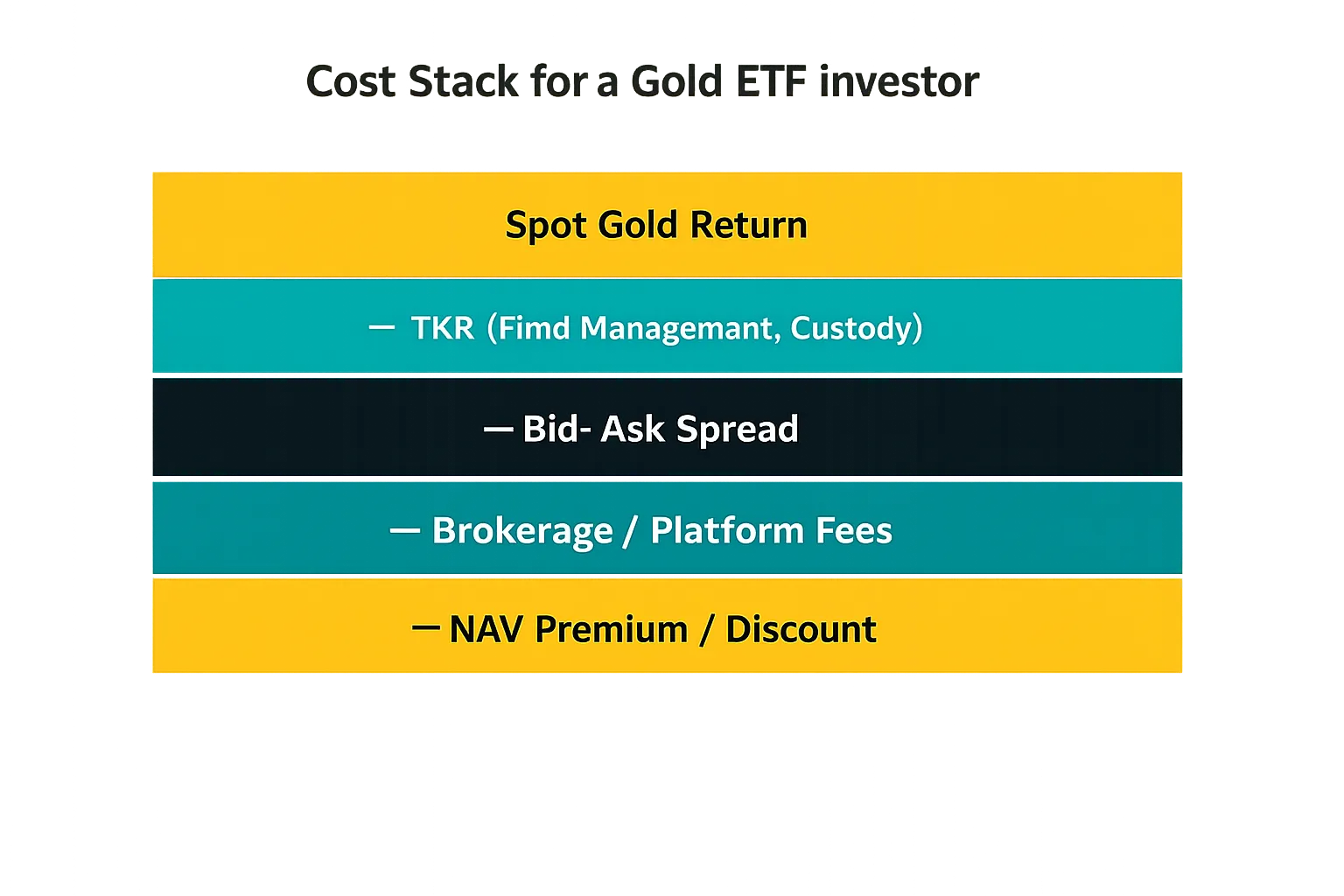
What costs add up
-
Annual TER (fund management, custody, trustee, audit).
-
Brokerage on buy/sell + potential platform fees.
-
Bid–ask spreads (implicit cost, visible only when you place orders).
-
Premium/discount to NAV on low-liquidity days.
Why small percentages matter
-
0.75% TER × 5 years is not 3.75% – it compounds against your returns.
-
Add 0.2%–0.6% spread each side and periodic brokerage: short-term gains can vanish.
Illustrative 5-year example
Assumptions used for illustration only:
-
Lumpsum ₹1,00,000 invested; 5-year spot gold CAGR assumed at 8% → pre-cost value ≈ ₹1,46,930.
-
ETF TER assumed at 0.75% p.a.; brokerage 0.1% each side; spread 0.5% each side; occasional 0.2% discount to NAV on exit.
-
SGB exit at year 5 (not at 8-year maturity); no fees; tax assumed at 20% on gains; SGB’s 2.5% interest not included here to isolate cost drag.
-
Digital gold via app: no annual fee; spread 0.8% each side; tax assumed at 20% on gains.
|
Instrument |
Assumed annual fee/TER |
One-time trading costs |
Typical spread |
Tax at exit (assumptions) |
Net value vs spot gold |
|---|---|---|---|---|---|
|
Gold ETF |
0.75% p.a. |
₹300 (buy+sell) |
0.5% each side |
20% on gains (illustrative) |
≈ ₹-14,838 vs spot |
|
SGB |
0% |
₹0 (primary) |
N/A |
20% on gains at year 5 (illustrative) |
≈ ₹-9,386 vs spot |
|
Digital Gold via app |
0% |
₹0 |
0.8% each side |
20% on gains (illustrative) |
≈ ₹-10,666 vs spot |
Note: Illustrative, not advice – replace with current scheme costs. Taxes depend on prevailing law and your slab. SGB gains are exempt only on redemption at maturity (8 years); interim exits may be taxable.
Pro tips to reduce drag
-
Prefer higher-liquidity ETFs; check average daily volumes and market depth.
-
Use limit orders to control entry/exit price; avoid wide spreads and illiquid times.
-
Don’t over-trade; let holding periods work in your favor.
-
Batch purchases (fewer, larger orders) when possible to reduce fixed costs.
Want gold exposure with no brokerage, Demat, or market-hour limits – plus free Bitcoin rewards on every purchase? Try OroPocket. Start from ₹1 via UPI: https://oropocket.com/app
Disadvantage #2: Tracking error vs spot gold
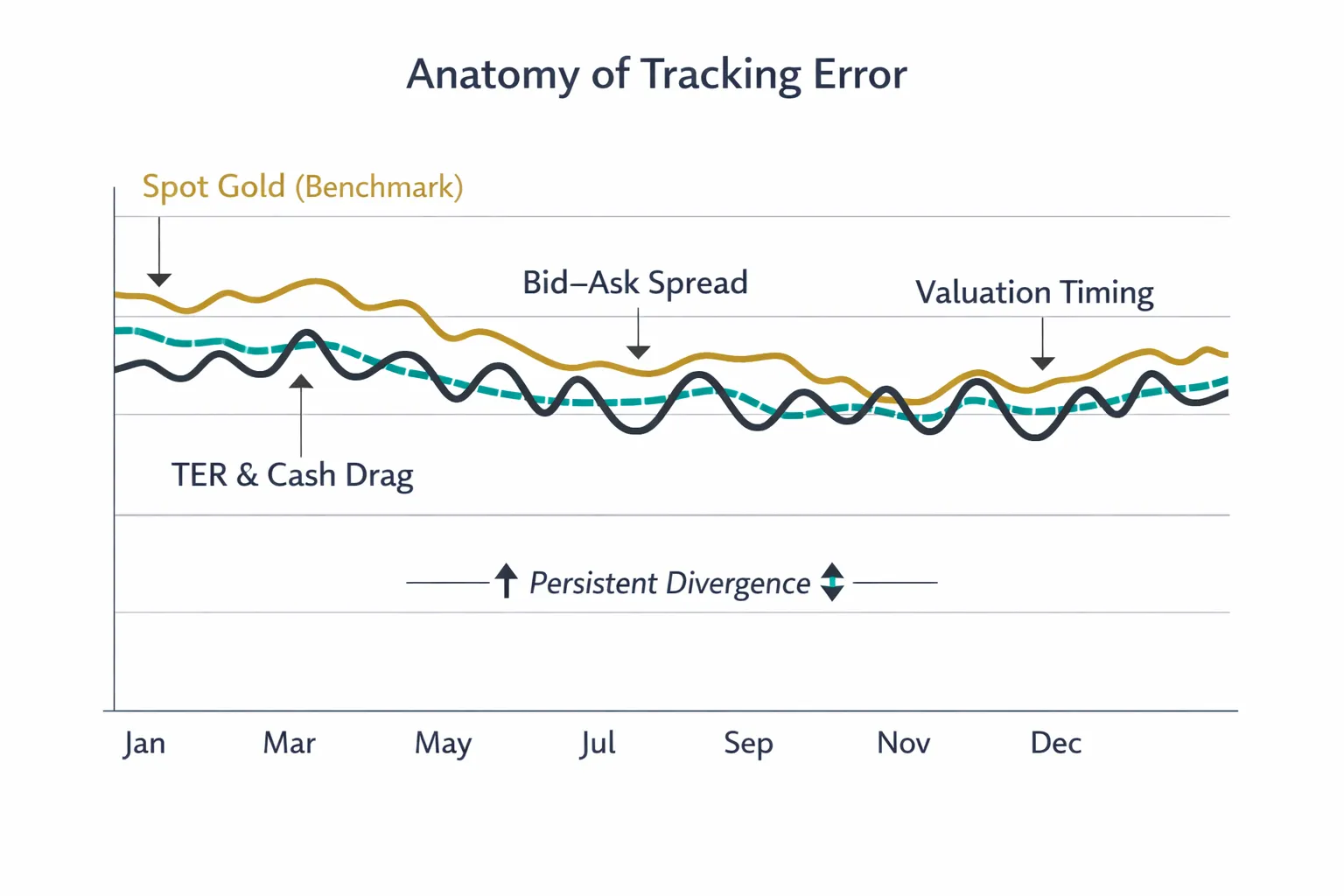
Why ETFs deviate from gold
-
Fees and cash balances.
-
In-kind creation/redemption lags.
-
Valuation timing vs live gold price (NAV vs market price).
What it means for you
-
Over time, even a small annual tracking error can lead to a noticeable gap vs physical gold performance.
-
Short holding periods magnify the impact of spreads + NAV discounts.
How to check before buying
-
Review each scheme’s published tracking error/variance.
-
Prefer funds with tighter historical tracking and larger AUM.
Looking for gold that mirrors spot without Demat friction – and earns Bitcoin rewards on every purchase? Try OroPocket. Start from ₹1 via UPI: https://oropocket.com/app
Disadvantage #3: Liquidity and execution risks on the exchange
The problem
-
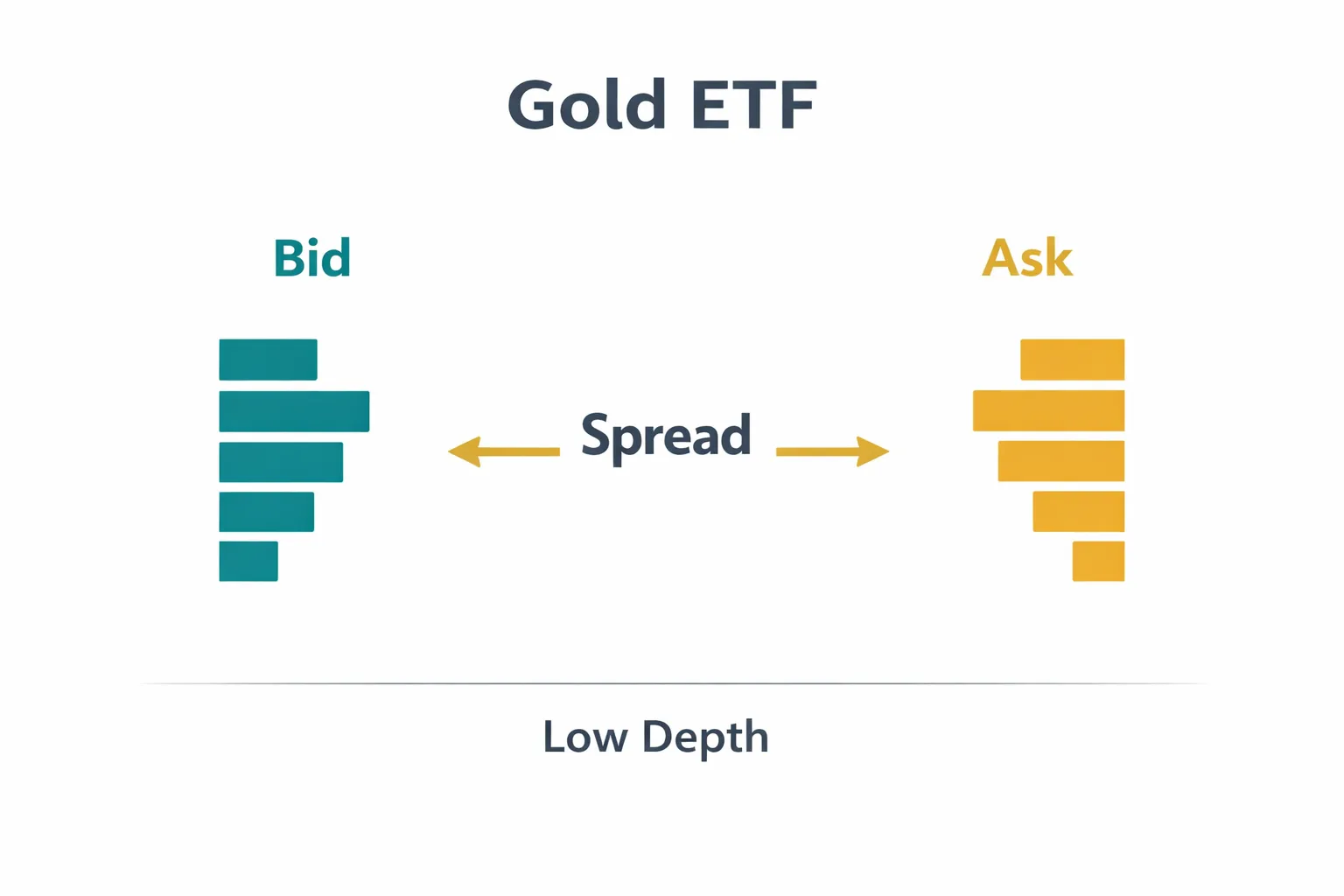
Many gold ETFs have modest daily volumes; wide bid–ask spreads lead to impact cost.
-
Market hours only; during stress, spreads can widen further.
Why it matters more for small investors
-
Frequent small buys/sells = more spread paid.
-
Market orders can execute at poor prices; NAV ≠ executable price.
“India’s gold ETF market is dominated by a few high-turnover funds; many smaller schemes see relatively lower daily volumes – spreads can be materially wider in such funds.” – Source
How to protect yourself
-
Use limit orders; check depth; prefer higher-AUM, higher-turnover schemes; avoid illiquid times.
-
Place trades when underlying gold markets (global) are active to reduce pricing gaps.
-
If you’re doing micro-buys via UPI and want 24/7 access without brokerage, consider digital gold on OroPocket – and earn Bitcoin rewards on every purchase. Start from ₹1: https://oropocket.com/app
Disadvantage #4: Taxation can be less favorable than SGBs (and rules changed recently)
The shifting rules you must know
-
Recent Indian tax changes affected non-equity mutual funds; indexation benefits altered for purchases after specific dates.
-
Many investors still assume the old LTCG + indexation regime – verify current rules before investing.
“On SGBs, the semi-annual interest is taxable, but capital gains on redemption at maturity are exempt for individual investors.” – Source
Why SGBs can be superior for long-term holders
-
2.5% annual interest (taxable) and capital gains tax exemption at maturity (as per prevailing rules) can beat ETF post-tax returns for 7–8 year horizons.
Practical takeaway
-
Your after-tax outcome can flip your choice; run the math with your slab and holding period.
|
Instrument |
Short-term tax |
Long-term tax |
Indexation availability |
Additional benefits |
Typical holding period sweet spot |
|---|---|---|---|---|---|
|
Gold ETF (NSE/BSE) |
For units purchased post 1-Apr-2023 under “Specified MF” rules: gains taxed at slab (regardless of period). |
Post 1-Apr-2023 purchases: no LTCG concession (taxed at slab). Legacy units (pre-cutoff, >3 yrs): 20% with indexation (per then-prevailing rules). |
No (post 1-Apr-2023); Yes for legacy units (subject to rules at purchase time). |
None; costs include TER, brokerage, spreads. |
Longer horizons only if costs/spreads are low; often trails SGB post-tax. |
|
Sovereign Gold Bond (SGB) |
If sold before maturity (on exchange): STCG taxed at slab (≤3 yrs). |
Redemption at 8-year maturity: capital gains exempt for individuals; pre-maturity transfers (>3 yrs): 20% with indexation. |
Yes for pre-maturity transfers; Not applicable on maturity (exempt). |
2.5% annual interest (taxable); RBI-backed security. |
7–8 years (hold to maturity) to maximize tax edge. |
|
Physical Gold |
STCG taxed at slab (≤3 yrs). |
20% with indexation (>3 yrs). |
Yes (currently). |
Tangible asset; making charges/GST at purchase may apply. |
3+ years for indexation to matter. |
|
Digital Gold (platform-led ownership) |
Typically treated like physical gold: STCG taxed at slab (≤3 yrs). |
Typically 20% with indexation (>3 yrs). |
Yes (currently, as a capital asset). |
No Demat; UPI-friendly; platform spreads, delivery fees may apply. |
Flexible for micro-buys; 3+ years for indexation. |
Note: Date-sensitive snapshot. Tax rules have changed in recent years and may change again. Check latest CBDT/AMFI/RBI circulars and your tax advisor before investing.
Disadvantage #5: Access friction for micro and habit-based investing
Frictions that stop small, frequent buys
-
Requires Demat + trading account, full broker onboarding/KYC, and learning an exchange interface.
-
Exchange market hours only; no instant UPI micro-buys 24×7.
-
Real-world ticket size is 1 ETF unit ≈ 1 gram of gold – so you can’t start with ₹10–₹100.
-
SIPs via brokers exist, but they’re not as seamless as UPI Autopay; failed mandates and market-hour execution reduce consistency.
-
Every small order pays a spread and brokerage, which punishes frequent micro-buys.
Why this matters to 22–35-year-olds
-
Habits beat timing. Daily/weekly small buys smooth volatility and build discipline.
-
Friction breaks streaks – if you can’t buy in 30 seconds on your phone, you’ll skip days.
-
Higher minimum ticket sizes block first-time investors from starting now.
What to look for instead
-
UPI-native micro-investing with true ₹1 entry, instant settlement, and 24/7 availability.
-
Zero-brokerage flows, transparent pricing, and tight spreads for small orders.
-
Rewards that reinforce behavior – streaks, cashback, and gamified nudges to keep you consistent.
Want gold that fits your routine, not the other way around? Buy 24K gold from ₹1 on OroPocket, invest via UPI in 30 seconds, and earn free Bitcoin on every purchase. Download now: https://oropocket.com/app
Disadvantage #6: No real-world utility or small-bar redemption
Limits of an ETF unit
-
You can’t convert typical holdings into jewelry or small coins/bars (except large “creation units” like ~1 kg with select AMCs).
-
No cultural or gifting utility for festivals and weddings – an ETF unit in a Demat account can’t be worn, gifted as a coin, or handed over at a ceremony.
-
Redemptions are cash-only for most retail investors; you don’t get metal in hand.
Workarounds (and their limits)
-
Selling the ETF and buying jewelry means paying making charges, facing purity checks, and spending time at a jeweller – plus bid–ask and brokerage on the ETF sale.
-
Converting to small bars/coins outside the fund introduces spreads, verification fees, and logistics.
-
For instant utility – like gifting gold to a friend for a festival – digital gold with instant transfer works better than waiting for market hours and settlement.
Want utility without the friction? Gift or send 24K gold from ₹1 in seconds with OroPocket – earn free Bitcoin on every purchase. Try it now: https://oropocket.com/app
When should you still pick a Gold ETF? And when to avoid it
Good fit
-
You already use a broker/Demat and value exchange liquidity during market hours.
-
You’re making occasional, larger-ticket buys; willing to hold multi-year.
-
You can choose high-liquidity, low-tracking-error schemes and place disciplined limit orders.
Consider alternatives instead
-
Long-term (7–8 years) with tax efficiency → SGBs.
-
Micro, habit-based, instant UPI buys with utility (send/gift) → Digital gold apps.
-
Want rewards layered on safe assets → Platforms that combine gold with Bitcoin cashback.
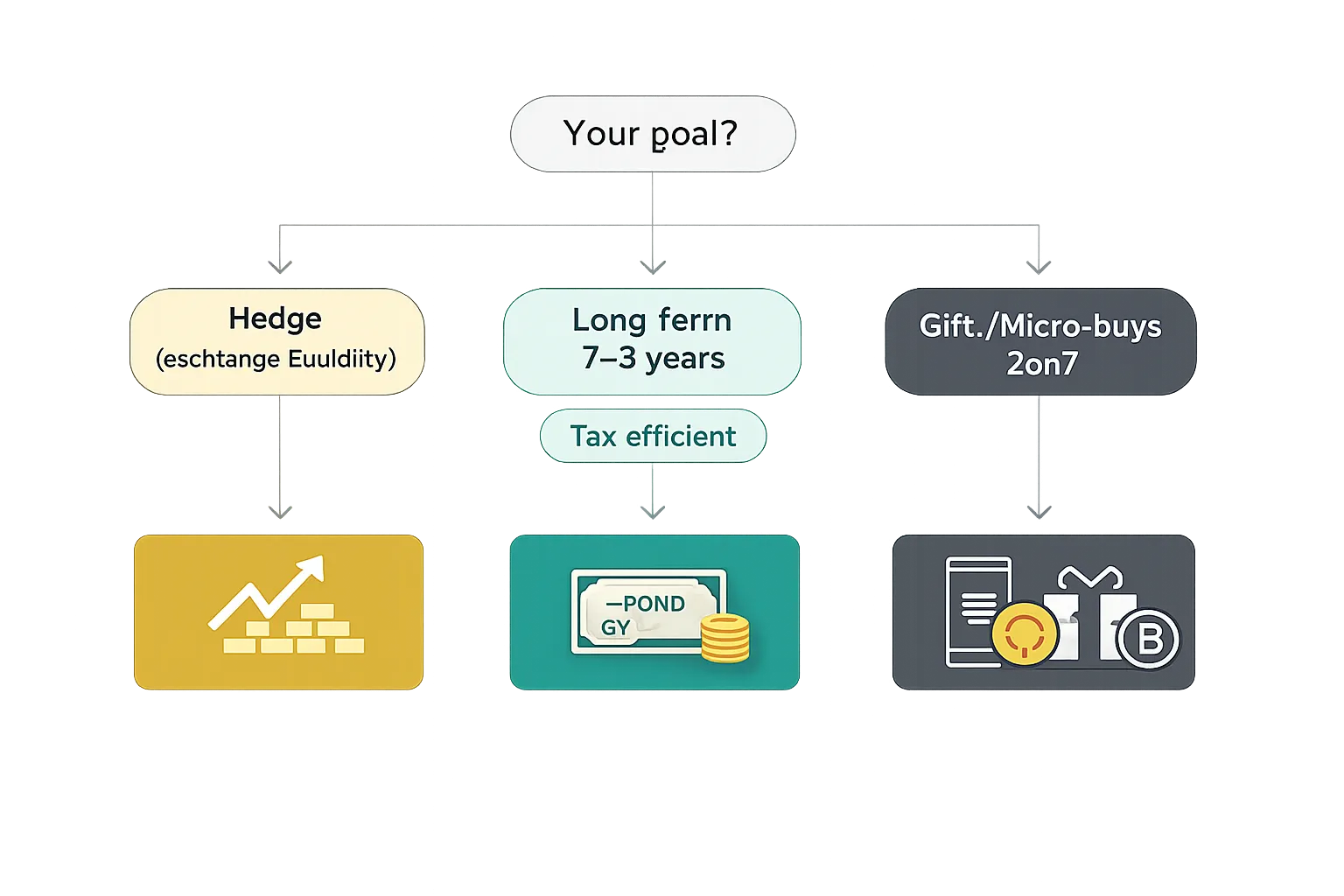
Map the right tool to your goal
-
Emergency hedge vs wealth compounding vs gifting needs are different jobs – pick the tool accordingly.
Ready to act? Buy 24K gold from ₹1 on OroPocket, get free Bitcoin on every purchase, and gift gold instantly to friends and family. Download the app: https://oropocket.com/app
A modern alternative: Digital gold on OroPocket (gold + free Bitcoin rewards)
Why it solves the ETF drawbacks for young Indians
-
Start from ₹1 via UPI – no Demat, no market-hour constraint. Buy in 30 seconds, any time.
-
Zero purity anxiety: 24K pure gold, 100% insured, securely vaulted with RBI-compliant partners.
-
Habit building made easy: Daily streaks, spin-to-win, and SIP-like consistency keep you on track.
-
Unique edge: Earn free Satoshis (Bitcoin rewards) on every gold/silver purchase – two assets for the price of one.
How OroPocket compares on the pain points
-
Cost friction: No brokerage, no Demat account charges; instant UPI; transparent pricing.
-
Liquidity: Buy/sell instantly in-app; send gold to friends and family in seconds.
-
Utility: Gift gold for Diwali, birthdays, or weddings digitally – no making charges or store runs.
Pro tips to maximize rewards on OroPocket
-
Maintain 5-day streaks to unlock bonus rewards and accelerate your stack.
-
Refer friends: both of you earn 100 Satoshi + a free spin.
-
Use micro-buys on price dips; automate consistency with small, frequent investments.
Download OroPocket and start building gold + Bitcoin rewards today. Get the app: https://oropocket.com/app
Conclusion: Pick the right gold exposure – start with OroPocket
-
Gold ETFs are convenient, but the disadvantages are real: cost drag, tracking error, liquidity traps, taxation changes, and access friction.
-
If you want an inflation hedge that fits your life – ₹1 entry, UPI-native, habit-friendly, and rewarding – go digital gold with Bitcoin cashback.
-
Take control in 30 seconds: Download the OroPocket app on iOS/Android and start building gold the modern, smart way.
Call to action: Download OroPocket now → https://oropocket.com/app