
Which is better, FD or digital gold?

Intro: FD vs Digital Gold – quick answer and comparison at a glance
What this guide covers in 3 lines
-
Who should pick a bank/NBFC Fixed Deposit (FD)
-
Who should pick digital gold (and when it can beat FD in real returns)
-
When to combine both for stability + growth
TL;DR recommendation
-
Pick FD if you need guaranteed income, zero price swings, and a fixed goal date.
-
Pick digital gold if you want an inflation hedge, long-term growth potential, and anytime liquidity.
-
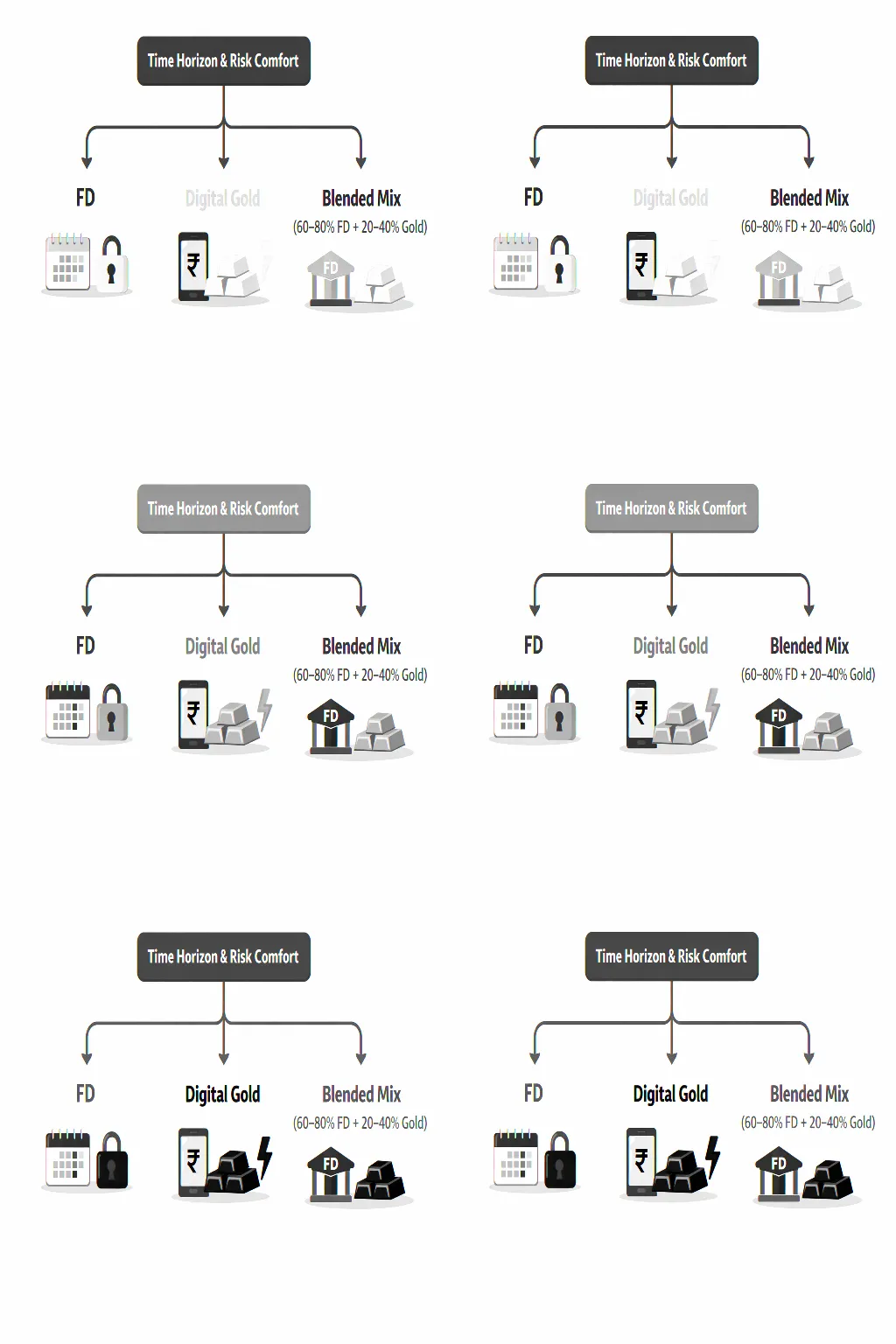
For most young savers, a 60–80% FD + 20–40% gold split works well; tilt more to gold when horizons are 5+ years.
Comparison at a glance (table)
|
Feature |
Fixed Deposit (FD) |
Digital Gold |
|---|---|---|
|
Returns potential |
Fixed, predictable |
Market-linked; historically higher over long periods |
|
Risk type |
Credit risk of issuer |
Price volatility |
|
Liquidity |
Premature withdrawal penalty |
Redeem anytime |
|
Minimum investment |
Typically lump sum |
Start from ₹1 on OroPocket |
|
Income generation |
Periodic interest payouts |
No periodic income; capital appreciation on sale |
|
Taxes |
Interest taxed at slab rates |
Capital gains tax on sale; rules evolve – check latest |
|
Costs |
Mostly none; penalty if broken |
Spread + 3% GST on buy; no making charges |
|
Safety |
DICGC-insured up to ₹5 lakh per bank |
Vaulted, insured, 24K purity with reputed custodians |
Why this article is better than what you’ve read
-
Uses real Indian context (UPI, DICGC, GST, typical rates)
-
Gives a clear decision framework + sample allocation
-
Shows how OroPocket’s ₹1 entry and Bitcoin rewards can tilt your effective outcomes without extra risk
How they work: what you’re really buying
Fixed Deposit (FD)
-
You lend money to a bank/NBFC for a fixed tenure at a fixed interest rate
-
Payout options: cumulative (reinvest interest) or non-cumulative (monthly/quarterly income)
-
Safety net: DICGC insurance up to ₹5 lakh per depositor per bank (bank FDs only)
-
Corporate/NBFC FDs rely on issuer rating (AAA/AA, etc.) – higher rates can imply higher risk
Digital Gold (via OroPocket and similar vault-backed providers)
-
You buy fractions of 24K gold stored in insured, audited vaults
-
Ownership is digital; buy/sell 24×7 in small amounts; purity and storage managed by the provider
-
No making charges; spreads apply; audited custody with reputed bullion partners
-
On OroPocket: start at ₹1, pay via UPI, gift gold, track holdings in-app
What problem each solves
-
FD: certainty of return, predictable maturity amount, easy planning for fixed dates
-
Digital gold: inflation hedge, portfolio diversifier, simple long-term wealth anchor without storage hassles
Returns vs. inflation: the numbers that matter
Historical performance (directionally)
-
Gold has delivered strong long-term rupee returns over multi-decade periods; best viewed on 5–10+ year horizons
-
Bank/NBFC FDs typically offer 5–8% p.a., varying with rate cycles; real return depends on inflation and tax
“From 1973 to 2023, gold prices in India have grown at a CAGR of roughly 11%.” – Source
“As of Dec 2025, Indian bank and NBFC FDs generally offer between 5% and 8% interest.” – Source
Real return lens (why many savers feel stuck)
-
Real return = Post-tax return – Inflation
-
Example approach: If FD yields 7% and your slab is 20%, post-tax ≈ 5.6%; with 5.5–6.5% inflation, real return can approach zero
-
Gold’s market-linked nature means higher variance year to year but historically better odds of beating inflation long-term
Takeaways for planning
-
Short horizon (≤3 years): FD advantage on certainty
-
Long horizon (≥5 years): gold often narrows or exceeds FD after-tax real returns
-
Stagger entries: SIP in gold; ladder your FDs
Risk, safety, and regulation
FD risks and protections
-
Credit/default risk of the issuer; stick to strong banks/NBFCs with top ratings
-
DICGC insurance covers bank FDs up to ₹5 lakh per depositor per bank (not NBFC FDs)
-
Interest rate reinvestment risk if you need to roll over in a low-rate cycle
Digital gold risks and mitigants
-
Price volatility – NAV moves daily with global gold prices
-
Provider selection: prefer platforms with reputed bullion partners, audited vaults, and full insurance
-
Platform risk: ensure clear title to gold, independent trustees/custodians, and robust redemption processes
Pros/Cons matrix: FD vs Digital Gold
|
Factor |
Fixed Deposit (FD) |
Digital Gold |
|---|---|---|
|
Safety |
High for bank FDs due to DICGC cover; depends on issuer strength for NBFC FDs |
High when vaulted, fully insured, with reputed custodians |
|
Transparency |
Clear interest rate and tenure; known maturity value |
Real-time buy/sell prices; custody audits and purity assurances are key |
|
Counterparty risk |
Bank/NBFC default risk; mitigated by ratings and DICGC for banks |
Platform and custodian risk; mitigated by independent trustees, insured vaults |
|
Volatility |
Very low price volatility |
Market-linked; daily price movements |
“DICGC insures eligible bank deposits up to ₹5,00,000 per depositor per bank, covering principal and interest.” – Source
Liquidity and access: how fast can you get cash?
FD
-
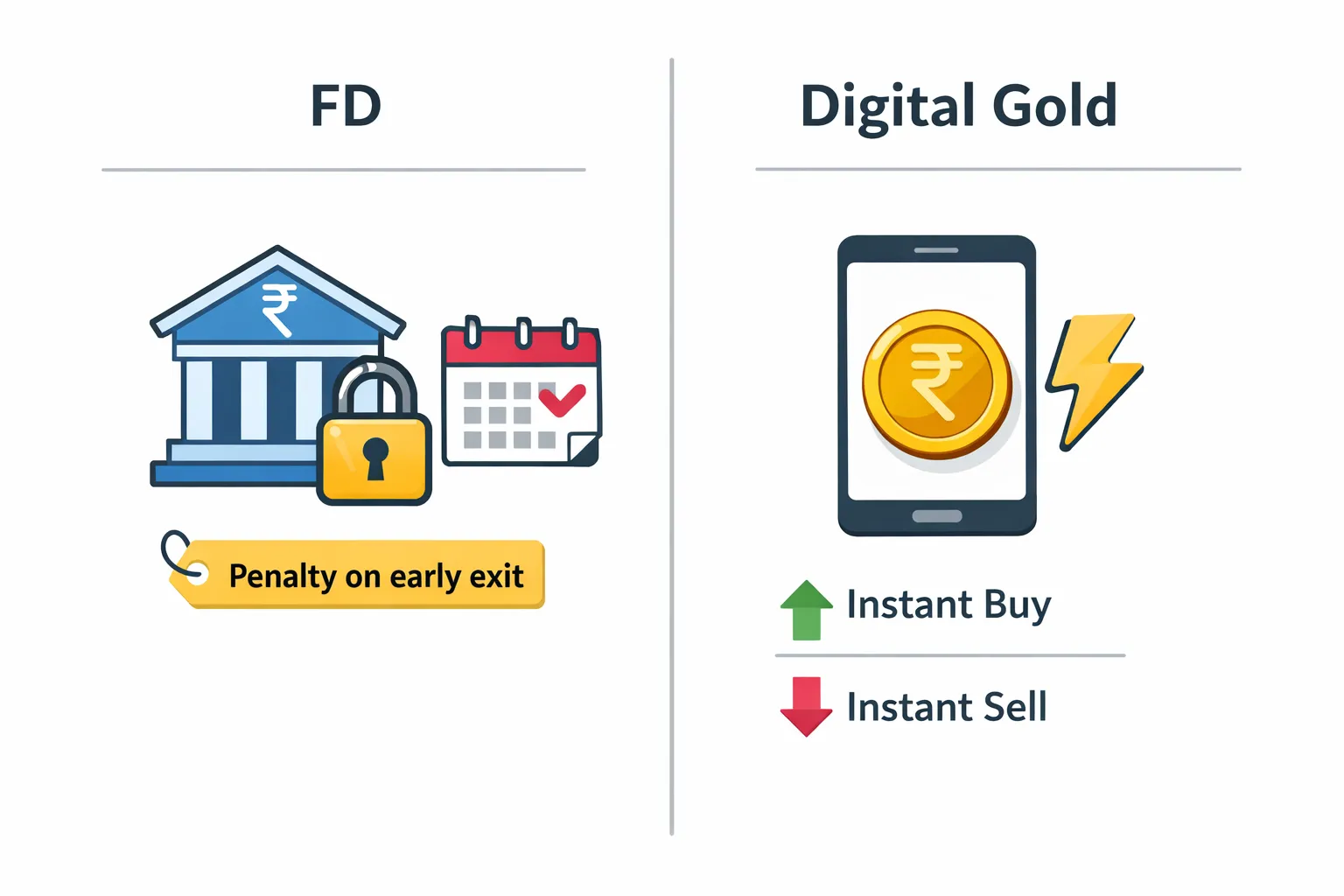
Premature withdrawal allowed but attracts penalty and adjusted interest
-
Loan against FD often available (typically up to ~75–90% of FD value)
-
Best for known goal dates where you won’t need to break the deposit
Digital Gold
-
Buy/sell in seconds; no lock-in; fractional amounts
-
No paperwork; instant UPI payments and cashout to bank via partner policies
-
Gift/send gold to family; great for flexible saving and emergencies
Everyday convenience
-
Track on mobile; automate habits via SIPs and round-ups (where supported)
-
For OroPocket: ₹1 start, daily streaks and spins keep you investing consistently
Taxes and costs (what most comparisons miss)
FD taxation
-
Interest is taxed as per your income slab; TDS may apply above thresholds
-
No GST on investing; penalties if broken early reduce effective yield
Digital gold taxation
-
Treated as a capital asset; tax applies only when you sell
-
Long- vs short-term capital gains rules and rates can change – check latest CBDT guidance for FY 2025–26 before decisions
-
3% GST applies on gold purchases (industry standard), no making charges like jewellery
SGB footnote (if you prefer a government-backed gold route)
-
Capital gains on redemption at maturity are tax-exempt; semi-annual interest is taxable
-
Lock-in of 8 years (with early exit options via exchanges post year 5)
Costs, spreads, and the true ‘all-in’ return
FD
-
Mostly zero explicit fees; watch for premature exit penalties
-
Reinvestment risk if rates fall at maturity
Digital Gold
-
Buy/sell spread (varies by provider); check live quote vs reference price
-
3% GST on buy; no making/assaying/storage hassles
-
Platform benefits can offset costs: OroPocket gives Satoshi (Bitcoin) rewards on each purchase – boosting effective value without changing risk of gold itself
What to check before you choose
-
FD: issuer rating, DICGC cover (for banks), penalty terms, payout option
-
Digital Gold: spread, custody partner, audit/insurance, liquidity, rewards/benefits
Who should choose what: a simple decision framework
Choose FD if you
-
Need guaranteed returns on a fixed date (fees, rent, education, visa funds)
-
Are in or near retirement and prioritise income stability
-
Will lose sleep over daily price moves
Choose Digital Gold if you
-
Have a 5+ year horizon and want an inflation hedge
-
Value micro-investing (₹1 starts), on-demand liquidity, and zero storage hassle
-
Want to diversify beyond FDs without stock/crypto complexity
Smart middle ground (common for 22–35 age group)
-
60–80% in laddered FDs for stability + 20–40% in digital gold for growth hedge
-
Increase gold tilt as horizon lengthens or inflation rises
-
On OroPocket: automate a gold SIP, earn Bitcoin rewards, and gift gold for milestones
How to combine both: simple, actionable plans
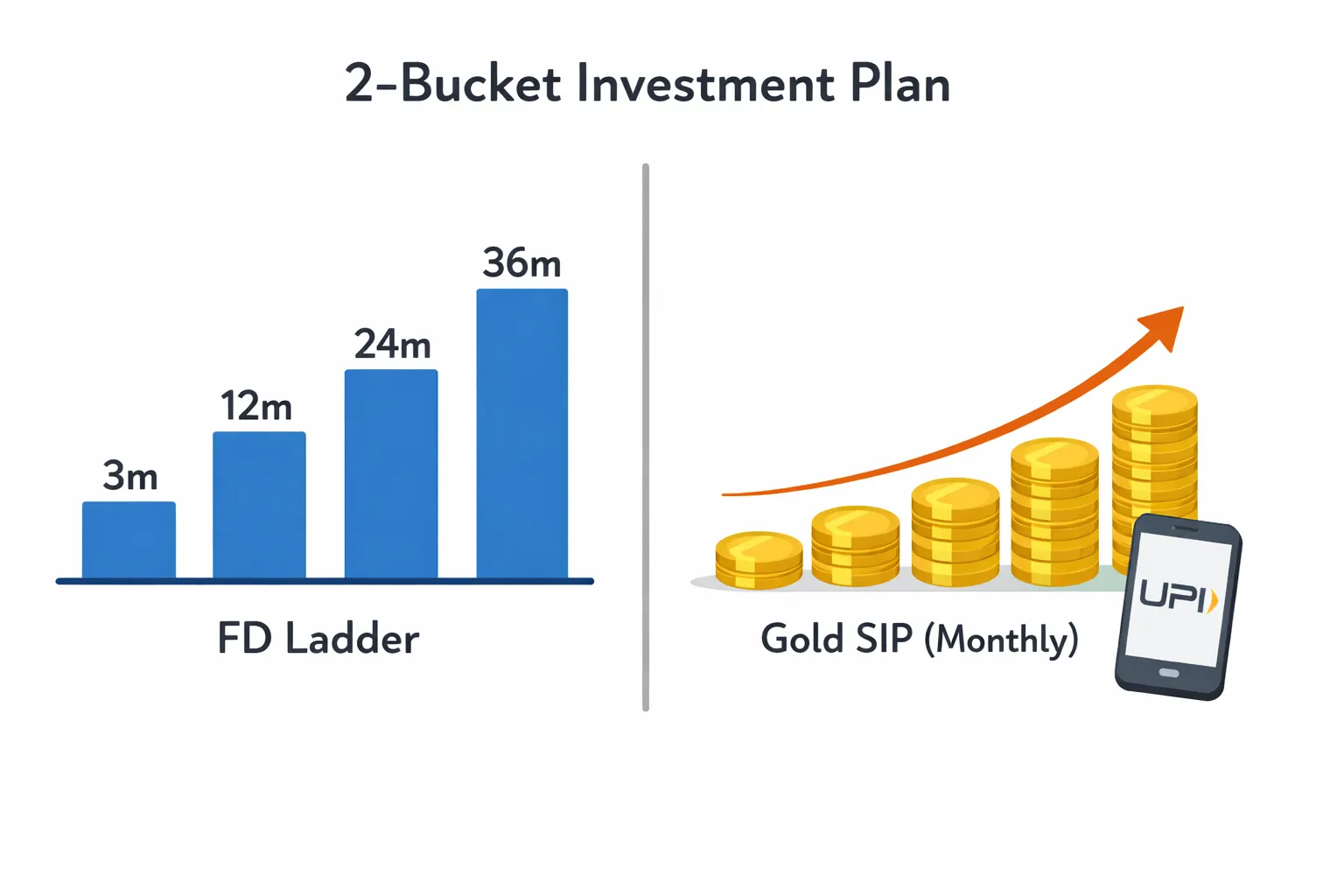
The 2-bucket plan
-
Bucket A (Safety): Ladder 3–12–24–36 month FDs to smooth reinvestment risk
-
Bucket B (Growth Hedge): Monthly digital gold SIP (start with ₹500–₹2,000; even ₹1 works on OroPocket)
Example for ₹5,000/month starter
-
₹3,500 into FD ladder, ₹1,500 into digital gold SIP
-
Review split annually; rebalance back to target if gold rallies sharply
How OroPocket boosts this plan
-
₹1 entry via UPI; daily streaks + spin-to-win build habit
-
Bitcoin rewards on every purchase add extra upside without extra effort
-
Send/gift gold instantly for family goals
Guardrails
-
Keep emergency fund liquid (savings/short FD) before investing
-
Don’t chase short-term gold spikes; stick to SIP discipline
Final verdict: Which should you pick today?
The short answer
-
If you need certainty and dates: go FD.
-
If you want long-term inflation protection and flexibility: go digital gold.
-
If you want both: do a blended plan and rebalance annually.
Why OroPocket stands out for digital gold
-
Start with ₹1 via UPI; 24K pure, fully insured vaults, RBI-compliant operations
-
Earn free Bitcoin (Satoshis) on every gold/silver purchase – unique upside without changing your gold risk
-
Gamified streaks and rewards make consistency easy
Next step
-
Build your 80/20 (or 70/30) plan in 10 minutes: set an FD ladder with your bank/NBFC and start a gold SIP on OroPocket today
-
Download the OroPocket app to begin in under a minute
“In India, gold has historically preserved purchasing power and improved portfolio diversification; when inflation exceeded 6%, gold rose ~12.6% annually on average.” – Source